Events & Promotions
|
|

GMAT Club Daily Prep
Thank you for using the timer - this advanced tool can estimate your performance and suggest more practice questions. We have subscribed you to Daily Prep Questions via email.
Customized
for You
Track
Your Progress
Practice
Pays
Not interested in getting valuable practice questions and articles delivered to your email? No problem, unsubscribe here.
 Sep 23
12:30 AM EDT
-01:30 AM EDT
Learn how Keshav, a Chartered Accountant, scored an impressive 705 on GMAT in just 30 days with GMATWhiz's expert guidance. In this video, he shares preparation tips and strategies that worked for him, including the mock, time management, and more Sep 24
01:30 AM EDT
-01:30 AM EDT
Tejas studied hard but kept repeating the same mistakes. After 3 attempts at 645, a focused 4-week strategy helped him identify and fix what was holding him back—leading to a 695 with just 12–15 hours of study per week. Sep 26
01:00 PM EDT
-04:00 PM EDT
Top scores are possible when you enroll in a powerful GMAT course, taught live online + 6 months access to TTP OnDemand video courses included. Class starts Saturdays Sept. 26, 2026 - Dec. 19, 2026, 1:00pm-4:00pm ES Sep 26
06:00 PM PDT
-07:00 PM PDT
Free- full-length test + 15 concept videos + 150+ short videos + study plan! Sep 29
11:00 AM EDT
-01:00 PM EDT
" Description: Top scores are possible when you enroll in a powerful GMAT course, taught live online + 6 months access to TTP OnDemand video courses included! Class starts Tues/Thur Sept. 29, 2026 - Dec. 3, 2026, 11:00am-1:00pm EST Oct 01
07:00 AM BST
-08:00 AM GMT
Welcome to the GMAT Club's Free Interview Prep Event for Top MBA Programs! Buy tickets - Virtual series that’s all set to equip you to -excel in your MBA interviews.

 28 Feb 2024, 00:48
Kudos
Bookmarks


Dropdown 1: Greatest
Dropdown 2: 4-6
Be sure to select an answer first to save it in the Error Log before revealing the correct answer (OA)!
Difficulty:
 95%
(hard)
95%
(hard)
Question Stats:
55% (02:07) correct 45%
(02:24)
wrong
based on 2287
sessions
45%
(02:24)
wrong
based on 2287
sessions
History
Date
Time
Result
Not Attempted Yet
Based on a study of a 10,000 person sample of the adult population of Country Y, the unbroken curve on the graph plots an association between daily consumption of various amounts of Beverage Z and the relative risk of contracting Disease X compared to the risk with no consumption of Beverage Z (indicated by 1.00). For the entire adult population of Country Y, the relative-risk values could—because of sampling error—be either higher or lower than for the particular 10,000 person sample studied. Thus the two broken lines show the estimates of how high or how low those relative-risk values for that population could be.
From the drop-down menus, select the options that create the statement that is most strongly supported by the information provided.
Compared to the risk with no consumption of Beverage Z, the reduction in relative risk of contracting Disease X for adults of Country Y is when the daily consumption of Beverage Z is in the range of 100 mg glasses of Beverage Z are consumed daily.
ID: 700269
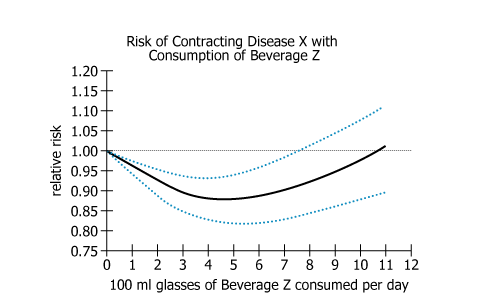
GMAT-Club-Forum-p7bvgapm.png [ 17.85 KiB | Viewed 9705 times ]
Attachment:
GMAT-Club-Forum-p7bvgapm.png [ 17.85 KiB | Viewed 9705 times ]
ShowHide Answer
Official Answer
Dropdown 1: Greatest
Dropdown 2: 4-6
 22 Mar 2024, 04:27
Kudos
Bookmarks
A cursory glance at this question is likely to create that fear in your head that this is a very difficult question. But as you watch the video solution, you will realize that if you patiently read the complex language in the dataset as you read the chart, while drawing inferences as you go along, you will be in a much confident position when you get to the question statement, which is again pretty convoluted to understand if you do not ‘own the dataset’.
“Compared to the risk with no consumption of Beverage Z, the reduction in relative risk of contracting Disease X for adults of Country Y is ____ when the daily consumption of Beverage Z is in the range of ____ 100 mg glasses.”
Try reading the sentence above without thoroughly understanding the dataset and you will be clueless.
So, the key to solving this question correctly and confidently is spending the necessary time in understanding the dataset, even it it takes you 2’ to minute the dataset and the chart, spend that time since once you do that, you will be able to simplify the question statement and then arrive at the answer. This question is definitely not a time saver question so do not rush through it.
“Compared to the risk with no consumption of Beverage Z, the reduction in relative risk of contracting Disease X for adults of Country Y is ____ when the daily consumption of Beverage Z is in the range of ____ 100 mg glasses.”
Try reading the sentence above without thoroughly understanding the dataset and you will be clueless.
So, the key to solving this question correctly and confidently is spending the necessary time in understanding the dataset, even it it takes you 2’ to minute the dataset and the chart, spend that time since once you do that, you will be able to simplify the question statement and then arrive at the answer. This question is definitely not a time saver question so do not rush through it.


 01 Mar 2024, 01:35
Kudos
Bookmarks
Iwillget770
The question talks of comparison on relative risk with no consumption of a beverage and some consuption of the beverage, so we are dealing with the straight line vs the curved line.
The first blank talks of this relation and the options are:
Unchanged: For unchanged, the two lines, straight and curved, should be superimposed on each other. But that is not the situation anywhere on the line graph. Discard. (Although the lines intersect at a certain time, but the second blank talks of range of number of glasses).
Least: Least reduction will be when the two lines are close to each other.
Greatest: Greatest reduction will be when the curved line is the farthest from staright line
Let us now, relate least and greatest with second blank.
1-3: It is not the lowest or greatest as the curved line is sloping downwards ( moves from 0.97 to 0.90), so reduction is neither the least nor the greatest.
4-6: The curved line flattens at this location and is at the lowest point 0.90-0.92, so the reduction is the greatest in this range.
7-8: The curved line moves upwards from 0.93 to 0.95, thus neither the least nor the greatest.
Correct combination:
1. Greatest
2. 4-6
Attachment:
GMAT-Club-Forum-b4iut5iw.png [ 17.85 KiB | Viewed 8992 times ]