Events & Promotions
|
|

GMAT Club Daily Prep
Thank you for using the timer - this advanced tool can estimate your performance and suggest more practice questions. We have subscribed you to Daily Prep Questions via email.
Customized
for You
Track
Your Progress
Practice
Pays
Not interested in getting valuable practice questions and articles delivered to your email? No problem, unsubscribe here.
 Sep 23
12:30 AM EDT
-01:30 AM EDT
Learn how Keshav, a Chartered Accountant, scored an impressive 705 on GMAT in just 30 days with GMATWhiz's expert guidance. In this video, he shares preparation tips and strategies that worked for him, including the mock, time management, and more Sep 24
01:30 AM EDT
-01:30 AM EDT
Tejas studied hard but kept repeating the same mistakes. After 3 attempts at 645, a focused 4-week strategy helped him identify and fix what was holding him back—leading to a 695 with just 12–15 hours of study per week. Sep 26
01:00 PM EDT
-04:00 PM EDT
Top scores are possible when you enroll in a powerful GMAT course, taught live online + 6 months access to TTP OnDemand video courses included. Class starts Saturdays Sept. 26, 2026 - Dec. 19, 2026, 1:00pm-4:00pm ES Sep 26
06:00 PM PDT
-07:00 PM PDT
Free- full-length test + 15 concept videos + 150+ short videos + study plan! Sep 29
11:00 AM EDT
-01:00 PM EDT
" Description: Top scores are possible when you enroll in a powerful GMAT course, taught live online + 6 months access to TTP OnDemand video courses included! Class starts Tues/Thur Sept. 29, 2026 - Dec. 3, 2026, 11:00am-1:00pm EST Oct 01
07:00 AM BST
-08:00 AM GMT
Welcome to the GMAT Club's Free Interview Prep Event for Top MBA Programs! Buy tickets - Virtual series that’s all set to equip you to -excel in your MBA interviews.

Fish181
Joined: 13 Dec 2023
Last visit: 10 Aug 2026
Posts: 127
Given Kudos: 53
Status:Applying in R1 of 2024 to t15
Affiliations: University of Tennessee
Location: United States (CO)
Concentration: Strategy, Finance
GMAT Focus 1: 605 Q76 V84 DI80 
GMAT Focus 2: 615 Q78 V86 DI78
GPA: 3.62
WE:Analyst (Consumer Packaged Goods)
GMAT Focus 2: 615 Q78 V86 DI78
Posts: 127
 28 Feb 2024, 13:44
Kudos
Bookmarks


Dropdown 1: End
Dropdown 2: a steep decrease
Be sure to select an answer first to save it in the Error Log before revealing the correct answer (OA)!
Difficulty:
 95%
(hard)
95%
(hard)
Question Stats:
45% (01:55) correct 55%
(01:58)
wrong
based on 2563
sessions
55%
(01:58)
wrong
based on 2563
sessions
History
Date
Time
Result
Not Attempted Yet
Select from each of the drop-down menus the option that creates the most accurate statement.
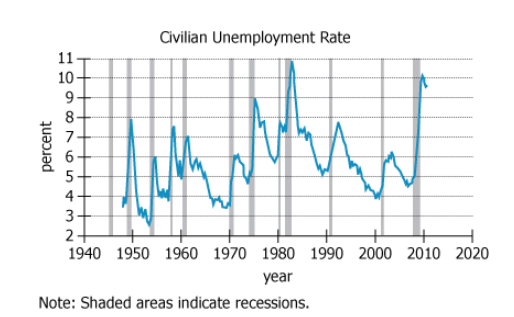
Based on the information in the graph, peaks in civilian unemployment rates occurred nearest the of a recession.
Based on the information in the graph, the period immediately following the recession ending in the late 1940s, compared with the period immediately following the recession ending in the early 1990s, was characterized by in civilian unemployment rates.
ID: 100316
2222222.PNG [ 76.88 KiB | Viewed 20809 times ]
Attachment:
2222222.PNG [ 76.88 KiB | Viewed 20809 times ]
ShowHide Answer
Official Answer
Dropdown 1: End
Dropdown 2: a steep decrease
 20 Jun 2024, 05:54
Kudos
Bookmarks
Fish181
The graph indicates recessions using the grey bars so first recession started in 1945 and ended in 1946 approx. Second recession started in 1949 and ended in 1950 (just before) etc.
Based on the information in the graph, peaks in civilian unemployment rates occurred nearest the ___ of a recession.
Attachment:
Screenshot 2024-06-20 at 6.13.59 PM.png [ 143.74 KiB | Viewed 16960 times ]
The unemployment rate is highest (peaks) at the end of the recessions (or slightly after that in recent years).
ANSWER:End
Based on the information in the graph, the period immediately following the recession ending in the late 1940s, compared with the period immediately following the recession ending in the early 1990s, was characterized by ____ in civilian unemployment rates.
Attachment:
Screenshot 2024-06-20 at 6.15.34 PM.png [ 133.46 KiB | Viewed 16439 times ]
The period immediately following the recession in late 1940s witnessed a sharp decline in unemploment rate (from 8% to about 3%) as shown by the slope of the blue line after the peak.
In comparison, the period immediately following the recession in early 1990s witnessed an increase in unemploment rate (from 6.5% to about 7.7%) as shown by the upward slope of the blue line to reach the peak.
Hence period following the recession ending in the late 1940s was characterized by a steep decline in civilian unemployment rates.
ANSWER: a steep decrease
General Discussion
 28 Feb 2024, 17:01
Kudos
Bookmarks
Quote:
We’re looking for peaks in the unemployment rates (blue line) in relation to recessions (shaded area). There’s a pattern of a peak always close to the right end of the shaded area, thus, as per the graphic, highest rates are seen nearest the end of a recession.
Quote:
This is tricky. Intuitively one can go initially to the “steep increase” alternative (myself included) since the curves are steepen post-recession late 1940s and 1990s. But, prompt asks for period immediately following the recession ending in the late 1940s, compared with the period immediately following the recession ending in the early 1990 - so we have to compare late 1940s post-recession rate of about 8% with 1990s post-recession rate about 6%, which, in comparison, shows a steep decrease in value.
Posted from my mobile device