Events & Promotions
|
|

GMAT Club Daily Prep
Thank you for using the timer - this advanced tool can estimate your performance and suggest more practice questions. We have subscribed you to Daily Prep Questions via email.
Customized
for You
Track
Your Progress
Practice
Pays
Not interested in getting valuable practice questions and articles delivered to your email? No problem, unsubscribe here.
 Sep 02
01:00 PM EDT
-11:59 PM EDT
Take 30% off all study plans with code COURSEWORK - Expires on Monday 9/7 Sep 03
01:30 AM EDT
-02:30 AM EDT
At one point, she believed GMAT wasn’t for her. After scoring 595, self-doubt crept in and she questioned her potential. But instead of quitting, she made the right strategic changes. The result? A remarkable comeback to 695. Check out how Saakshi did it. Sep 04
10:00 AM PDT
-11:00 AM PDT
What does test anxiety really look like on the GMAT? For many test takers, it does not look like a panic attack. Instead, it shows up as brain fog, rereading, negative comparisons, mental noise.... Sep 06
09:30 AM EDT
-12:30 PM EST
Top scores are possible when you enroll in a powerful EA course, taught live online + 6 months access to TTP OnDemand video courses included! Perfect class schedule and easy course access for working professionals. Class starts Sundays Sept. 6, 2026.- Sep 07
12:01 AM PDT
-11:59 PM PDT
On the 7th, GMAT Club Tests will be Free! Including all the Quizzes, Questions, and Tests. 12 AM - 11:59 PM PDT  Sep 07
12:30 AM EDT
-01:30 AM EDT
Tejas studied hard but kept repeating the same mistakes. After 3 attempts at 645, a focused 4-week strategy helped him identify and fix what was holding him back—leading to a 695 with just 12–15 hours of study per week.- Sep 09
07:00 AM PDT
-10:00 AM PDT
Meet AdComs and explore top Master’s programs - MiM, MiF, MSc, MSBA and more. - Application Fee Waivers - Free 1-Week of GMAT Club Tests: - Master's Application Toolkit - Grand Prize Giveaway  Sep 15
07:00 PM EDT
-09:00 PM EST
Elite scores are possible when you enroll in a powerful GMAT course, taught live online + 6 months access to TTP OnDemand video courses included! Class starts Tues/Thurs Sept. 15, 2026 - Nov. 15, 2027, 7:00pm-9:00pm EST Sep 21
08:00 PM EDT
-10:00 PM EDT
Boost your GMAT score in less than one month in a live online class + 6 months access to TTP OnDemand video courses included! Class starts Mon, Tues, Wed, Thur, Fri Sept. 21, 2026 - Oct. 9, 2027, 7:00pm-10:00pm EST

 Updated on: 28 Aug 2026, 11:48
Originally posted by Iwillget770 on 04 Mar 2024, 00:46.
Last edited by Bunuel on 28 Aug 2026, 11:48, edited 4 times in total.
Last edited by Bunuel on 28 Aug 2026, 11:48, edited 4 times in total.
Kudos
Bookmarks


0.9: Could be x
1.4: Could be x
2: Cannot be x
Be sure to select an answer first to save it in the Error Log before revealing the correct answer (OA)!
Difficulty:
 95%
(hard)
95%
(hard)
Question Stats:
49% (03:07) correct 51%
(03:07)
wrong
based on 1251
sessions
51%
(03:07)
wrong
based on 1251
sessions
History
Date
Time
Result
Not Attempted Yet
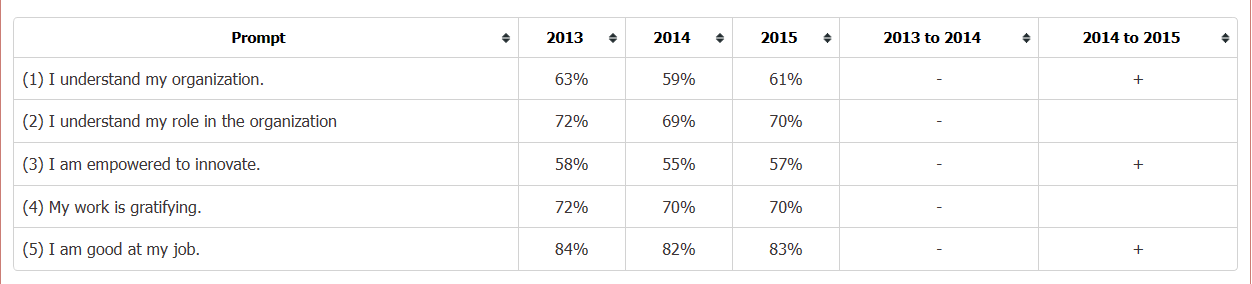
For each of three years and five survey prompts, the table shows the percentage of respondents to a job-satisfaction survey who agreed with the prompt. For columns showing pairs of years in the top row, a minus sign (–) or plus sign (+) for a prompt indicates that the change in the percentage of respondents from the first year to the second represents a significant decrease or significant increase, respectively. For the difference in the number of percentage points to be considered significant, its absolute value must be greater than a certain number, x. Although the percentages in the table are rounded to the nearest percentage point, whether a change is significant is determined using the raw percentages prior to rounding.
For each of the following values, select Could be x if that exact value for x is consistent with the information provided. Otherwise, select Cannot be x.
| Prompt | 2013 | 2014 | 2015 | 2013 to 2014 | 2014 to 2015 |
|---|---|---|---|---|---|
| (1) I understand my organization. | 63% | 59% | 61% | - | + |
| (2) I understand my role in the organization | 72% | 69 | 70% | - | . |
| (3) I am empowered to innovate. | 58% | 55% | 57% | - | + |
| (4) My work is gratifying. | 72% | 70% | 70% | - | . |
| (5) I am good at my job. | 84% | 82% | 83% | - | + |
For each of the following values, select Could be x if that exact value for x is consistent with the information provided. Otherwise, select Cannot be x.
| Could be x | Cannot be x | |
| 0.9 | ||
| 1.4 | ||
| 2 |
ShowHide Answer
Official Answer
0.9: Could be x
1.4: Could be x
2: Cannot be x
Every tricky question should trigger a follow up quiz.
Build that habit with
GMAT Club Forum Quiz →.
ID: 700273

GMAT-Club-Forum-zak31nab.png [ 19.91 KiB | Viewed 6982 times ]
Attachment:
GMAT-Club-Forum-zak31nab.png [ 19.91 KiB | Viewed 6982 times ]
 04 Mar 2024, 22:54
Kudos
Bookmarks
Iwillget770
Essentially, the question is testing you on your rounding basics. Diff in percentage points from one year to another was calculated. If it was more than x, a +/- was put. If it was less than x, it was left blank.
Then the given values in the table were rounded. So each given value, say 63% could actually be anything from 62.5% (including) to 63.5%(excluding).
Focus on the values where the difference is smallest possible but 'significant'.
In 14-15, 82% - 83% is significant. Here the actual difference could be 81.5% to a little less than 83.5%. So the maximum actual difference could be slightly less than 2. So x can be slightly less than 2 but it cannot be 2. If x were 2, then this would have been 'not significant.'
Focus on the values where the difference is largest possible but 'not significant'.
In 14-15, 69% - 70% is not significant
These could be a little less than 69.5% and 69.5% so the minimum value of x could be very little (slightly more than 0).
Say actual values here could be 69.4% - 69.5%. Then if x = 0.1, even then these would be 'not significant'.
Hence x can easily take very small values so 0.9 and 1.4 are both acceptable.
Attachment:
GMAT-Club-Forum-ds19se3d.png [ 19.91 KiB | Viewed 8733 times ]


 04 Mar 2024, 05:44
Kudos
Bookmarks
For the difference in the number of percentage points to be considered significant, its absolute value must be greater than a certain number, x.
What are the different differences given: 1%, 2% and 3%.
But we are looking at the least possible value, x, so that value should satisfy the difference of 1%.
One such difference given is 69 to 70.
69 could be 68.5 to 68.499999 when not rounded. Similarly 70 would be 69.5 to 70.499999.
The maximum difference, therefore will be 70.499999 - 68.5 = 1.99999999
0.9 could fit in with 69 and 69.9(rounded to 70)
1.4 could fit in with 69 and 70.4(rounded to 70)
However, 2 will not fit in as then 1% taken as significant will not be permitted
What are the different differences given: 1%, 2% and 3%.
But we are looking at the least possible value, x, so that value should satisfy the difference of 1%.
One such difference given is 69 to 70.
69 could be 68.5 to 68.499999 when not rounded. Similarly 70 would be 69.5 to 70.499999.
The maximum difference, therefore will be 70.499999 - 68.5 = 1.99999999
0.9 could fit in with 69 and 69.9(rounded to 70)
1.4 could fit in with 69 and 70.4(rounded to 70)
However, 2 will not fit in as then 1% taken as significant will not be permitted







