Events & Promotions
|
|

GMAT Club Daily Prep
Thank you for using the timer - this advanced tool can estimate your performance and suggest more practice questions. We have subscribed you to Daily Prep Questions via email.
Customized
for You
Track
Your Progress
Practice
Pays
Not interested in getting valuable practice questions and articles delivered to your email? No problem, unsubscribe here.
 Aug 26
10:00 AM EDT
-11:59 PM EDT
Save up to $1,000 on select GMAT prep now. This Fall, achieve your most ambitious goals with millions of student success stories behind you. Aug 27
10:00 AM EDT
-11:00 AM EDT
We’ve worked incredibly hard to build TTP into the best test prep experience possible, and it would mean a lot to us to win Newsweek’s 2026 Readers’ Choice Award for Best Test Prep. If TTP has helped you, we’d be incredibly grateful for your vote. Aug 31
10:00 AM PDT
-11:00 AM EDT
Top Scores Start with a Elite Online Prep Course. Enroll for 6 months of access to over 400 hours of GMAT video lessons AND 715+ Score Guarantee! Sep 02
12:30 AM EDT
-01:30 AM EDT
Thought your job leaves no time for GMAT prep? After multiple GMAT attempts and a demanding consulting job, Kshitij improved to 695 in under 2 months. Learn the mindset shifts, study strategy, and execution changes that made the breakthrough possible. Sep 02
08:00 PM PDT
-09:00 PM PDT
Video explanations + diagnosis of 10 weakest areas + 150+ short videos + study plan! Sep 03
01:30 AM EDT
-02:30 AM EDT
At one point, she believed GMAT wasn’t for her. After scoring 595, self-doubt crept in and she questioned her potential. But instead of quitting, she made the right strategic changes. The result? A remarkable comeback to 695. Check out how Saakshi did it. Sep 06
09:30 AM EDT
-12:30 PM EST
Top scores are possible when you enroll in a powerful EA course, taught live online + 6 months access to TTP OnDemand video courses included! Perfect class schedule and easy course access for working professionals. Class starts Sept. 6, 9:30am-12:30pm EST Sep 09
07:00 AM PDT
-10:00 AM PDT
Meet AdComs and explore top Master’s programs - MiM, MiF, MSc, MSBA and more. - Application Fee Waivers - Free 1-Week of GMAT Club Tests: - Master's Application Toolkit - Grand Prize Giveaway


 10 Jul 2026, 08:00
Kudos
Bookmarks


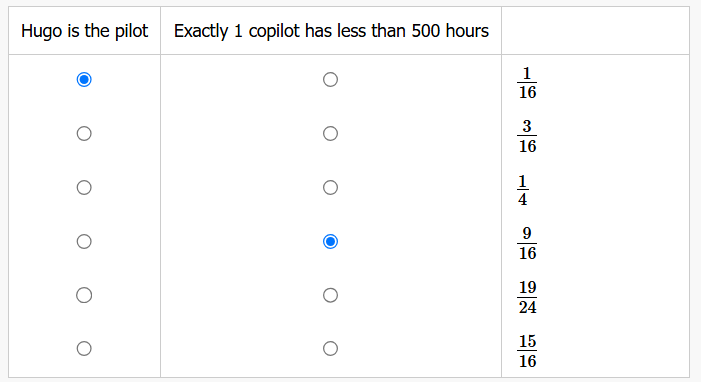
Hugo is the pilot: \(\frac{1}{16}\)
Exactly 1 copilot has less than 500 hours: \(\frac{9}{16}\)
Be sure to select an answer first to save it in the Error Log before revealing the correct answer (OA)!
Difficulty:
 95%
(hard)
95%
(hard)
Question Stats:
58% (02:34) correct 42%
(03:36)
wrong
based on 294
sessions
42%
(03:36)
wrong
based on 294
sessions
History
Date
Time
Result
Not Attempted Yet
The cockpit crew for a long-haul flight must consist of 1 pilot and 2 copilots, selected from an available pool of 4 pilots and 6 copilots. One of the pilots, Hugo, is only certified to serve as pilot if each of the two selected copilots has at least 500 hours of flight experience, a qualification held by 3 of the 6 available copilots. The remaining pilots can fly with any copilot. A cockpit crew will be selected at random from all possible crew combinations that meet these conditions.
The two columns in the table refer to two separate cases, each based on the same random selection from all valid cockpit crews. In the table, for Hugo is the pilot, select the probability that Hugo is the pilot on the selected cockpit crew. For Exactly 1 copilot has less than 500 hours, select the probability that exactly 1 of the 2 copilots on the selected cockpit crew has less than 500 hours. Make only two selections, one in each column.
The two columns in the table refer to two separate cases, each based on the same random selection from all valid cockpit crews. In the table, for Hugo is the pilot, select the probability that Hugo is the pilot on the selected cockpit crew. For Exactly 1 copilot has less than 500 hours, select the probability that exactly 1 of the 2 copilots on the selected cockpit crew has less than 500 hours. Make only two selections, one in each column.
| Hugo is the pilot | Exactly 1 copilot has less than 500 hours | |
| \(\frac{1}{16}\) | ||
| \(\frac{3}{16}\) | ||
| \(\frac{1}{4}\) | ||
| \(\frac{9}{16}\) | ||
| \(\frac{19}{24}\) | ||
| \(\frac{15}{16}\) |
ShowHide Answer
Official Answer
Hugo is the pilot: \(\frac{1}{16}\)
Exactly 1 copilot has less than 500 hours: \(\frac{9}{16}\)
|


⚠️ Important: GMAT Club does not allow AI-generated posts. AI-generated solutions are not eligible for kudos, and users who post them may face moderation action, including a ban.
10 Jul 2026, 09:00
Kudos
Bookmarks
Manhattan Prep Official Explanation
The cockpit crew for a long-haul flight must consist of 1 pilot and 2 copilots, selected from an available pool of 4 pilots and 6 copilots. One of the pilots, Hugo, is only certified to serve as pilot if each of the two selected copilots has at least 500 hours of flight experience, a qualification held by 3 of the 6 available copilots. The remaining pilots can fly with any copilot. A cockpit crew will be selected at random from all possible crew combinations that meet these conditions.
The two columns in the table refer to two separate cases, each based on the same random selection from all valid cockpit crews. In the table, for Hugo is the pilot, select the probability that Hugo is the pilot on the selected cockpit crew. For Exactly 1 copilot has less than 500 hours, select the probability that exactly 1 of the 2 copilots on the selected cockpit crew has less than 500 hours. Make only two selections, one in each column.
Step 1: Understand the Prompt and Question
Glance at the answers. The fractions point to a Quant-based question. Further, the words probability and combinations in the question stem indicate that this is a Probability and Combinatorics problem. Finally, read the question stem. The task requires evaluating independent column conditions rather than a single joint event, meaning you can solve for the two columns separately.
Next, read the entire prompt and jot down the given information on your scratch paper:
Total available: 4 pilots, 6 copilots
Crew required: 1 pilot, 2 copilots
Certification: Hugo (pilot) can only fly with experienced copilots (at least 500 hours)
Copilots: 3 have at least 500 hours, 3 have less than 500 hours
Step 2: Plan your Approach
The specific details suggest listing scenarios when constraints are imposed (e.g. when Hugo is the pilot, as this limits the choice of copilots and makes the list short) and using formulaic combinatorics when there are minimal constraints other than choosing k from n (e.g. when Hugo is not the pilot). Calculate the number of possible crews for these two mutually exclusive scenarios (Hugo is pilot or not); their sum is the total number of possible crew combinations.
The standard combination formula for n choose k \(= \frac{n!}{k!(n-k)!}\) applies when order doesn’t matter, as it doesn’t for the two copilots in this problem. Where possible, check any formula result with logic.
Step 3: Solve the Problem
First determine the denominator of both answers, which is the total number of possible crew combinations that meet the given constraints.
If Hugo is the pilot: Choose Hugo and then choose 2 of the 3 copilots who have at least 500 hours flight experience. If the 3 copilots with enough experience are A, B, and C, the possible crews are:
Hugo, A, B
Hugo, A, C
Hugo, B, C
Alternatively, apply the formula:
Crews with Hugo = 1 * 3!/(2!1!) = 3
If Hugo is not the pilot, choose 1 of the other 3 pilots, and any 2 of the 6 available copilots:
Crews without Hugo = 3!/(1!2!) * 6!/(2!4!) = 45
Logical check: There are 3 unique ways to choose the non-Hugo pilot, so the 3 term makes sense. Of the 6 copilots, the first copilot can pair with any of the other 5. Then for the second copilot, the pairing with the first has already been counted, so count only the pairing of the second copilot with any of the other 4, and so on. There are 5 + 4 + 3 + 2 + 1 + 0 = 15 unique pairs of copilots that can be made from the 6 copilots available.
In total, there are 45 + 3 = 48 possible crew combinations. This is the denominator for both of the probabilities in the question.
Solve for Column 1, in which Hugo is the pilot. As shown above, Hugo is the pilot in exactly 3 of the 48 possible crew combinations:
Probability = 3/48 = 1/16
Solve for Column 2: Exactly 1 copilot has less than 500 hours implies that the crew must have exactly 1 copilot from the experienced group (3 choices) and exactly 1 copilot from the less-experienced group (3 choices).
# of such copilot pairs = 3!/(1!2!) * 3!/(1!2!) = 9
Hugo cannot fly with any of these pairs because he requires both copilots to have at least 500 hours of flight experience, but the other 3 pilots can fly with any of these pairs.
# of resulting permissible crews = 3 pilots ✕ 9 copilot pairs = 27
Probability = 27/48 = 9/16

GMAT-Club-Forum-zfovdxvn.png [ 17.48 KiB | Viewed 1440 times ]
The cockpit crew for a long-haul flight must consist of 1 pilot and 2 copilots, selected from an available pool of 4 pilots and 6 copilots. One of the pilots, Hugo, is only certified to serve as pilot if each of the two selected copilots has at least 500 hours of flight experience, a qualification held by 3 of the 6 available copilots. The remaining pilots can fly with any copilot. A cockpit crew will be selected at random from all possible crew combinations that meet these conditions.
The two columns in the table refer to two separate cases, each based on the same random selection from all valid cockpit crews. In the table, for Hugo is the pilot, select the probability that Hugo is the pilot on the selected cockpit crew. For Exactly 1 copilot has less than 500 hours, select the probability that exactly 1 of the 2 copilots on the selected cockpit crew has less than 500 hours. Make only two selections, one in each column.
Step 1: Understand the Prompt and Question
Glance at the answers. The fractions point to a Quant-based question. Further, the words probability and combinations in the question stem indicate that this is a Probability and Combinatorics problem. Finally, read the question stem. The task requires evaluating independent column conditions rather than a single joint event, meaning you can solve for the two columns separately.
Next, read the entire prompt and jot down the given information on your scratch paper:
Total available: 4 pilots, 6 copilots
Crew required: 1 pilot, 2 copilots
Certification: Hugo (pilot) can only fly with experienced copilots (at least 500 hours)
Copilots: 3 have at least 500 hours, 3 have less than 500 hours
Step 2: Plan your Approach
The specific details suggest listing scenarios when constraints are imposed (e.g. when Hugo is the pilot, as this limits the choice of copilots and makes the list short) and using formulaic combinatorics when there are minimal constraints other than choosing k from n (e.g. when Hugo is not the pilot). Calculate the number of possible crews for these two mutually exclusive scenarios (Hugo is pilot or not); their sum is the total number of possible crew combinations.
The standard combination formula for n choose k \(= \frac{n!}{k!(n-k)!}\) applies when order doesn’t matter, as it doesn’t for the two copilots in this problem. Where possible, check any formula result with logic.
Step 3: Solve the Problem
First determine the denominator of both answers, which is the total number of possible crew combinations that meet the given constraints.
If Hugo is the pilot: Choose Hugo and then choose 2 of the 3 copilots who have at least 500 hours flight experience. If the 3 copilots with enough experience are A, B, and C, the possible crews are:
Hugo, A, B
Hugo, A, C
Hugo, B, C
Alternatively, apply the formula:
Crews with Hugo = 1 * 3!/(2!1!) = 3
If Hugo is not the pilot, choose 1 of the other 3 pilots, and any 2 of the 6 available copilots:
Crews without Hugo = 3!/(1!2!) * 6!/(2!4!) = 45
Logical check: There are 3 unique ways to choose the non-Hugo pilot, so the 3 term makes sense. Of the 6 copilots, the first copilot can pair with any of the other 5. Then for the second copilot, the pairing with the first has already been counted, so count only the pairing of the second copilot with any of the other 4, and so on. There are 5 + 4 + 3 + 2 + 1 + 0 = 15 unique pairs of copilots that can be made from the 6 copilots available.
In total, there are 45 + 3 = 48 possible crew combinations. This is the denominator for both of the probabilities in the question.
Solve for Column 1, in which Hugo is the pilot. As shown above, Hugo is the pilot in exactly 3 of the 48 possible crew combinations:
Probability = 3/48 = 1/16
Solve for Column 2: Exactly 1 copilot has less than 500 hours implies that the crew must have exactly 1 copilot from the experienced group (3 choices) and exactly 1 copilot from the less-experienced group (3 choices).
# of such copilot pairs = 3!/(1!2!) * 3!/(1!2!) = 9
Hugo cannot fly with any of these pairs because he requires both copilots to have at least 500 hours of flight experience, but the other 3 pilots can fly with any of these pairs.
# of resulting permissible crews = 3 pilots ✕ 9 copilot pairs = 27
Probability = 27/48 = 9/16
Attachment:
GMAT-Club-Forum-zfovdxvn.png [ 17.48 KiB | Viewed 1440 times ]
General Discussion

 10 Jul 2026, 08:16
Kudos
Bookmarks
in general the total ways would be - 4c1 * 6c2 = 4 * 15 = 60
but we have a restriction with Hugo, so for Hugo only 3C2 Copilots are valid = 3
and for the rest 3 pilots there is no restriction - 3c1 * 6c2 = 3 * 15 = 45
so Total ways = 48
I calculated first without the hugo restriction and ended up with random answer (3/60), then the above occurred to me ...haha
So for First Question - P(H) = 3/48 = 1/16
and for second question P(only one >500) =
for Copilot - 3C1 * 3C1 = 9
for pilot - 3C2 (as Hugo can't be accepted)
so, P (Only one >500) = 9*3 / 48 = 9/16
but we have a restriction with Hugo, so for Hugo only 3C2 Copilots are valid = 3
and for the rest 3 pilots there is no restriction - 3c1 * 6c2 = 3 * 15 = 45
so Total ways = 48
I calculated first without the hugo restriction and ended up with random answer (3/60), then the above occurred to me ...haha
So for First Question - P(H) = 3/48 = 1/16
and for second question P(only one >500) =
for Copilot - 3C1 * 3C1 = 9
for pilot - 3C2 (as Hugo can't be accepted)
so, P (Only one >500) = 9*3 / 48 = 9/16