Events & Promotions
| Last visit was: 20 Sep 2026, 19:20 |
It is currently 20 Sep 2026, 19:20 |
|
|

GMAT Club Daily Prep
Thank you for using the timer - this advanced tool can estimate your performance and suggest more practice questions. We have subscribed you to Daily Prep Questions via email.
Customized
for You
Track
Your Progress
Practice
Pays
Not interested in getting valuable practice questions and articles delivered to your email? No problem, unsubscribe here.
 Sep 21
07:00 PM EDT
-10:00 PM EDT
Boost your GMAT score in less than one month in a live online class + 6 months access to TTP OnDemand video courses included! Sep 18
10:00 AM IST
-11:00 PM IST
Start your journey with a fully customized action plan and work with a dedicated mentor to achieve a 735+ score. Sep 20
03:30 AM EDT
-04:30 AM EDT
Looking for your GMAT motivation to break through the score plateau? Pragati improved her score by massive 160 points with strategic guidance and hard-work! Find out how personalized mentorship and a strong mindset can turn GMAT struggles into success. Sep 23
12:30 AM EDT
-01:30 AM EDT
Learn how Keshav, a Chartered Accountant, scored an impressive 705 on GMAT in just 30 days with GMATWhiz's expert guidance. In this video, he shares preparation tips and strategies that worked for him, including the mock, time management, and more Sep 26
01:00 PM EDT
-04:00 PM EDT
Top scores are possible when you enroll in a powerful GMAT course, taught live online + 6 months access to TTP OnDemand video courses included. Class starts Saturdays Sept. 26, 2026 - Dec. 19, 2026, 1:00pm-4:00pm ES Sep 26
06:00 PM PDT
-07:00 PM PDT
Free- full-length test + 15 concept videos + 150+ short videos + study plan!


N
Be sure to select an answer first to save it in the Error Log before revealing the correct answer (OA)!
Difficulty:
(N/A)
Question Stats:
100% (01:26) correct 0%
(00:00)
wrong
based on 2
sessions
0%
(00:00)
wrong
based on 2
sessions
History
Date
Time
Result
Not Attempted Yet
STANDARD DEVIATION
Definition
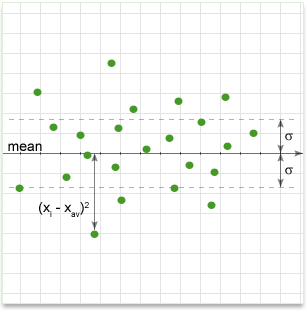
Standard Deviation (SD, or STD or \(σ\)) - a measure of the dispersion or variation in a distribution, equal to the square root of variance or the arithmetic mean (average) of squares of deviations from the arithmetic mean.
\(variance = \frac{\sum(x_i - x_{av})^2}{N}\)
\(σ= \sqrt{variance} = \sqrt{\frac{\sum(x_i - x_{av})^2}{N}}\)
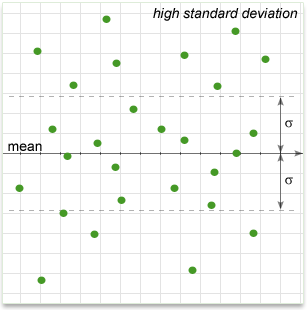
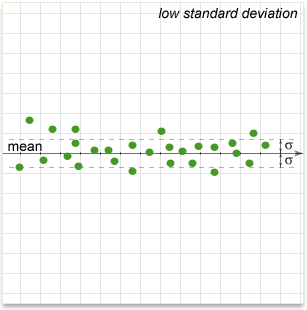
In simple terms, it shows how much variation there is from the "average" (mean). It may be thought of as the average difference from the mean of distribution, how far data points are away from the mean. A low standard deviation indicates that data points tend to be very close to the mean, whereas high standard deviation indicates that the data are spread out over a large range of values.
Properties
\(σ \ge 0\);
\(σ = 0\) only if all elements in a set is equal;
Let standard deviation of \(\{x_i\}\) be \(σ\) and mean of the set be \(m\):
Standard deviation of \(\{\frac{x_i}{a}\}\) is \(σ^{'}=\frac{σ}{a}\). Decrease/increase in all elements of a set by a constant percentage will decrease/increase standard deviation of the set by the same percentage.
Standard deviation of \(\{x_i+a\}\) is \(σ^{'}=σ\). Decrease/increase in all elements of a set by a constant value DOES NOT decrease/increase standard deviation of the set.
if a new element \(y\) is added to \(\{x_i\}\) set and standard deviation of a new set \(\{\{x_i\},y\}\) is \(σ^{'}\), then:
1) \(σ^{'} > σ\) if \(|y-m|>σ\)
2) \(σ^{'} = σ\) if \(|y-m|=σ\)
3) \(σ^{'} < σ\) if \(|y-m|<σ\)
4) \(σ^{'}\) is the lowest if \(y=m\)
Tips and Tricks
GMAC in majority of problems doesn't ask you to calculate standard deviation. Instead it tests your intuitive understanding of the concept. In 90% cases it is a faster way to use just average of \(|x_i-x_{av}|\) instead of true formula for standard deviation, and treat standard deviation as "average difference between elements and mean". Therefore, before trying to calculate standard deviation, maybe you can solve a problem much faster by using just your intuition.
Advance tip. Not all points contribute equally to standard deviation. Taking into account that standard deviation uses sum of squares of deviations from mean, the most remote points will essentially contribute to standard deviation. For example, we have a set A that has a mean of 5. The point 10 gives \((10-5)^2=25\) in sum of squares but point 6 gives only \((6-5)^2=1\). 25 times the difference! So, when you need to find what set has the largest standard deviation, always look for set with the largest range because remote points have a very significant contribution to standard deviation.
Examples
Example #1
Q: There is a set \(\{67,32,76,35,101,45,24,37\}\). If we create a new set that consists of all elements of the initial set but decreased by 17%, what is the change in standard deviation?
Solution: We don't need to calculate as we know rule that decrease in all elements of a set by a constant percentage will decrease standard deviation of the set by the same percentage. So, the decrease in standard deviation is 17%.
Example #2
Q: There is a set of consecutive even integers. What is the standard deviation of the set?
(1) There are 39 elements in the set.
(2) the mean of the set is 382.
Solution: Before reading Data Sufficiency statements, what can we say about the question? What should we know to find standard deviation? "consecutive even integers" means that all elements strictly related to each other. If we shift the set by adding or subtracting any integer, does it change standard deviation (average deviation of elements from the mean)? No. One thing we should know is the number of elements in the set, because the more elements we have the broader they are distributed relative to the mean. Now, look at DS statements, all we need it is just first statement. So, A is sufficient.
Example #3
Q: Standard deviation of set \(\{23,31,76,45,16,55,54,36\}\) is 18.3. How many elements are 1 standard deviation above the mean?
Solution: Let's find mean: \(m=\frac{23+31+76+45+16+55+54+36}{8}=42\)
Now, we need to count all numbers greater than 42+18.3=60.3. It is one number - 76. The answer is 1.
Example #4
Q: There is a set A of 19 integers with mean 4 and standard deviation of 3. Now we form a new set B by adding 2 more elements to the set A. What two elements will decrease the standard deviation the most?
A) 9 and 3
B) -3 and 3
C) 6 and 1
D) 4 and 5
E) 5 and 5
Solution: The closer to the mean, the greater decrease in standard deviation. D has 4 (equal our mean) and 5 (differs from mean only by 1). All other options have larger deviation from mean.
Normal distribution
It is a more advance concept that you will never see in GMAT but understanding statistic properties of standard deviation can help you to be more confident about simple properties stated above.
In probability theory and statistics, the normal distribution or Gaussian distribution is a continuous probability distribution that describes data that cluster around a mean or average. Majority of statistical data can be characterized by normal distribution.
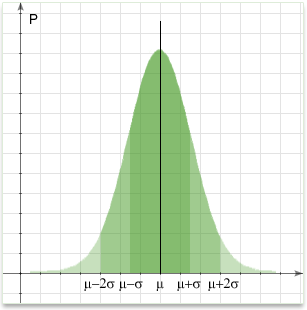
\(m-σ < x < m + σ\) covers 68% of data
\(m-2σ < x < m + 2σ\) covers 95% of data
\(m-3σ < x < m + 3σ\) covers 99% of data
Practice Questions
Easy:
1. https://gmatclub.com/forum/the-data-set ... 76313.html
2. https://gmatclub.com/forum/which-of-the ... 31485.html
3. https://gmatclub.com/forum/a-certain-ch ... 43982.html
4. https://gmatclub.com/forum/if-d-is-the- ... 93979.html
5. https://gmatclub.com/forum/for-a-certai ... 28661.html
6. https://gmatclub.com/forum/a-certain-li ... 59504.html
7. https://gmatclub.com/forum/the-standard ... 99221.html
8. https://gmatclub.com/forum/the-resident ... 83362.html
9. https://gmatclub.com/forum/the-arithmet ... 29117.html
10. https://gmatclub.com/forum/the-mean-and ... 98248.html
Medium:
1. https://gmatclub.com/forum/a-certain-ch ... 43982.html
2. https://gmatclub.com/forum/set-s-consis ... 51019.html
3. https://gmatclub.com/forum/a-vending-ma ... 93351.html
4. https://gmatclub.com/forum/which-of-the ... 62530.html
5. https://gmatclub.com/forum/set-j-consis ... 06956.html
6. https://gmatclub.com/forum/the-table-ab ... 20477.html
7. https://gmatclub.com/forum/if-a-certain ... 30542.html
8. https://gmatclub.com/forum/a-researcher ... 34893.html
9. https://gmatclub.com/forum/a-certain-li ... 03989.html
Hard:
1. https://gmatclub.com/forum/if-m-is-a-ne ... 26819.html
2. https://gmatclub.com/forum/set-q-consis ... 55781.html
3. https://gmatclub.com/forum/which-of-the ... 00345.html
4. https://gmatclub.com/forum/the-list-sho ... 91966.html
5. https://gmatclub.com/forum/a-researcher ... 59754.html
6. https://gmatclub.com/forum/e-is-a-colle ... 99774.html
7. https://gmatclub.com/forum/set-a-consis ... 10876.html
8. https://gmatclub.com/forum/if-j-k-m-n-a ... 72294.html
9. https://gmatclub.com/forum/which-of-the ... 90680.html
10. https://gmatclub.com/forum/the-list-abo ... 93102.html

Math_SD_graph.png [ 6.04 KiB | Viewed 219269 times ]

Math_SD_graph_low.png [ 5.92 KiB | Viewed 219106 times ]

Math_SD_graph_high.png [ 7.06 KiB | Viewed 219215 times ]

Math_SD_normal.png [ 7.67 KiB | Viewed 217438 times ]

Math_icon_std.png [ 2.67 KiB | Viewed 213365 times ]
Definition
Standard Deviation (SD, or STD or \(σ\)) - a measure of the dispersion or variation in a distribution, equal to the square root of variance or the arithmetic mean (average) of squares of deviations from the arithmetic mean.
\(variance = \frac{\sum(x_i - x_{av})^2}{N}\)
\(σ= \sqrt{variance} = \sqrt{\frac{\sum(x_i - x_{av})^2}{N}}\)
In simple terms, it shows how much variation there is from the "average" (mean). It may be thought of as the average difference from the mean of distribution, how far data points are away from the mean. A low standard deviation indicates that data points tend to be very close to the mean, whereas high standard deviation indicates that the data are spread out over a large range of values.
Properties
\(σ \ge 0\);
\(σ = 0\) only if all elements in a set is equal;
Let standard deviation of \(\{x_i\}\) be \(σ\) and mean of the set be \(m\):
Standard deviation of \(\{\frac{x_i}{a}\}\) is \(σ^{'}=\frac{σ}{a}\). Decrease/increase in all elements of a set by a constant percentage will decrease/increase standard deviation of the set by the same percentage.
Standard deviation of \(\{x_i+a\}\) is \(σ^{'}=σ\). Decrease/increase in all elements of a set by a constant value DOES NOT decrease/increase standard deviation of the set.
if a new element \(y\) is added to \(\{x_i\}\) set and standard deviation of a new set \(\{\{x_i\},y\}\) is \(σ^{'}\), then:
1) \(σ^{'} > σ\) if \(|y-m|>σ\)
2) \(σ^{'} = σ\) if \(|y-m|=σ\)
3) \(σ^{'} < σ\) if \(|y-m|<σ\)
4) \(σ^{'}\) is the lowest if \(y=m\)
Tips and Tricks
GMAC in majority of problems doesn't ask you to calculate standard deviation. Instead it tests your intuitive understanding of the concept. In 90% cases it is a faster way to use just average of \(|x_i-x_{av}|\) instead of true formula for standard deviation, and treat standard deviation as "average difference between elements and mean". Therefore, before trying to calculate standard deviation, maybe you can solve a problem much faster by using just your intuition.
Advance tip. Not all points contribute equally to standard deviation. Taking into account that standard deviation uses sum of squares of deviations from mean, the most remote points will essentially contribute to standard deviation. For example, we have a set A that has a mean of 5. The point 10 gives \((10-5)^2=25\) in sum of squares but point 6 gives only \((6-5)^2=1\). 25 times the difference! So, when you need to find what set has the largest standard deviation, always look for set with the largest range because remote points have a very significant contribution to standard deviation.
Examples
Example #1
Q: There is a set \(\{67,32,76,35,101,45,24,37\}\). If we create a new set that consists of all elements of the initial set but decreased by 17%, what is the change in standard deviation?
Solution: We don't need to calculate as we know rule that decrease in all elements of a set by a constant percentage will decrease standard deviation of the set by the same percentage. So, the decrease in standard deviation is 17%.
Example #2
Q: There is a set of consecutive even integers. What is the standard deviation of the set?
(1) There are 39 elements in the set.
(2) the mean of the set is 382.
Solution: Before reading Data Sufficiency statements, what can we say about the question? What should we know to find standard deviation? "consecutive even integers" means that all elements strictly related to each other. If we shift the set by adding or subtracting any integer, does it change standard deviation (average deviation of elements from the mean)? No. One thing we should know is the number of elements in the set, because the more elements we have the broader they are distributed relative to the mean. Now, look at DS statements, all we need it is just first statement. So, A is sufficient.
Example #3
Q: Standard deviation of set \(\{23,31,76,45,16,55,54,36\}\) is 18.3. How many elements are 1 standard deviation above the mean?
Solution: Let's find mean: \(m=\frac{23+31+76+45+16+55+54+36}{8}=42\)
Now, we need to count all numbers greater than 42+18.3=60.3. It is one number - 76. The answer is 1.
Example #4
Q: There is a set A of 19 integers with mean 4 and standard deviation of 3. Now we form a new set B by adding 2 more elements to the set A. What two elements will decrease the standard deviation the most?
A) 9 and 3
B) -3 and 3
C) 6 and 1
D) 4 and 5
E) 5 and 5
Solution: The closer to the mean, the greater decrease in standard deviation. D has 4 (equal our mean) and 5 (differs from mean only by 1). All other options have larger deviation from mean.
Normal distribution
It is a more advance concept that you will never see in GMAT but understanding statistic properties of standard deviation can help you to be more confident about simple properties stated above.
In probability theory and statistics, the normal distribution or Gaussian distribution is a continuous probability distribution that describes data that cluster around a mean or average. Majority of statistical data can be characterized by normal distribution.
\(m-σ < x < m + σ\) covers 68% of data
\(m-2σ < x < m + 2σ\) covers 95% of data
\(m-3σ < x < m + 3σ\) covers 99% of data
Practice Questions
Easy:
1. https://gmatclub.com/forum/the-data-set ... 76313.html
2. https://gmatclub.com/forum/which-of-the ... 31485.html
3. https://gmatclub.com/forum/a-certain-ch ... 43982.html
4. https://gmatclub.com/forum/if-d-is-the- ... 93979.html
5. https://gmatclub.com/forum/for-a-certai ... 28661.html
6. https://gmatclub.com/forum/a-certain-li ... 59504.html
7. https://gmatclub.com/forum/the-standard ... 99221.html
8. https://gmatclub.com/forum/the-resident ... 83362.html
9. https://gmatclub.com/forum/the-arithmet ... 29117.html
10. https://gmatclub.com/forum/the-mean-and ... 98248.html
1. https://gmatclub.com/forum/a-certain-ch ... 43982.html
2. https://gmatclub.com/forum/set-s-consis ... 51019.html
3. https://gmatclub.com/forum/a-vending-ma ... 93351.html
4. https://gmatclub.com/forum/which-of-the ... 62530.html
5. https://gmatclub.com/forum/set-j-consis ... 06956.html
6. https://gmatclub.com/forum/the-table-ab ... 20477.html
7. https://gmatclub.com/forum/if-a-certain ... 30542.html
8. https://gmatclub.com/forum/a-researcher ... 34893.html
9. https://gmatclub.com/forum/a-certain-li ... 03989.html
1. https://gmatclub.com/forum/if-m-is-a-ne ... 26819.html
2. https://gmatclub.com/forum/set-q-consis ... 55781.html
3. https://gmatclub.com/forum/which-of-the ... 00345.html
4. https://gmatclub.com/forum/the-list-sho ... 91966.html
5. https://gmatclub.com/forum/a-researcher ... 59754.html
6. https://gmatclub.com/forum/e-is-a-colle ... 99774.html
7. https://gmatclub.com/forum/set-a-consis ... 10876.html
8. https://gmatclub.com/forum/if-j-k-m-n-a ... 72294.html
9. https://gmatclub.com/forum/which-of-the ... 90680.html
10. https://gmatclub.com/forum/the-list-abo ... 93102.html
Show SpoilerImages
Attachment:
Math_SD_graph.png [ 6.04 KiB | Viewed 219269 times ]
Attachment:
Math_SD_graph_low.png [ 5.92 KiB | Viewed 219106 times ]
Attachment:
Math_SD_graph_high.png [ 7.06 KiB | Viewed 219215 times ]
Attachment:
Math_SD_normal.png [ 7.67 KiB | Viewed 217438 times ]
Attachment:
Math_icon_std.png [ 2.67 KiB | Viewed 213365 times ]

 21 Dec 2009, 11:54
Kudos
Bookmarks
Quote:
I don't know if I am making this sound more complicated but I think there are two concepts here... May be a rephrase would help
1) Decrease/increase in all elements of a set by a constant value DOES NOT decrease/increase standard deviation of the set. See here - gmat-club-test-m11-doubt-81138.html
2) Decrease in all elements of a set by a constant percentage will decrease standard deviation of the set by the same percentage.
2) is different from 1) because the same percentage decrease/increase results in different values for the different elements of the set and is not the same as increase/decrease by a constant value.
 09 Jan 2010, 18:35
Kudos
Bookmarks
Quote:
I do not get it , how could we calculate Standard deviation of even consecutive integers without knowing the set ?
or it means that Standard deviation of any 39 consecitive even integers will be same as they are equally distributed with respect to the avarge ?
General Discussion
 12 Dec 2009, 22:06
Kudos
Bookmarks
Well, I'm a little confused in regard to Example #4.
Actually, the SD value is an unrelative piece of information, we can solve this problem by mean value alone.
Correct me if I'm wrong, any comment is welcome, thanks a lot.
Quote:
What on earth is the mean? 11 or 4? I guess it might be 4 by the explanation that follows.
Actually, the SD value is an unrelative piece of information, we can solve this problem by mean value alone.
Correct me if I'm wrong, any comment is welcome, thanks a lot.