| Last visit was: 29 Apr 2026, 16:04 |
It is currently 29 Apr 2026, 16:04 |
|
|
Customized
for You
Track
Your Progress
Practice
Pays
| FROM Tuck Admissions Blog: Becoming the Best Entrepreneur You Can Be |
![]() ![]() ![]() Joaquin Villarreal T’08 (left) is manager of the Entrepreneurship Initiative at Tuck. Mathias Machado T’09 is an associate director of the Career Development Office (CDO). Q: How can I become a great entrepreneur? Mathias Machado: Entrepreneurs need grit because they are inevitably going to face disappointment and discouragement. What do you say to someone who’s hit a roadblock? Joaquin Villarreal: Welcome to the club! That’s what entrepreneurship is: hard work, obstacles, and more hard work. Unless you happen to be the movie version of Mark Zuckerberg, it’s not going to be easy. I want to stress that point: the classic movie success story—a guy in a dorm room one second, a trillionaire the next second—that’s 0.1% of the entrepreneurial experience at most. MM: Like we also discussed earlier, there’s a lot of changing your idea along the way, too. Even with Facebook, what it became was not the original idea. JV: Exactly. Entrepreneurship involves a lot of banging your head against walls. MM: So what advice do you have for someone to sharpen their entrepreneurial skills to—let’s hope—make their journey a little more successful? JV: Train yourself to execute. You want to be in the mindset of getting things done, not just planning to do things and thinking, because you’ve planned them on paper, that they’re done. MM: How do you draw the line between action and planning? JV: You should plan before you do anything. Think of it this way: if you take a bus, you’ve got to plan which bus you’re going to take, but you’re not actually taking the bus until you’re physically on it. It’s the same concept. You’ve got to plan before you execute, but until you execute, then you’re not an entrepreneur yet. MM: Taking action and responsibility go hand-in-hand. JV: Exactly. There are no excuses when you’re an entrepreneur: you can delegate tasks but not responsibility. Even if someone else dropped the ball or didn’t show up, when you own your own business, it’s your responsibility regardless. The sooner you adopt that mindset, the better off you’ll be. Q: What Makes a Successful Entrepreneur? MM: Entrepreneurship can seem like a mystery to a lot of people. Are there any qualities that give an aspiring entrepreneur an advantage? JV: Too often, I think the answers to that question are clichéd and unhelpful. If I had to name one quality, I think back to a talk given by Brent Dance T’13, who works at Google. He is also an entrepreneur who started a couple of companies, including a nonprofit aimed at aiding and educating Russian orphans. I invited him for our speaker series and one of the things he said that stood out most was that an entrepreneur has to have grit. If you don’t have it, you’ll need it. MM: Very true. After all, no entrepreneurial journey will be uneventful. JV: If you get discouraged too easily, you’ll never make it. Like I said, I think people spend too much time discussing the qualities entrepreneurs need, but there’s no questioning the need for grit. MM: What do you think is one of the most common pitfalls aspiring entrepreneurs should avoid? JV: Focusing too much on the importance of the actual idea. The main question students ask our Entrepreneurs-in-Residence is, “How do I know if my idea is good enough to devote my life to it?” The answer is that there’s never an idea that’s “good enough”—you have to make the call yourself. MM: That must come as a surprise. JV: What I mean is that the idea is not the most important thing—there are so many paths to take and the idea changes so much that it makes more sense to focus more on what you are passionate about and what drives you. While you’re at Tuck, I would recommend you focus less on the idea and instead focus on learning and executing. That will help you the most, regardless of whatever the idea you end up settling on. (Photo above by Laura DeCapua) |
| FROM Tuck Admissions Blog: Before You Hit Submit: Finishing Touches Checklist |
![]() At this time of the year, your to-do list is likely to include baking, shopping, and holiday parties. But if you're submitting an application as part of Tuck's January Round, the January 6 deadline is right around the corner. Don't let your hectic schedule prevent you from submitting the strongest application possible. To make things just a little bit easier, we've created your finishing touches checklist. Good luck as you continue to work on your application and we look forward to meeting you soon! 1. If you are able to visit and take advantage of our open interview policy, book yours soon. Visiting and interviewing before you submit your application helps inform the “Why Tuck” essay and may also help you better articulate why Tuck is a good fit for you and you for Tuck. The interview deadline for the January application round is January 30th. Of course, we understand that circumstances sometimes prevent applicants from a visit to Tuck, and that’s OK! An interview is not required in order to apply and Tuck does offer interviews by invitation. 2. Check-in on your recommenders to be sure they are on track to submit their recommendation on time. Be sure to do this at least two weeks prior to the application deadline to ensure that they have time to comply with the deadline, or, if necessary, you have time to find a new recommender. 3. Don’t procrastinate on tackling the essays! This is often an element of the application that many prospective students leave as the final step in the application process, and many are surprised by how challenging they can be. Remember, the suggested word count for each essay is around 500 words, so a great deal of introspection is often needed to ensure that you present the most clear, concise and well-presented essays you can. 4. Proofread. Proofread. Proofread. We can’t say this enough. You may be surprised to know how often we see mistakes that are so easy to avoid with a little attention to detail (remember, Spellcheck is not foolproof, nor is “find and replace”). Focus on good grammar and clear, focused writing. 5. Strive to submit your application prior to the January 6th deadline. Not only will this allow you to troubleshoot if the unexpected happens, it also ensures that you don’t have to experience the last-minute rush of getting everything in on time. 6. Be sure to submit your official GMAT score. The turnaround time for official GMAT scores is down to just 5 or 6 days, so you have some additional leeway in terms of how close to the January deadline you take the test and still have time to get it submitted. 7. Continue to be introspective and explore programs you think would be a good fit. We invite you to take advantage of the many tools, resources and opportunities available to you. |
| FROM Tuck Admissions Blog: Women’s Tripod Hockey: Tuck.Puck.Love. |
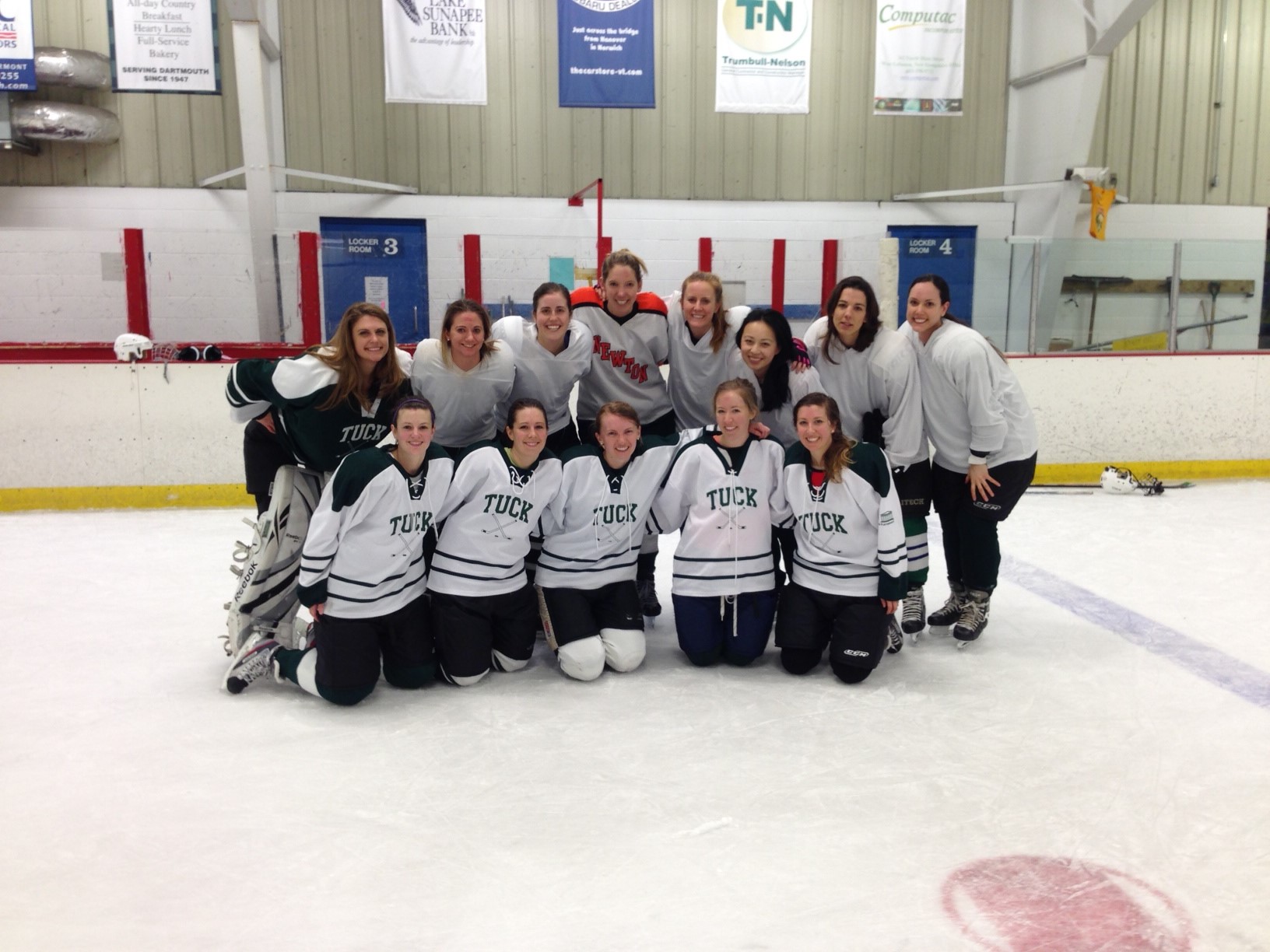
![]() ![]() By Christine Hou T'15 Christine is a second-year student at Tuck pursuing a dual-degree with Harvard Kennedy School. After growing up in Silicon Valley and obtaining a bachelor’s degree from UC Berkeley, she spent time as a management consultant at Bain & Company in San Francisco. Immediately before matriculating to Tuck, Christine consulted for the Gates Foundation and TechnoServe across East Africa. This past summer she interned with Acumen Fund in Nairobi, focusing on health care and education investments. To set the stage for this blog post: I’m a native Californian who, having just spent a year under the East African equatorial sun, arrived in Hanover terrified of the ice. The sports I played were volleyball, tennis, and running—athletics held in a room or outdoors in the sun where my opponent is either across a net or nonexistent. I was nervous to step into a rink, but I came here to challenge myself. So when someone suggested I play women’s tripod hockey, I decided to buy a full set of hockey gear and put my name on the list. At Tuck, our schedules are pushed to the brink. My first game was the night before a paper was due, before a presentation, and on only 24-hours of sleep over a five-day period. Exhausted, I cursed myself as I strapped on my pads and grabbed my stick. But once the whistle blew, all thoughts besides the puck dissipated. For the first time since Tuck started, my brain was quiet. I was focused. I was in the moment. And then I fell flat on my face. Which, in my defense, happens a lot in tripod hockey. The word "tripod” is there for a reason—players regularly employ their stick as a third leg to stay upright. And the ice is littered with tripods during the year. This past fall, over 150 women signed up to play. Over the course of ~six weeks, they played over eight games leading up to playoffs, and some moved on to the coveted championships. This dizzying and sometimes silly environment makes for great exercise and solid friendships. We have supported each other through cringe-worthy falls, through intensely competitive games that come down to shootouts and last minute goals, through debilitating defeats, and through joyous victories. As cliché as it sounds, tripod hockey does teach valuable skills outside the classroom. It’s proof that when you face your fears consistently, you can overcome them. Also, hockey forces you to pick yourself up time and time again after you’ve fallen hard. And when you’re on the ice, pride gets in the way of playing—so you learn to put it away. Lastly, tripod is all about having fun. Though we all strive to win, at the end of the day, it’s hard to take the game too seriously when someone wipes out every minute. Instead, the focus is on our teammates—celebrating in the team boxes every time someone stops or hits the puck. And that’s what makes women’s tripod hockey so rewarding. It’s an incredibly supportive network of ladies who encourage you even when you’re flat on your back on the ice. Now that is Tuck.Puck.Love. |
| FROM Tuck Admissions Blog: My International Exchange Experience at Tuck |
![]() By Felipe Kovacic T'EX Felipe Kovacic is an exchange student from Sydney, where he studies at Australia’s top-ranked MBA (executive) program at the Australian Graduate School of Management (AGSM) of the University of New South Wales (UNSW) Business School. Felipe was born in Australia, however, his Chilean parents eventually took him back to Chile where he served 14 years in the Chilean Navy, also receiving an electronic engineering degree from the Naval Academy. Over six years ago, he left the Navy to return to Australia where he works as a business development executive at Australia´s largest energy company, Origin Energy. Felipe also has interests in sustainability, languages, literature, writing, and taking long walks. My experience at Tuck has been amazing and has far exceeded my expectations. I conducted significant research on Tuck before coming for the four-month exchange. I learned about the uncommon bond Tuckies share, as well as the exceptional quality of teaching from faculty which I was able to experience firsthand. Other exchange students and I we were immediately well received and integrated in to all the activities at Tuck. Though Tuck is located in Hanover, N.H., which is not a large city, its location can be a big advantage. It allows us to focus on studying and promotes stronger participation in student activities including numerous clubs. I participate in several including the Case Competition Club and the Dartmouth Energy Collaborative. As an Ivy League and top-tier business school, Tuck has very strong relationships with other top business schools. I was able to participate in several activities at MIT and Harvard which are only a two-hour drive away. You get the best of both worlds—not too close yet not too far from the action—which allows you to make the absolute most of the learning opportunities. A highlight of my exchange happened as a result of the clubs at Tuck and the strong relationships they help build. I participated in the MBA International Sales Competition and Conference co-organized by MIT Sloan and Harvard Business School. With a team that included members from Stanford and Rice University, we won the second-place prize in the competition. Apart from very rigorous academic requirements, there is also time for personal enjoyment. My family was able to visit me during the exchange. With my wife and three-and-a-half-year-old son, we were able to go on a trip during Thanksgiving break to Montreal, Ottawa, Toronto, Niagara Falls, and New York. Though I have previously traveled quite a bit and also participated in exchanges during my time in the Chilean Navy—I have sailed on board German, French, Argentinian, Brazilian and Mexican ships—Tuck is definitely one of the most significant life and professional experiences that I have had. It has added another important dimension to my MBA experience. The Tuck alumni in my home countries of Australia and Chile have also been amazing when I have reached out to them. I would definitely recommend Tuck to any prospective applicants. (Above: Felipe and his colleagues won second place in the MBA International Sales Competition and Conference co-organized by MIT Sloan and Harvard Business School.) |
Success stories and strategies from high-scoring candidates.