Events & Promotions
|
|

GMAT Club Daily Prep
Thank you for using the timer - this advanced tool can estimate your performance and suggest more practice questions. We have subscribed you to Daily Prep Questions via email.
Customized
for You
Track
Your Progress
Practice
Pays
Not interested in getting valuable practice questions and articles delivered to your email? No problem, unsubscribe here.
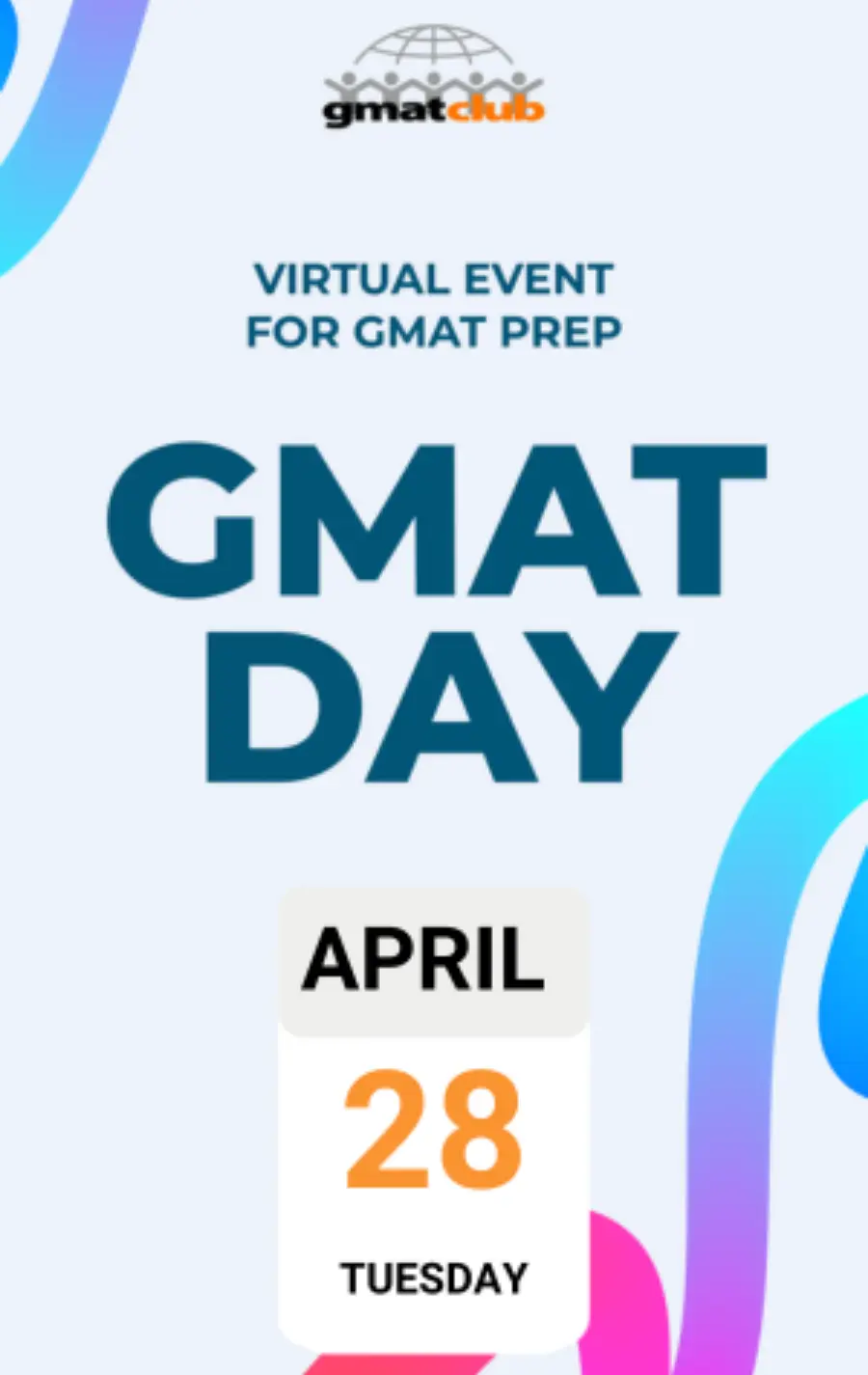
 Apr 28
08:00 AM PDT
-11:00 AM PDT
Whether you are just beginning your MBA journey or fine-tuning your path to a 700+ score, GMAT Day is designed to give you a competitive edge. Apr 29
12:30 AM EDT
-01:30 AM EDT
Learn how Kamakshi achieved a GMAT 675 with an impressive 96th %ile in Data Insights. Discover the unique methods and exam strategies that helped her excel in DI along with other sections for a balanced and high score. Apr 30
01:30 AM EDT
-02:30 AM EDT
At one point, she believed GMAT wasn’t for her. After scoring 595, self-doubt crept in and she questioned her potential. But instead of quitting, she made the right strategic changes. The result? A remarkable comeback to 695. Check out how Saakshi did it. May 01
11:00 AM PDT
-12:00 PM PDT
Free- full-length test + 15 concept videos + 150+ short videos + study plan! May 03
06:30 AM PDT
-08:30 AM PDT
Verbal trouble on GMAT? Fix it NOW! Join Sunita Singhvi for a focused webinar on actionable strategies to boost your Verbal score and take your performance to the next level.

 23 Oct 2019, 11:09
Kudos
Bookmarks


D
Be sure to select an answer first to save it in the Error Log before revealing the correct answer (OA)!
Difficulty:
 65%
(hard)
65%
(hard)
Question Stats:
58% (02:18) correct 42%
(02:18)
wrong
based on 222
sessions
42%
(02:18)
wrong
based on 222
sessions
History
Date
Time
Result
Not Attempted Yet

Students can learn mathematics only by exploring it on their own, with generous room for trial and error. For what matters, in the long run, is not acquiring particular computational skills (since without constant use skills rapidly fade), but knowing how to find and use suitable mathematical tools whenever they become necessary.
If the position expressed above is correct, then each of the following can be true EXCEPT:
(A) Mathematics teachers are often afraid that someone will ask a question that they cannot answer, and this insecurity frequently leads to authoritarianism in the classroom.
(B) Prospective teachers should themselves learn mathematics as a process of constructing and interpreting patterns, of devising strategies for solving problems, and of discovering the beauties and applications of mathematics.
(C) Political leaders must accept responsibility for coordinating a nationwide plan for all levels of instruction if mathematics education is to improve.
(D) The most effective method for teaching students mathematics is for teachers to state the definitive rule for solving exercises of a given type and then to insist on rote practice in its proper application.
(E) Most current teaching presents mathematics as established doctrine, stressing the production of right answers rather than the ability to communicate reasons.
Kudos for the OA and explanation
If the position expressed above is correct, then each of the following can be true EXCEPT:
(A) Mathematics teachers are often afraid that someone will ask a question that they cannot answer, and this insecurity frequently leads to authoritarianism in the classroom.
(B) Prospective teachers should themselves learn mathematics as a process of constructing and interpreting patterns, of devising strategies for solving problems, and of discovering the beauties and applications of mathematics.
(C) Political leaders must accept responsibility for coordinating a nationwide plan for all levels of instruction if mathematics education is to improve.
(D) The most effective method for teaching students mathematics is for teachers to state the definitive rule for solving exercises of a given type and then to insist on rote practice in its proper application.
(E) Most current teaching presents mathematics as established doctrine, stressing the production of right answers rather than the ability to communicate reasons.
Kudos for the OA and explanation

ShankSouljaBoi

Joined: 21 Jun 2017
Last visit: 28 Mar 2026
Posts: 599
Given Kudos: 4,090
Location: India
Concentration: Finance, Economics
Schools: Rotman '23 (D) IIMA PGPX'22 (D) Desautels '23 (D) Schulich Sept '23 (D) WBS (D) IIML IPMX'25 (A)
GMAT 1: 660 Q49 V31
GMAT 2: 620 Q47 V30
GMAT 3: 650 Q48 V31
GPA: 3.1
WE:Corporate Finance (Non-Profit and Government)
Products:
Schools: Rotman '23 (D) IIMA PGPX'22 (D) Desautels '23 (D) Schulich Sept '23 (D) WBS (D) IIML IPMX'25 (A)
GMAT 3: 650 Q48 V31
Posts: 599
23 Oct 2019, 11:32
Kudos
Bookmarks
Toughie ! Took 3:33 minutes.
Conclusion - mathematics should not be learnt ( you don't have to be calculators to solve a mathematical problem ) . Mathematics should be solved by finding tools and using them, when in need.
This is a can be true except question, which means irrelevant choices to the conclusion can be true in real life. Our answer will be something not parallel to the author's point of view.
A-- irrelevant to conclusion. Maybe true in real life. I don't know
B-- follows the conclusion. out
C-- same as A. Out
D-- totally against the conclusion. So this choice can never be true.
E-- Maybe true in real life idk.
D is the winner.
Posted from my mobile device
Conclusion - mathematics should not be learnt ( you don't have to be calculators to solve a mathematical problem ) . Mathematics should be solved by finding tools and using them, when in need.
This is a can be true except question, which means irrelevant choices to the conclusion can be true in real life. Our answer will be something not parallel to the author's point of view.
A-- irrelevant to conclusion. Maybe true in real life. I don't know
B-- follows the conclusion. out
C-- same as A. Out
D-- totally against the conclusion. So this choice can never be true.
E-- Maybe true in real life idk.
D is the winner.
Posted from my mobile device
23 Oct 2019, 11:58
Kudos
Bookmarks
Please give kudo.
This was a great question. By the way, it was an official question form the GRE exam.
Regards
This was a great question. By the way, it was an official question form the GRE exam.
Regards