Last visit was: 22 Apr 2026, 09:58 It is currently 22 Apr 2026, 09:58
Close
GMAT Club Daily Prep
Thank you for using the timer - this advanced tool can estimate your performance and suggest more practice questions. We have subscribed you to Daily Prep Questions via email.

Customized
for You

we will pick new questions that match your level based on your Timer History

Track
Your Progress

every week, we’ll send you an estimated GMAT score based on your performance

Practice
Pays

we will pick new questions that match your level based on your Timer History
Not interested in getting valuable practice questions and articles delivered to your email? No problem, unsubscribe here.
Close
Request Expert Reply
Confirm Cancel
User avatar
EgmatQuantExpert
User avatar
e-GMAT Representative
Joined: 04 Jan 2015
Last visit: 02 Apr 2024
Posts: 3,657
Own Kudos:
20,862
 [51]
Given Kudos: 165
Expert
Expert reply
Posts: 3,657
Kudos: 20,862
 [51]
3
Kudos
Add Kudos
48
Bookmarks
Bookmark this Post
Most Helpful Reply
User avatar
PKN
Joined: 01 Oct 2017
Last visit: 11 Oct 2025
Posts: 809
Own Kudos:
1,636
 [6]
Given Kudos: 41
Status:Learning stage
WE:Supply Chain Management (Energy)
Posts: 809
Kudos: 1,636
 [6]
4
Kudos
Add Kudos
1
Bookmarks
Bookmark this Post
User avatar
EgmatQuantExpert
User avatar
e-GMAT Representative
Joined: 04 Jan 2015
Last visit: 02 Apr 2024
Posts: 3,657
Own Kudos:
20,862
 [5]
Given Kudos: 165
Expert
Expert reply
Posts: 3,657
Kudos: 20,862
 [5]
3
Kudos
Add Kudos
2
Bookmarks
Bookmark this Post
General Discussion
avatar
rahulkashyap
Joined: 09 Oct 2015
Last visit: 24 Feb 2019
Posts: 165
Own Kudos:
75
 [2]
Given Kudos: 28
Posts: 165
Kudos: 75
 [2]
2
Kudos
Add Kudos
Bookmarks
Bookmark this Post
How did you get 1 2 5 6 7 and 8 from those 2 intervals?

Posted from my mobile device
User avatar
PKN
Joined: 01 Oct 2017
Last visit: 11 Oct 2025
Posts: 809
Own Kudos:
1,636
 [2]
Given Kudos: 41
Status:Learning stage
WE:Supply Chain Management (Energy)
Posts: 809
Kudos: 1,636
 [2]
1
Kudos
Add Kudos
Bookmarks
Bookmark this Post
rahulkashyap
How did you get 1 2 5 6 7 and 8 from those 2 intervals?

Posted from my mobile device

Hi rahulkashyap,
a) x≤2 and x is a +ve integer. hence x could be: 1, 2
b) 4<x<9 and x is a +ve integer. hence x could be: 5,6,7,8
User avatar
dave13
Joined: 09 Mar 2016
Last visit: 15 Mar 2026
Posts: 1,086
Own Kudos:
1,137
 [1]
Given Kudos: 3,851
Posts: 1,086
Kudos: 1,137
 [1]
1
Kudos
Add Kudos
Bookmarks
Bookmark this Post
EgmatQuantExpert

Solution


Given:
    • We are given that x is a positive integer
    • And, we are given an inequality, \(\frac{(x - 2)}{(x^2 – 13x + 36)} ≤ 0\)

To find:
    • We need to find out the number of values of x that satisfies the given inequality

Approach and Working:
    • If we observe the given inequality, we can see that the denominator is a quadratic expression.
    • So, let’s try to factorise the quadratic expression, \(x^2 – 13x + 36\)
      o \(x^2 – 13x + 36 = (x – 9) * (x – 4)\)

    • Thus, the inequality can be written as, \(\frac{(x - 2)}{(x – 9)(x - 4)} ≤ 0\)
    Now, we need to multiply the numerator and denominator of LHS with (x – 9)*(x – 4)
      o \(\frac{(x - 2) (x – 9)(x - 4)}{[(x – 9)(x - 4)]^2} ≤ 0\)
      o The denominator of the above inequality is always greater than 0 and x ≠ 4 or 9, since the denominator cannot be equal to 0.
      o So, the numerator must be ≤ 0, for \(\frac{(x - 2)(x – 9)(x - 4)}{[(x – 9)(x - 4)]^2} ≤ 0\).
      o We need to find the values of x, for which (x - 2) (x – 4)(x - 9) ≤ 0

Approach 1: Wavy-line method

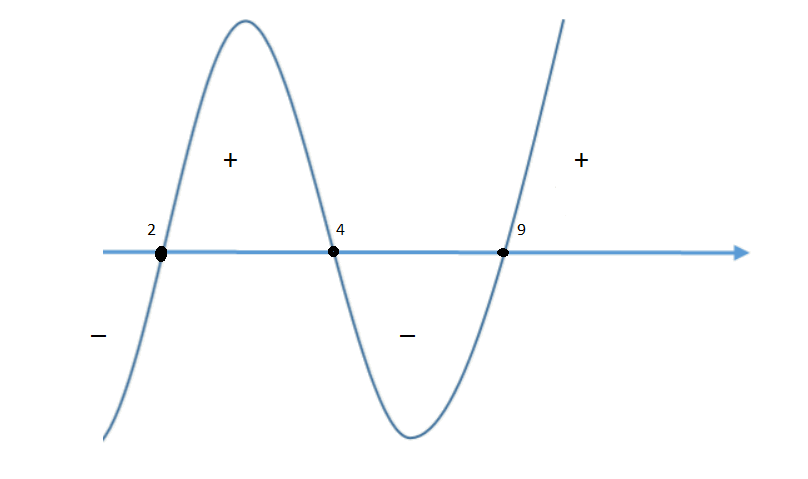
    • The zero points of the inequality are {2, 4, 9} and the wavy-line will be as follows:


    • So, the expression will be equal to zero for x = {2, 4, 9}
      o But, as we already know that, x cannot take the values 4 and 9
      o Thus, x = {2}
    • The expression will be negative in the regions, 4 < x < 9 and x < 2
      o But we know that x is a positive integer, so, the expression will be negative for x = {1, 5, 6, 7, 8}
    • Therefore, the given inequality satisfies for x = {1, 2, 5, 6, 7, 8}

Approach 2: Number-line method

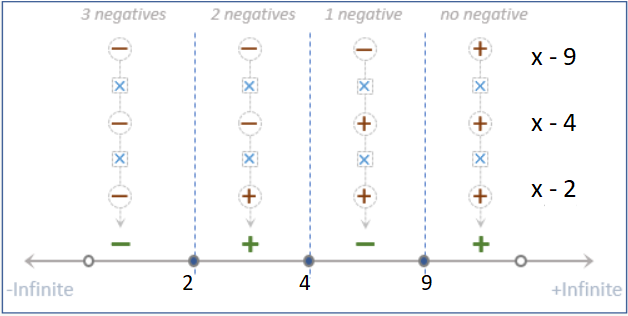
The zero points of the inequality are {2, 4, 9} and highlighting these points on a number line, we get:


    • Thus, (x - 2) (x – 4)(x - 9) will be ≤ 0 in two regions, x ≤ 2 and 4 ≤ x ≤ 9, but we already inferred that x ≠ {4 , 9}
    • And we know that x is a positive integer
    • Therefore, the given inequality satisfies for x = {1, 2, 5, 6, 7, 8}

Hence, the correct answer is option C.

Answer: C


Greetings EgmatQuantExpert , Gladiator59, pushpitkc

i would appreciate you could take time to answrr my questions below :) thank you! :)

Question 1. Why do we need to multiply the numerator and denominator of LHS with (x – 9)*(x – 4) in which cases do we need to do so ?


Question 2. if the denominator of the above inequality is always greater than 0 and x ≠ 4 or 9, since the denominator cannot be equal to 0. WHY do we remove whole denominator in the end, leave only this (x - 2) (x – 4)(x - 9) ≤ 0 ???


Question 3. And the last question :grin: is it gramatically paralel structure to say "Approach and Working" :) may be "Aprroach and Work" is better or "Approach first and then start Working" :lol: how about "approach while working and by the time you approach it will be solved" :lol:
User avatar
pushpitkc
Joined: 26 Feb 2016
Last visit: 19 Feb 2025
Posts: 2,800
Own Kudos:
6,235
 [3]
Given Kudos: 47
Location: India
GPA: 3.12
Posts: 2,800
Kudos: 6,235
 [3]
1
Kudos
Add Kudos
1
Bookmarks
Bookmark this Post
dave13


i would appreciate you could take time to answrr my questions below :) thank you! :)

Question 1. Why do we need to multiply the numerator and denominator of LHS with (x – 9)*(x – 4) in which cases do we need to do so ?


Question 2. if the denominator of the above inequality is always greater than 0 and x ≠ 4 or 9, since the denominator cannot be equal to 0. WHY do we remove whole denominator in the end, leave only this (x - 2) (x – 4)(x - 9) ≤ 0 ???


Question 3. And the last question :grin: is it gramatically paralel structure to say "Approach and Working" :) may be "Aprroach and Work" is better or "Approach first and then start Working" :lol: how about "approach while working and by the time you approach it will be solved" :lol:

Hey dave13

The answer to question 1 is that they do so to make the denominator a square.
Remember a square of a number/expression can never be negative. Now, that
we have that in order, for the overall expression to be neagtive or equal to zero,
the numerator must be negative or have a value of zero at maximum.

That's the reason why they remove the denominator and keep only the numerator
Hope that answers your second question. :)

As for your thid question, I am sure generis will have an answer. Unfortunately,
I am not qualified to make that judgement :lol: :lol:
User avatar
Gladiator59
Joined: 16 Sep 2016
Last visit: 18 Mar 2026
Posts: 841
Own Kudos:
2,716
 [1]
Given Kudos: 271
Status:It always seems impossible until it's done.
GMAT 1: 740 Q50 V40
GMAT 2: 770 Q51 V42
Products:
GMAT 2: 770 Q51 V42
Posts: 841
Kudos: 2,716
 [1]
Kudos
Add Kudos
Bookmarks
Bookmark this Post
dave13,

pushpitkc has already answered it perfectly.

I'd like to add that this is a common trick in inequality questions, to make perfect squares and then "ignore them" as the perfect squares of real numbers are greater than or equal to zero.

However, as an advanced step you can go ahead and skip that part. Treat the numerator and denominator the same and use the wavy approach. ( While multiplying by same factor in both num and den we are doing this itself!)

To add a little to q2 raised by you above, -ve * +ve is -ve and +ve * +ve is +ve... Which means multiplying by positive entity does not change the sign... Hence we can ignore the perfect square part in denominator.

Q3: no clue what you're talking about! :-D

Let me know if you wanna followup.

Best,
Gladi

Posted from my mobile device
User avatar
Kinshook
User avatar
Major Poster
Joined: 03 Jun 2019
Last visit: 22 Apr 2026
Posts: 5,986
Own Kudos:
Given Kudos: 163
Location: India
GMAT 1: 690 Q50 V34
WE:Engineering (Transportation)
Products:
GMAT 1: 690 Q50 V34
Posts: 5,986
Kudos: 5,858
Kudos
Add Kudos
Bookmarks
Bookmark this Post
EgmatQuantExpert
If x is a positive integer, how many values of x satisfy the inequality, \(\frac{(x - 2)}{(x^2 – 13x + 36)} ≤ 0\)?

    A. 4
    B. 5
    C. 6
    D. 7
    E. Cannot be determined

To read all our articles: Must read articles to reach Q51


Asked: If x is a positive integer, how many values of x satisfy the inequality, \(\frac{(x - 2)}{(x^2 – 13x + 36)} ≤ 0\)?

(x-2)/(x-4)(x-9) <=0

Possible values of x = {1,2,5,6,7,8}

IMO C
avatar
Avinash514043
Joined: 05 Apr 2019
Last visit: 27 Dec 2022
Posts: 8
Own Kudos:
Given Kudos: 21
Posts: 8
Kudos: 10
Kudos
Add Kudos
Bookmarks
Bookmark this Post
Why can't 0 be one of the integer.

Posted from my mobile device
avatar
Niteshkumar89
Joined: 23 Mar 2020
Last visit: 21 Nov 2021
Posts: 1
Given Kudos: 1
Posts: 1
Kudos: 0
Kudos
Add Kudos
Bookmarks
Bookmark this Post
rahulkashyap
How did you get 1 2 5 6 7 and 8 from those 2 intervals?

Posted from my mobile device

3 is also satisfying the equation
2
Kudos
Add Kudos
Bookmarks
Bookmark this Post
EgmatQuantExpert
If x is a positive integer, how many values of x satisfy the inequality, \(\frac{(x - 2)}{(x^2 – 13x + 36)} ≤ 0\)?

    A. 4
    B. 5
    C. 6
    D. 7
    E. Cannot be determined

To read all our articles: Must read articles to reach Q51


Attachments

File comment: You can use this method of plotting transition points on the number line.

This is fast method and with practice one can get used to it.

6226da61-516a-4a8a-b3d5-c724a9240d3f.jpg
6226da61-516a-4a8a-b3d5-c724a9240d3f.jpg [ 81.43 KiB | Viewed 13341 times ]

User avatar
kiranbhasker
Joined: 22 Apr 2020
Last visit: 04 Jul 2022
Posts: 17
Own Kudos:
Given Kudos: 372
GPA: 3.5
Products:
Posts: 17
Kudos: 6
Kudos
Add Kudos
Bookmarks
Bookmark this Post
Adding to all the above solutions,

the correct option is 6.

The question says Positive integer, hence x cannot take 0 or lesser values. x<=2 - this is a key point in the question.
so X can take 1 and 2 to satisfy the equation and remaining solutions, by following the number line or wavy line method results can be obtained.
avatar
Anubha1
Joined: 28 Jul 2020
Last visit: 09 Feb 2022
Posts: 3
Own Kudos:
Given Kudos: 6
Posts: 3
Kudos: 1
Kudos
Add Kudos
Bookmarks
Bookmark this Post
Hi equation holds good at x=4 and 9since it is expression <=0 thus at 4 and 9 the value of expression is 0
thus x=1,2,4,5,6,7,8, and 9.
User avatar
DeeBee54
Joined: 19 Jan 2021
Last visit: 11 May 2025
Posts: 21
Own Kudos:
Given Kudos: 120
Posts: 21
Kudos: 2
Kudos
Add Kudos
Bookmarks
Bookmark this Post
Anubha1
Hi equation holds good at x=4 and 9since it is expression <=0 thus at 4 and 9 the value of expression is 0
thus x=1,2,4,5,6,7,8, and 9.

At x=4 and x=9, the denominator will become 0 and such an expression where D = 0 is not defined. Hence these situations are to be ignored from solution set
User avatar
Sambon
Joined: 28 Mar 2021
Last visit: 26 Mar 2023
Posts: 23
Own Kudos:
Given Kudos: 47
Schools: HBS '25 (A)
Products:
Schools: HBS '25 (A)
Posts: 23
Kudos: 19
Kudos
Add Kudos
Bookmarks
Bookmark this Post
Here is an alternative solution for those interested:

Factor the denominator to get (x-9)*(x-4) so your overall inequality becomes \(\frac{(x-2)}{(x-9)*(x-4)} ≤ 0\)
We want to find values of x that will return a negative result or zero.

As a first step, you can deduce that x≠9 and x≠4, but x=2 is the first solution. From here, we're only really interested in two ranges: x>2 and x<2.
What if x>2? For any value of x greater than 2, the numerator will be positive. If x=3, the denominator is also positive so it does not satisfy the inequality. But when x = 5, 6, 7, and 8 the denominator is negative, leading to a negative result. So x=5,6,7,8 are four more solutions with a total of 5 at this point. If x>9, the denominator is always positive.

What if x<2? For any value of x less than 2, the numerator will be negative. But since we're given that x is a positive integer, x can only be 1. If x=1, we will get a negative result and this is our final solution, taking the total number of solutions to 6.
User avatar
TargetMBA007
Joined: 22 Nov 2019
Last visit: 20 Mar 2026
Posts: 258
Own Kudos:
Given Kudos: 216
Schools: Stanford (S)
GPA: 4.0
Schools: Stanford (S)
Posts: 258
Kudos: 383
Kudos
Add Kudos
Bookmarks
Bookmark this Post
I was wondering, if we did not square the denominator and simply included the points in the denominator on the wave curve line, would that change the answer? With this Q, I tend to get the correct answer with that approach too, so I wonder how essential it is to square the denominator in such questions?

EgmatQuantExpert Bunuel
User avatar
Bunuel
User avatar
Math Expert
Joined: 02 Sep 2009
Last visit: 22 Apr 2026
Posts: 109,745
Own Kudos:
Given Kudos: 105,820
Products:
Expert
Expert reply
Active GMAT Club Expert! Tag them with @ followed by their username for a faster response.
Posts: 109,745
Kudos: 810,628
Kudos
Add Kudos
Bookmarks
Bookmark this Post
TargetMBA007
If x is a positive integer, how many values of x satisfy the inequality, \(\frac{(x - 2)}{(x^2 – 13x + 36)} ≤ 0\)?

    A. 4
    B. 5
    C. 6
    D. 7
    E. Cannot be determined

I was wondering, if we did not square the denominator and simply included the points in the denominator on the wave curve line, would that change the answer? With this Q, I tend to get the correct answer with that approach too, so I wonder how essential it is to square the denominator in such questions?

EgmatQuantExpert Bunuel

Here is the easiest way of solving this question:

\(\frac{(x - 2)}{x^2 – 13x + 36} ≤ 0\);

\(\frac{(x - 2)}{(x-4)(x-9)} ≤ 0\).

The "roots", in ascending order, are 2, 4, and 9, which gives us 4 ranges:

    \(x \leq 2\);
    \(2 < x < 4\);
    \(4 < x < 9\);
    \(x>9\).

Next, test an extreme value for \(x\): if \(x\) is some large enough number, say 100, then all three terms will be positive, giving a positive result for the whole expression. So when \(x > 9\), the expression is positive. Now, apply the alternating sign trick: \(\text{(- + - +)}\). So, the ranges when the expression is less than or equal to 0 are: \(x \leq 2\) and \(4 < x < 9\).

Since it is given that x is a positive integer, the possible values for x are 1, 2, 5, 6, 7, and 8, totaling 6 values. Note that while x can be 2, it cannot be 4 or 9, as that would make the denominator 0, and division by zero is not allowed.

Answer: C.
User avatar
bumpbot
User avatar
Non-Human User
Joined: 09 Sep 2013
Last visit: 04 Jan 2021
Posts: 38,969
Own Kudos:
Posts: 38,969
Kudos: 1,117
Kudos
Add Kudos
Bookmarks
Bookmark this Post
Automated notice from GMAT Club BumpBot:

A member just gave Kudos to this thread, showing it’s still useful. I’ve bumped it to the top so more people can benefit. Feel free to add your own questions or solutions.

This post was generated automatically.
Moderators:
Math Expert
109745 posts
Tuck School Moderator
853 posts