Last visit was: 06 Sep 2026, 04:53 It is currently 06 Sep 2026, 04:53
Close
GMAT Club Daily Prep
Thank you for using the timer - this advanced tool can estimate your performance and suggest more practice questions. We have subscribed you to Daily Prep Questions via email.

Customized
for You

we will pick new questions that match your level based on your Timer History

Track
Your Progress

every week, we’ll send you an estimated GMAT score based on your performance

Practice
Pays

we will pick new questions that match your level based on your Timer History
Not interested in getting valuable practice questions and articles delivered to your email? No problem, unsubscribe here.
Close
Request Expert Reply
Confirm Cancel
User avatar
edwin.que
Joined: 27 Oct 2023
Last visit: 30 Apr 2024
Posts: 14
Own Kudos:
1,100
 [103]
Posts: 14
Kudos: 1,100
 [103]
3
Kudos
Add Kudos
99
Bookmarks
Bookmark this Post
Most Helpful Reply
User avatar
gmatophobia
User avatar
Quant Chat Moderator
Joined: 22 Dec 2016
Last visit: 30 Aug 2026
Posts: 3,174
Own Kudos:
12,328
 [8]
Given Kudos: 1,860
Location: India
Concentration: Strategy, Leadership
Posts: 3,174
Kudos: 12,328
 [8]
4
Kudos
Add Kudos
4
Bookmarks
Bookmark this Post
User avatar
chetan2u
User avatar
GMAT Expert
Joined: 02 Aug 2009
Last visit: 05 Sep 2026
Posts: 11,288
Own Kudos:
46,099
 [6]
Given Kudos: 339
Status:Math and DI Expert
Location: India
Concentration: Human Resources, General Management
GMAT Focus 1: 735 Q90 V89 DI81
Products:
Expert
Expert reply
GMAT Focus 1: 735 Q90 V89 DI81
Posts: 11,288
Kudos: 46,099
 [6]
2
Kudos
Add Kudos
4
Bookmarks
Bookmark this Post
General Discussion
avatar
Jayam12
Joined: 31 Oct 2023
Last visit: 19 Jun 2025
Posts: 53
Own Kudos:
Given Kudos: 200
Location: India
Posts: 53
Kudos: 41
Kudos
Add Kudos
Bookmarks
Bookmark this Post
Hi gmatophobia

Needed your help in understanding this concept

https://www.manhattanprep.com/gmat/blog ... tive%20one.

So I read this article on how to deal with square roots in gmat. It says that we do not consider negative values after square root

Why is -(3)^1/2 correct?

Doesn't this question yield only one positive root?
User avatar
Bunuel
User avatar
Math Expert
Joined: 02 Sep 2009
Last visit: 06 Sep 2026
Posts: 113,157
Own Kudos:
839,466
 [2]
Given Kudos: 111,334
Products:
Expert
Expert reply
Active GMAT Club Expert! Tag them with @ followed by their username for a faster response.
Posts: 113,157
Kudos: 839,466
 [2]
Kudos
Add Kudos
2
Bookmarks
Bookmark this Post
Jayam12
Hi gmatophobia

Needed your help in understanding this concept

https://www.manhattanprep.com/gmat/blog ... tive%20one.

So I read this article on how to deal with square roots in gmat. It says that we do not consider negative values after square root

Why is -(3)^1/2 correct?

Doesn't this question yield only one positive root?
Check the highlighted part below.

­Mathematically, \(\sqrt{...}\) is the square root sign, a function (called the principal square root function), which cannot give negative result. So, this sign (\(\sqrt{...}\)) always means non-negative square root.


The graph of the function f(x) = √x

Notice that it's defined for non-negative numbers and is producing non-negative results.

TO SUMMARIZE:
When the GMAT (and generally in math) provides the square root sign for an even root, such as a square root, fourth root, etc. then the only accepted answer is the non-negative root. That is:

√9 = 3, NOT +3 or -3;
\(\sqrt[4]{16} = 2\), NOT +2 or -2;

Notice that in contrast, the equation x^2 = 9 has TWO solutions, +3 and -3. Because x^2 = 9 means that x =-√9 =-3 or x = √9 = 3.

Hope it helps.
 ­
User avatar
Purnank
Joined: 05 Jan 2024
Last visit: 29 Apr 2026
Posts: 678
Own Kudos:
638
 [2]
Given Kudos: 167
Location: India
Concentration: General Management, Strategy
GMAT Focus 1: 635 Q88 V76 DI80
Products:
GMAT Focus 1: 635 Q88 V76 DI80
Posts: 678
Kudos: 638
 [2]
2
Kudos
Add Kudos
Bookmarks
Bookmark this Post
­1/x * ( 1/(x+1)  +  1/(x+2) ) = 1/(x+1)
1/x+1  +  1/x+2 = x/x+1
Simplify,
(x+2+x+1) / (x+1)*(x+2)  = x / x+1
2x+3 / x+2 = x
2x+3 = x^2 + 2x
cancel out 2x
x^2 = 3
take square root 
2 values possible answer C.
 
User avatar
Pr4n
Joined: 23 May 2025
Last visit: 05 Feb 2026
Posts: 92
Own Kudos:
Given Kudos: 42
GMAT Focus 1: 645 Q83 V82 DI80
GMAT Focus 2: 665 Q84 V85 DI80
Posts: 92
Kudos: 16
Kudos
Add Kudos
Bookmarks
Bookmark this Post
If someone solved it the way I did, either they will cut two x's or they will not cut anything solve as it is in which case x=0 could also be a solution but notice that x can't be 0 as then 1/0 will be formed in the original eqn which mathematically isn't correct, hence only 2 solutions.

But if you cut x with each other it is correct for this question as it is an equality and not an inequality so you don't need to worry about the sign, second looking at the denominator we can tell x is not 0 so you can actually cancel the x's which each other and still get the right solution of 2 solutions.

I was confused between 2 & 3 when i face this question in a mock test, so putting this out there for anyone who chose 3 instead of 2, as they found x=0 also a solution when they solved the equation.
User avatar
devdattakhoche
Joined: 16 Feb 2025
Last visit: 18 Jan 2026
Posts: 19
Own Kudos:
Given Kudos: 27
GMAT Focus 1: 615 Q84 V79 DI79
GRE 1: Q164 V151
GMAT Focus 1: 615 Q84 V79 DI79
GRE 1: Q164 V151
Posts: 19
Kudos: 10
Kudos
Add Kudos
Bookmarks
Bookmark this Post
Bunuel, KarishmaB

Is there a faster way to solve this?
It took me ~3.5 minutes because at first glance it looks like I need to take the LCM and expand into a cubic. Only later I noticed the (x + 1) common factor, which reduces it to a quadratic.

But is there a shortcut or a recognition trick so that I don’t start expanding into a cubic in the first place? Any conceptual way to see the simplification earlier, instead of solving everything algebraically?

Looking for a more efficient GMAT-style approach.

Thanks!
User avatar
HarshavardhanR
Joined: 16 Mar 2023
Last visit: 05 Sep 2026
Posts: 649
Own Kudos:
758
 [2]
Given Kudos: 99
Status:Independent GMAT Tutor
Affiliations: Ex - Director, Subject Matter Expertise at e-GMAT
Expert
Expert reply
Active GMAT Club Expert! Tag them with @ followed by their username for a faster response.
Posts: 649
Kudos: 758
 [2]
2
Kudos
Add Kudos
Bookmarks
Bookmark this Post


---
Harsha
Attachment:
GMAT-Club-Forum-yexvi5bj.png
GMAT-Club-Forum-yexvi5bj.png [ 167.6 KiB | Viewed 5934 times ]
User avatar
devdattakhoche
Joined: 16 Feb 2025
Last visit: 18 Jan 2026
Posts: 19
Own Kudos:
Given Kudos: 27
GMAT Focus 1: 615 Q84 V79 DI79
GRE 1: Q164 V151
GMAT Focus 1: 615 Q84 V79 DI79
GRE 1: Q164 V151
Posts: 19
Kudos: 10
Kudos
Add Kudos
Bookmarks
Bookmark this Post
Good one, this makes more sense.

Thinking in direction that.. we see common terms in denominators , so just need to find suitable multiplication, this helps solve this questions really fast in like 20-25 seconds.
HarshavardhanR


---
Harsha
Attachment:
GMAT-Club-Forum-yexvi5bj.png
User avatar
lawyeroffduty
Joined: 22 May 2024
Last visit: 16 Feb 2026
Posts: 37
Own Kudos:
Given Kudos: 240
Location: India
Concentration: General Management, Strategy
GPA: 8.07
WE:Law (Law)
Products:
Kudos
Add Kudos
Bookmarks
Bookmark this Post
can anyone share more such question of these types, it would be very helpful. thank you in advance.
User avatar
Bunuel
User avatar
Math Expert
Joined: 02 Sep 2009
Last visit: 06 Sep 2026
Posts: 113,157
Own Kudos:
Given Kudos: 111,334
Products:
Expert
Expert reply
Active GMAT Club Expert! Tag them with @ followed by their username for a faster response.
Posts: 113,157
Kudos: 839,466
Kudos
Add Kudos
Bookmarks
Bookmark this Post
User avatar
DishaAgarwal12
Joined: 10 Jun 2022
Last visit: 24 Aug 2026
Posts: 81
Own Kudos:
Given Kudos: 24
Location: India
GPA: 3.91
Products:
Posts: 81
Kudos: 8
Kudos
Add Kudos
Bookmarks
Bookmark this Post
why can't x be 0,-1,-2
User avatar
Bunuel
User avatar
Math Expert
Joined: 02 Sep 2009
Last visit: 06 Sep 2026
Posts: 113,157
Own Kudos:
Given Kudos: 111,334
Products:
Expert
Expert reply
Active GMAT Club Expert! Tag them with @ followed by their username for a faster response.
Posts: 113,157
Kudos: 839,466
Kudos
Add Kudos
Bookmarks
Bookmark this Post
DishaAgarwal12
why can't x be 0,-1,-2
Because for x = 0, -1, or -2, the denominators become zero, so the equation is not defined. Remember, division by 0 is not allowed.
User avatar
SwethaReddyL
Joined: 28 Nov 2023
Last visit: 04 Sep 2026
Posts: 186
Own Kudos:
Given Kudos: 271
Location: India
Posts: 186
Kudos: 37
Kudos
Add Kudos
Bookmarks
Bookmark this Post
Bunuel / KarishmaB can you please tell me if the below approach is right?
I solved it this way,

i took the lcm after that,

x+2+x+1 (x+1) = x(x+1)(x+2)
2x+3(x+1) = x(x+1)(x+2)
5x+3 = 3 consecutive numbers


if i substitute values for x, the 3 consecutive numbers should be divisible by 3!, which is 6
by doing so, i get 2 values x = 5, 9
so i picked 2
but thinking of post 10, there are values divisible by 6 if substitute for x

help please
edwin.que
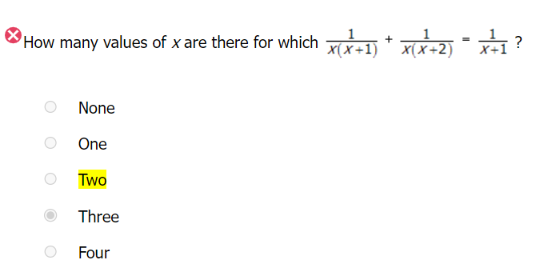
How many values of x are there for which \(\frac{1}{x(x+1)} + \frac{1}{x(x+2)} = \frac{1}{(x+1)}\)

A. None
B. One
C. Two
D. Three
E. Four
Attachment:
prep.png
User avatar
chetan2u
User avatar
GMAT Expert
Joined: 02 Aug 2009
Last visit: 05 Sep 2026
Posts: 11,288
Own Kudos:
Given Kudos: 339
Status:Math and DI Expert
Location: India
Concentration: Human Resources, General Management
GMAT Focus 1: 735 Q90 V89 DI81
Products:
Expert
Expert reply
GMAT Focus 1: 735 Q90 V89 DI81
Posts: 11,288
Kudos: 46,099
Kudos
Add Kudos
Bookmarks
Bookmark this Post
SwethaReddyL
Bunuel / KarishmaB can you please tell me if the below approach is right?
I solved it this way,

i took the lcm after that,

x+2+x+1 (x+1) = x(x+1)(x+2)
2x+3(x+1) = x(x+1)(x+2)
5x+3 = 3 consecutive numbers


if i substitute values for x, the 3 consecutive numbers should be divisible by 3!, which is 6
by doing so, i get 2 values x = 5, 9
so i picked 2
but thinking of post 10, there are values divisible by 6 if substitute for x

help please

Two points..

1)
x+2+x+1 (x+1) = x(x+1)(x+2)

How did you simplify the LHS of equation to get 2x+3(x+1)

2x+3(x+1) = x(x+1)(x+2)

2) x can be any real number, need not be integers.
So x(x+1)(x+2) need not be product of three consecutive numbers..
It could be 2.5x3.5x4.5
User avatar
egmat
User avatar
e-GMAT Representative
Joined: 02 Nov 2011
Last visit: 05 Sep 2026
Posts: 6,291
Own Kudos:
33,901
 [1]
Given Kudos: 716
GMAT Date: 08-19-2020
Expert
Expert reply
Active GMAT Club Expert! Tag them with @ followed by their username for a faster response.
Posts: 6,291
Kudos: 33,901
 [1]
1
Kudos
Add Kudos
Bookmarks
Bookmark this Post
Hi SwethaReddyL,

You landed on the right count (2), but the route you took isn't valid, and it's worth seeing why so it doesn't backfire on a similar question.

Let me start where your setup goes off track. Look at the clean version gmatophobia and chetan2u posted. Taking x(x+1)(x+2) as the common denominator:

- Left numerator: (x+2) + (x+1) = 2x+3
- Right side, 1/(x+1), written over the same denominator, has numerator x(x+2)

So the whole thing collapses to:

2x + 3 = x(x+2) - 2x+3 = x2+2x - x2 = 3 - x = ±√3.

In your work you wrote 2x+3(x+1) = x(x+1)(x+2) and kept the equation as a cubic (a product of three consecutive terms). That happened because the common (x+1) factor was never cancelled - it got dragged into both sides. Once you cancel it correctly, you're left with a simple quadratic, not a cubic.

The bigger issue is the divisibility step.

This equation never says x is an integer. There's no rule forcing x(x+1)(x+2) to be "3 consecutive numbers divisible by 6" - that's a number-property fact about integers, and it simply doesn't apply to an equation you're solving for any real x. The true solutions here, ±√3, aren't integers at all. Your x = 5 and x = 9 don't actually satisfy the original equation - check x=5: the left side is tiny fractions that can't equal 1/6. Getting "two" was a coincidence.

The takeaway: solve these by simplifying and taking roots, never by hunting for integers that make a product divisible by something. Equations give you roots through algebra - and those roots are allowed to be irrational.

Answer: C

SwethaReddyL
Bunuel / KarishmaB can you please tell me if the below approach is right?
I solved it this way,

i took the lcm after that,

x+2+x+1 (x+1) = x(x+1)(x+2)
2x+3(x+1) = x(x+1)(x+2)
5x+3 = 3 consecutive numbers


if i substitute values for x, the 3 consecutive numbers should be divisible by 3!, which is 6
by doing so, i get 2 values x = 5, 9
so i picked 2
but thinking of post 10, there are values divisible by 6 if substitute for x

help please

User avatar
SwethaReddyL
Joined: 28 Nov 2023
Last visit: 04 Sep 2026
Posts: 186
Own Kudos:
Given Kudos: 271
Location: India
Posts: 186
Kudos: 37
Kudos
Add Kudos
Bookmarks
Bookmark this Post
thanks much team. I get it now.
if i would've solved it like how you did, i am not sure if i would've included negative root. that is something i am still not clear about. isn't negative roots not considered in gmat?
egmat
Hi SwethaReddyL,

You landed on the right count (2), but the route you took isn't valid, and it's worth seeing why so it doesn't backfire on a similar question.

Let me start where your setup goes off track. Look at the clean version gmatophobia and chetan2u posted. Taking x(x+1)(x+2) as the common denominator:

- Left numerator: (x+2) + (x+1) = 2x+3
- Right side, 1/(x+1), written over the same denominator, has numerator x(x+2)

So the whole thing collapses to:

2x + 3 = x(x+2) - 2x+3 = x2+2x - x2 = 3 - x = ±√3.

In your work you wrote 2x+3(x+1) = x(x+1)(x+2) and kept the equation as a cubic (a product of three consecutive terms). That happened because the common (x+1) factor was never cancelled - it got dragged into both sides. Once you cancel it correctly, you're left with a simple quadratic, not a cubic.

The bigger issue is the divisibility step.

This equation never says x is an integer. There's no rule forcing x(x+1)(x+2) to be "3 consecutive numbers divisible by 6" - that's a number-property fact about integers, and it simply doesn't apply to an equation you're solving for any real x. The true solutions here, ±√3, aren't integers at all. Your x = 5 and x = 9 don't actually satisfy the original equation - check x=5: the left side is tiny fractions that can't equal 1/6. Getting "two" was a coincidence.

The takeaway: solve these by simplifying and taking roots, never by hunting for integers that make a product divisible by something. Equations give you roots through algebra - and those roots are allowed to be irrational.

Answer: C


User avatar
KarishmaB
Joined: 16 Oct 2010
Last visit: 05 Sep 2026
Posts: 16,645
Own Kudos:
81,195
 [1]
Given Kudos: 491
Location: Pune, India
Expert
Expert reply
Active GMAT Club Expert! Tag them with @ followed by their username for a faster response.
Posts: 16,645
Kudos: 81,195
 [1]
1
Kudos
Add Kudos
Bookmarks
Bookmark this Post
edwin.que
How many values of x are there for which \(\frac{1}{x(x+1)} + \frac{1}{x(x+2)} = \frac{1}{(x+1)}\)

A. None
B. One
C. Two
D. Three
E. Four

Attachment:
prep.png

\(\frac{1}{x(x+1)} + \frac{1}{x(x+2)} = \frac{1}{(x+1)}\)

\(\frac{1}{(x+1)} + \frac{1}{(x+2)} = \frac{x}{(x+1)}\)

\(\frac{1}{(x+2)} = \frac{(x-1)}{(x+1)}\)

\(x + 1 = (x+2)(x-1)\)

\(x^2 = 3\)

\(x = \sqrt{3}\) or \(- \sqrt{3}\)

Answer (C)
User avatar
Usernamevisible
Joined: 09 Jun 2022
Last visit: 06 Sep 2026
Posts: 480
Own Kudos:
Given Kudos: 1,282
Products:
Posts: 480
Kudos: 111
Kudos
Add Kudos
Bookmarks
Bookmark this Post
Think:

"Multiply both sides by the LCM."

It takes about 20 seconds:

LCM: x(x+1)(x+2)
Cancel each denominator.
Solve the resulting quadratic.
Check excluded values.

This is the standard approach for rational equations.
Moderator:
Math Expert
113157 posts