|
|

GMAT Club Daily Prep
Thank you for using the timer - this advanced tool can estimate your performance and suggest more practice questions. We have subscribed you to Daily Prep Questions via email.
Customized
for You
Track
Your Progress
Practice
Pays
Not interested in getting valuable practice questions and articles delivered to your email? No problem, unsubscribe here.


E
Be sure to select an answer first to save it in the Error Log before revealing the correct answer (OA)!
Difficulty:
 25%
(medium)
25%
(medium)
Question Stats:
75% (01:38) correct 25%
(01:46)
wrong
based on 4740
sessions
25%
(01:46)
wrong
based on 4740
sessions
History
Date
Time
Result
Not Attempted Yet
When drafting the Declaration of Sentiments that was adopted at the Seneca Falls Women’s Rights Conventions in 1848, included in it by the author, Elizabeth Cady Stanton, was a call for female enfranchisement.
(A) When drafting the Declaration of Sentiments that was adopted at the Seneca Falls Women’s Rights Conventions in 1848, included in it by the author, Elizabeth Cady Stanton, was a call for female enfranchisement.
(B) Including a call for female enfranchisement, a draft of the Declaration of Sentiments was adopted at the Seneca Falls Women’s Rights Convention in 1848 that Elizabeth Cady Stanton wrote.
(C) When the Declaration of Sentiments drafted by Elizabeth Cady Stanton was adopted at the Seneca Falls Women’s Rights Convention in 1848, a call for female enfranchisement had been included in it .
(D) A call for female enfranchisement, included in Elizabeth Cady Stanton’s draft of the Declaration of Sentiments in 1848, that was adopted by the Seneca Falls Women’s Rights Convention.
(E) When Elizabeth Cady Stanton drafted the Declaration of Sentiments that was adopted at the Seneca Falls Women’s Rights Convention in 1848, she included in it a call for female enfranchisement.
Source : GMATPREP Default Exam Pack
(A) When drafting the Declaration of Sentiments that was adopted at the Seneca Falls Women’s Rights Conventions in 1848, included in it by the author, Elizabeth Cady Stanton, was a call for female enfranchisement.
(B) Including a call for female enfranchisement, a draft of the Declaration of Sentiments was adopted at the Seneca Falls Women’s Rights Convention in 1848 that Elizabeth Cady Stanton wrote.
(C) When the Declaration of Sentiments drafted by Elizabeth Cady Stanton was adopted at the Seneca Falls Women’s Rights Convention in 1848, a call for female enfranchisement had been included in it .
(D) A call for female enfranchisement, included in Elizabeth Cady Stanton’s draft of the Declaration of Sentiments in 1848, that was adopted by the Seneca Falls Women’s Rights Convention.
(E) When Elizabeth Cady Stanton drafted the Declaration of Sentiments that was adopted at the Seneca Falls Women’s Rights Convention in 1848, she included in it a call for female enfranchisement.
Source : GMATPREP Default Exam Pack
If this question felt shaky,
try an adaptive mini quiz of similar problems in
GMAT Club Forum Quiz →. Free plan gives 5 questions per day.


 21 Aug 2017, 11:51
Kudos
Bookmarks
I’m not sure why, but this question seems to punk my students fairly often. So if you struggled with it, you’re not alone!
I like the modifiers in this one, but the verb tenses don’t quite work. The word “when” suggests that two actions happened at the same time, but that’s not reflected in the verb tenses: “When the Declaration of Sentiments… was adopted…, a call for female enfranchisement had been included in it.” That doesn’t make sense: if we’re using “when”, the tenses would have to be the same. Eliminate (C).
Quote:
This is a little bit tricky to spot, but “drafting” is an “-ing” modifier, and it needs to make sense with the subject that follows. But we never really get a subject that makes sense: the main clause is just “included in it by the author… was a call for female enfranchisement.” Elizabeth Cady Stanton is basically just a modifier here, but the sentence would only work if she’s the subject. (A) is out.
Quote:
I’m not crazy about the “including a call for female enfranchisement” at the beginning, since that phrase would suggest that we’re introducing some sort of example, and that doesn’t make sense. But the much, much bigger issue is the phrase “that Elizabeth Cady Stanton wrote.” It looks like it’s modifying the convention, and that doesn’t make sense. (More on “that” modifiers in this article.) (B) is gone.
Quote:
I like the modifiers in this one, but the verb tenses don’t quite work. The word “when” suggests that two actions happened at the same time, but that’s not reflected in the verb tenses: “When the Declaration of Sentiments… was adopted…, a call for female enfranchisement had been included in it.” That doesn’t make sense: if we’re using “when”, the tenses would have to be the same. Eliminate (C).
Quote:
This isn’t even a sentence. To have a sentence, we need an independent clause, with subject and a main verb. The structure here is “Noun, modifier, modifier.” The subject, “a call for female enfranchisement” is never actually paired with a verb. (D) fails.
Quote:
No problems here! The sentence starts with “when”, and the verb tenses are nice and consistent: all simple past, throughout the whole thing. The modifier beginning with “that” correctly modifies the Declaration of Sentiments. (E) is our winner.
 25 Feb 2013, 09:16
Kudos
Bookmarks
Best Practice 2 – Communicate “All” Aspects of Meaning of Original Choice
Continuing our “Best Practices for SC” series, this week I will present a very vital best practice – Always make sure that the correct choice communicates “all” logical information presented by the original choice.
Before I begin, I want to make sure that the readers of this article recognize the importance of understanding meaning of the original sentence. If you have any doubts regarding this aspect, then I suggest you view this session in which I go over this most important aspect of Sentence Correction section.
Coming back to this article - in this article we will take a look at an official question and see how the test makers may create an incorrect answer choice by removing key piece of information that the author wants to communicate. And how do you know what it is that the author wants to communicate – you read and comprehend the original choice. So apart from checking for logical meaning and grammatical correctness, you must also ensure that all the logical information present in the original choice is communicated by the correct answer. So let’s read on

Quote:
STEP 1 - UNDERSTAND THE MEANING OF CHOICE A
The first thing I will do is read the entire sentence slowly to grasp the intent of the author. After all I need to first understand what the author is trying to tell me through this sentence.
When drafting the Declaration of Sentiments that was adopted at the Seneca Falls Women’s Rights Conventions in 1848, included in it by the author, Elizabeth Cady Stanton, was a call for female enfranchisement.
• When drafting the Declaration of Sentiments – Ok the author wants to tell me something about that someone who drafted the DoS.
• I read along – that was adopted at the Seneca Falls Women’s Right Convention in 1848. Ok. So the DoS was adopted at this specific convention in the year 1848.
• Reading along, I see – included in it by the author, Elizabeth Cady Stanton – the author of this DoS is Elizabeth. And she included something in this DoS.
• was a call for female enfranchisement – So she included this call for female enfranchisement in the DoS.
So if I were to put the entire sentence together in my mind, I would say that the sentence talks about a document called Declaration of Sentiments (DoS). There is information about when it was adopted, where it was adopted, and who wrote it. We also know that when the author drafted this document, she included in it a call for female enfranchisement.
With this understanding we will now review the sentence once again but this time we will be looking specifically for grammatical errors.
STEP 2 – IDENTIFY THE ERRORS IN CHOICE A
When drafting the Declaration of Sentiments that was adopted at the Seneca Falls Women’s Rights Conventions in 1848, included in it by the author, Elizabeth Cady Stanton, was a call for female enfranchisement.
This sentence begins with an expression “when drafting DoS”. This expression appears to talk about the person who drafted the DoS. We know this is Elizabeth. So this expression logically modifies Elizabeth. But grammatically Elizabeth is not placed close to this modifier for this modification to take place. Thus, this sentence has modifier error.
Other than the modifier error, the sentence is written in grammatically correct form, and as we discussed earlier, it presents logical information.
Now with this understanding of meaning and errors in the original sentence, we will review the answer choices one by one and find the correct answer.
STEP 3 – FIND THE CORRECT CHOICE FROM THE ANSWER CHOICES
• Choice B: Including a call for female enfranchisement, a draft of the Declaration of Sentiments was adopted at the Seneca Falls Women’s Rights Conventions in 1848 that Elizabeth Cady Stanton wrote.
This choice is incorrect. Why? Notice the opening modifier “including a call for…” It non-sensically modifies “a draft”. Clearly the draft did not include this mentioned call. Furthermore, notice the modified entity of modifier “that Elizabeth Cady Stanton wrote” is not clear. It is not at all clear what this modifier modifies. In other words we know that this should modify the DoS, but it is placed next to 1848, illogically modifying this closest noun.
Now let’s move to choice C.
• Choice C: When the Declaration of Sentiments drafted by Elizabeth Cady Stanton was adopted at the Seneca Falls Women’s Rights Convention in 1848, a call for female enfranchisement had been included in it.
After first read, I can see that this choice corrects the modifier error in choice A. But when I read this choice again, I find that it misses to mention one very important point. Who included the call in the DoS? Notice how the verb “had been included” is now written in passive voice and the person who did this action is no longer mentioned explicitly in this choice. So for all we know, someone other than Elizabeth may have included this “call”. May be Elizabeth drafted the DoS, had it reviewed by someone, and this person included this call in it and then later this DoS was adopted at the convention. So this choice is wrong because it does not convey the complete meaning as communicated by the original sentence – more specifically it does not state that Elizabeth included the call. So it is very important to read and comprehend the entire sentence before moving to the answer choices. Otherwise, there is a high likelihood of marking the first seemingly ‘correct’ answer choice.
Now let’s look at choice D.
• Choice D: A call for female enfranchisement, included in Elizabeth Cady Stanton’s draft of the Declaration of Sentiments in 1848, that was adopted by the Seneca Falls Women’s Rights Convention.
This choice is incorrect because there is no main verb in the sentence. The subject “call” does not have any verb. This brings us to choice E, which better be written correctly since we have rejected all other choices
• Choice E: When Elizabeth Cady Stanton drafted the Declaration of Sentiments that was adopted at the Seneca Falls Women’s Rights Convention in 1848, she included in it a call for female enfranchisement.
This choice is absolutely correct. It is written in grammatically correct form and includes all pertinent information as intended by the author of choice A. Notice how the sentence explicitly mentions that Elizabeth included the call in the DoS.
So Choice E is the correct answer. Now let’s take a look at the key takeaways from this official question.

Here are the key things to keep in mind when you solve SC questions.
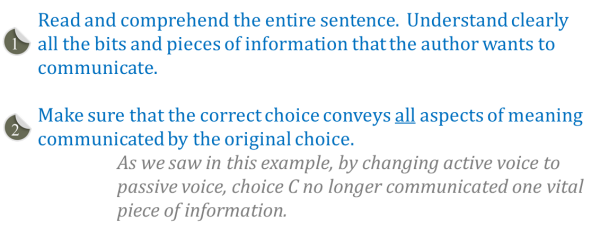
In fact “changing the voice” is one of the strategies used by the test makers to change the meaning of the sentence. For more information, read Strategy # 4 in the article that covers 5 strategies GMAC uses to change meaning of the sentence.
Now you are ready to apply your skills on the following exercise question. Keep in mind the takeaways as you answer this question. Good luck
EXERCISE QUESTION
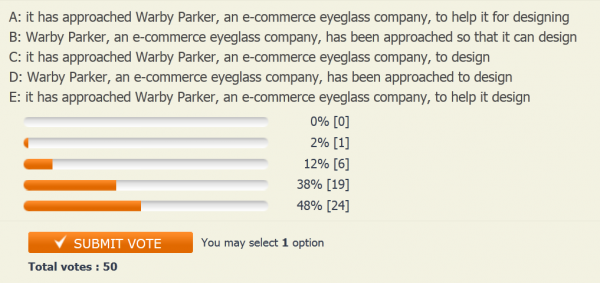
Although Google has launched ‘unchic’ glasses with a computer processor, a battery, and a tiny screen to provide Internet access through wearable technology, it has approached Warby Parker, an e-commerce eyeglass company, to help it for designing more fashionable frames.
A. it has approached Warby Parker, an e-commerce eyeglass company, to help it for designing
B. Warby Parker, an e-commerce eyeglass company, has been approached so that it can design
C. it has approached Warby Parker, an e-commerce eyeglass company, to design
D. Warby Parker, an e-commerce eyeglass company, has been approached to design
E. it has approached Warby Parker, an e-commerce eyeglass company, to help it design