Events & Promotions
|
|

GMAT Club Daily Prep
Thank you for using the timer - this advanced tool can estimate your performance and suggest more practice questions. We have subscribed you to Daily Prep Questions via email.
Customized
for You
Track
Your Progress
Practice
Pays
Not interested in getting valuable practice questions and articles delivered to your email? No problem, unsubscribe here.
 Sep 02
01:00 PM EDT
-11:59 PM EDT
Take 30% off all study plans with code COURSEWORK - Expires on Monday 9/7 Sep 04
10:00 AM EDT
-11:59 PM EDT
We’ve worked incredibly hard to build TTP into the best test prep experience possible, and it would mean a lot to us to win Newsweek’s 2026 Readers’ Choice Award for Best Test Prep. If TTP has helped you, we’d be incredibly grateful for your vote. Sep 06
09:30 AM EDT
-12:30 PM EST
Top scores are possible when you enroll in a powerful EA course, taught live online + 6 months access to TTP OnDemand video courses included! Perfect class schedule and easy course access for working professionals. Class starts Sundays Sept. 6, 2026. Sep 07
12:01 AM PDT
-11:59 PM PDT
On the 7th, GMAT Club Tests will be Free! Including all the Quizzes, Questions, and Tests. 12 AM - 11:59 PM PDT- Sep 07
10:00 AM PDT
-11:00 AM PDT
A complete walkthrough of GMAT Club’s free 12-week GMAT study plan: what you study each week, how progress and goals are tracked, how the error log works, and how your practice unlocks paid tools at no cost. - Sep 09
07:00 AM PDT
-10:00 AM PDT
Meet AdComs and explore top Master’s programs - MiM, MiF, MSc, MSBA and more. - Application Fee Waivers - Free 1-Week of GMAT Club Tests: - Master's Application Toolkit - Grand Prize Giveaway - Sep 09
10:00 AM PDT
-11:00 AM PDT
Three MBA applications. Three rejections. No interview invites. A year later, Aman was admitted to Cambridge Judge, SMU, and IMD. In this episode of MBA Admit Stories, Aman shares how he rebuilt his MBA application...  Sep 15
07:00 PM EDT
-09:00 PM EST
Elite scores are possible when you enroll in a powerful GMAT course, taught live online + 6 months access to TTP OnDemand video courses included! Class starts Tues/Thurs Sept. 15, 2026 - Nov. 15, 2027, 7:00pm-9:00pm EST Sep 21
08:00 PM EDT
-10:00 PM EDT
Boost your GMAT score in less than one month in a live online class + 6 months access to TTP OnDemand video courses included! Class starts Mon, Tues, Wed, Thur, Fri Sept. 21, 2026 - Oct. 9, 2027, 7:00pm-10:00pm EST

souvik101990
 Expert
Alum
Joined: 19 Mar 2012
Last visit: 15 Aug 2026
Posts: 4,309
Given Kudos: 2,326
Location: United States (WA)
Concentration: Leadership, General Management
Schools: Ross '20 (M)
GMAT 1: 760 Q50 V42
GMAT 2: 740 Q49 V42 (Online)
GMAT 3: 760 Q50 V42 (Online)
GPA: 3.8
WE:Marketing (Non-Profit and Government)
Products:
Expert reply
 24 Apr 2018, 07:04
Kudos
Bookmarks
5 Things I Learned Taking The New GMAT!
Just when I thought I was done with the GMAT, GMAC decided to change the test quite considerably. 30 mins shorter? Take my money, I thought to myself. While subjecting to the test again seemed like an ordeal that I wasn't quite ready for, but when bb asked me to take it and see how it feels, I decided to give it a shot. I took the test completely cold, meaning no preparation and no special routines. Just went to the centre and took it. My previous score was 760, and this time I came 10 points too close. One point in verbal which was waived off that I totally attribute to my nemesis - Reading Comprehension. So I sat on my experience, and ruminated on ways of writing this debrief. It was weird because, to be honest, it was a very similar experience. But at the same time, I saw a flock of very nervous folks figuring whether it is a good thing or a bad thing that the GMAT is shorter, and I wanted to help get some of us a reasonable resolve. So here goes!
1. Being great at SC is not going to help as much!
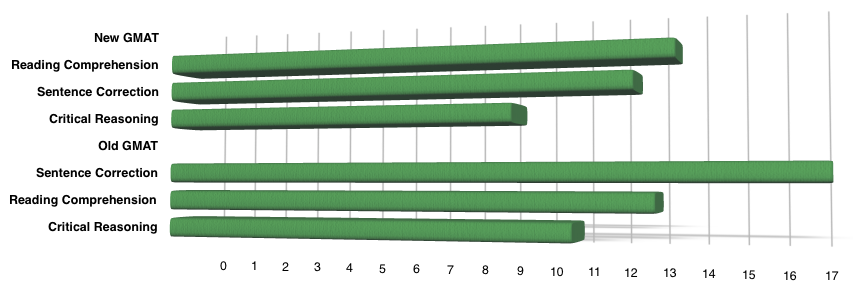
Sentence correction has always been my strong point. I used to be fairly effortless in my SC prep, and because I like structure and rules, I had a reasonably easy time in getting them right. I have gotten 760 twice and both times I scored a 98 percentile in SC. I am decent at CR and generally it is the tedious reading comprehension that takes away my focus, time, and my coveted V45
 . In the previous version of the GMAT, you could reasonably say that 15-16 questions on the test were going to be those of Sentence Correction. That makes SC the most important section (okay I might be assuming a few things here, but on the basis of pure numbers, you are playing at good odds with that inference). But now SC barely covers a third of the test. In my test, I do not think I saw more than 10 SC questions. That means SC went from being 40% of the verbal section to 27%. Aww man! That is a 32% drop. So you could, reasonably, make a case that the importance of sentence correction has dropped by a third. That is not great for people like me, and I suspect, other non-natives who generally find SC to be the easiest section to improve upon. Sigh.
 2. RC is the most important section on the GMAT verbal
On the flipside of the SC situation, RC seems to have filled up the void independently. I saw 4 RC passages. One of them was a giant. I was actually happy when I saw the size of the passage because I had this weird idea that long-ish passages tend to be straightforward. To my dismay it was about as dense as my almond flour mug bread
It came with five questions. YES, FIVE! By the end of that RC, I was exhausted, out of time, and could see my V45 slipping away from me. Anyway, going away from weird food analogies, I could potentially see 14-15 RC questions on the test. Even if you take an average of 3-4 questions per passage, it could easily be 16 questions. That keeps RC at almost the same level as last year, but because the overall verbal test is shorter, RC dominates the test. This means that you better sharpen those RC skills if that's something that you have identified as a weak area. 3. Quant is as consistent as it was
Sure the quant section is shorter by 6 questions, but I really do not think it makes a difference. I scored a Q50 in all the three tests that I took within a year. I have made, at least, 2 mistakes, and most 4 mistakes to get to the Q50. In the last test, I made 3 mistakes. Overall, the quant section did feel easier than usual. I generally have had 2-3 questions where I would be stumped for a while and at least one question where I would have to guess and move on. This time, it felt weirdly simple. I don't exactly know if it was because I was testing at near-zero stress or it was just a random mindset thing. The quant section did not feel different. I thought having fewer question would help my stamina, but clearly, I have done better with 37 questions, though statistically, I do not think it makes any difference.
4. Do not bother with experimental questions and mass-hysteria
If you are about to take the GMAT, I would recommend avoiding the thread on recent changes in the GMAT on the forum. While it is fun speculating exactly how many experimental questions there are, how important it is to guess how the GMAT is psychoanalyzing you and whether the NSA is involved. I think it is a pretty useless train of thought, which should only be reserved for folks who are done with the test. One of the most important piece of advice I got before my first 760 test was from bb. It was about taking one question at a time, and not thinking about how you are doing in the test. I think it is crucial, as big picture thinking while taking the GMAT will definitely deter you from actually doing better in the test. I agree that it is very hard to not freak out when you get a question on quant which just needs the expansion of (a+b) squared (I had that in my exam in Q19 - man I was scared!) and your brain may try to trick you into falling down a quicksand of self-deprecation. I would recommend actively fighting against it.
Think about it this way. If you accurately knew how many experimental questions there will be on the test, would that information really help you? Would you, at any point, even remotely guess whether the question in front of you is scored or not? NO. So, who cares? Focus your energy on solving the question, and if you are not progressing with the question, move the hell on.
5. The AWA-IR section is unchanged
Well, if you did not know that, what are you doing here? Do your research!
Final Takeaways
I think the GMAT is the most standardized test in the world. They spend thousands of dollars for each question and GMAC execs are one of the most highest paid nonprofit execs in the world. They would not roll out a new format of the test unless they were absolutely certain that it would put no statistically significant advantage on the test takes. That defeats the purpose of standardisation. I witnessed a similar paranoia where GMAT enabled section-order and all of a sudden everybody was speculating about how it can change your game. Well, not really! If it did, they wouldn't make the change. My suspicion is that these changes are highly superficial which are built to entice more GMAT test takes (I guess they are approaching a flatline in the number of test takers) and curb the rising popularity of the GRE, which in my honest opinion, is not nearly as great a test as the GMAT. People often consider the GRE as a somewhat easier way out, and GMAC is trying to ease up on the rigor (at least cosmetically) to make it more appealing to test takers. I do think that the RC-SC switch is major and it might shave a few points off your verbal score, but I strongly believe that even that change would be well under the standard deviation of test scores.
What do you think? Are you planning to take the test anytime soon? I would be happy to take questions


mcelroytutoring
Expert
Tutor
Joined: 10 Jul 2015
Last visit: 20 Aug 2026
Posts: 1,206
Given Kudos: 282
Status:Expert GMAT, GRE, and LSAT Tutor / Coach
Affiliations: Harvard University, A.B. with honors in Government, 2002
Location: United States (CO)
Age: 46 (11 years and counting on GMAT Club!)
GMAT 1: 770 Q47 V48
GMAT 2: 730 Q44 V47
GMAT 3: 750 Q50 V42
GMAT 4: 730 Q48 V42 (Online)
GRE 1: Q168 V169
GRE 2: Q170 V170
Expert reply
Updated on: 24 Apr 2018, 23:23
Originally posted by mcelroytutoring on 24 Apr 2018, 07:15.
Last edited by mcelroytutoring on 24 Apr 2018, 23:23, edited 16 times in total.
Last edited by mcelroytutoring on 24 Apr 2018, 23:23, edited 16 times in total.
Kudos
Bookmarks
Thanks again for the contribution, souvik101990. I agree that it doesn't make any sense for test-takers to worry about the number of experimentals on the new GMAT, especially that the number of experimentals has now been reduced by almost 50%.
In other words, unless you want to gamble with your GMAT score, it's not wise to try to guess which questions are experimentals.
However, when a high-scoring GMAT student such as yourself encounters a very easy question toward the middle/end of the test, it is likely that you have been served an experimental question, since the difficulty level of experimental questions is set in advance of the test.
-Brian
p.s. You mentioned getting 4 wrong on Quant for a Q50/51. How many questions did you answer correctly/incorrectly on Verbal for a V41? Would you mind sharing your ESR?
In other words, unless you want to gamble with your GMAT score, it's not wise to try to guess which questions are experimentals.
However, when a high-scoring GMAT student such as yourself encounters a very easy question toward the middle/end of the test, it is likely that you have been served an experimental question, since the difficulty level of experimental questions is set in advance of the test.
-Brian
p.s. You mentioned getting 4 wrong on Quant for a Q50/51. How many questions did you answer correctly/incorrectly on Verbal for a V41? Would you mind sharing your ESR?
 24 Apr 2018, 07:26
Kudos
Bookmarks