Last visit was: 03 May 2026, 19:05 It is currently 03 May 2026, 19:05
Close
GMAT Club Daily Prep
Thank you for using the timer - this advanced tool can estimate your performance and suggest more practice questions. We have subscribed you to Daily Prep Questions via email.

Customized
for You

we will pick new questions that match your level based on your Timer History

Track
Your Progress

every week, we’ll send you an estimated GMAT score based on your performance

Practice
Pays

we will pick new questions that match your level based on your Timer History
Not interested in getting valuable practice questions and articles delivered to your email? No problem, unsubscribe here.
Close
Request Expert Reply
Confirm Cancel
User avatar
Accepted.com
User avatar
Major Poster
Joined: 20 Apr 2003
Last visit: 18 Dec 2022
Posts: 6,466
Own Kudos:
859
 [1]
Given Kudos: 92
Location: Los Angeles CA
Posts: 6,466
Kudos: 859
 [1]
Kudos
Add Kudos
1
Bookmarks
Bookmark this Post
User avatar
Accepted.com
User avatar
Major Poster
Joined: 20 Apr 2003
Last visit: 18 Dec 2022
Posts: 6,466
Own Kudos:
Given Kudos: 92
Location: Los Angeles CA
Posts: 6,466
Kudos: 859
Kudos
Add Kudos
Bookmarks
Bookmark this Post
User avatar
Accepted.com
User avatar
Major Poster
Joined: 20 Apr 2003
Last visit: 18 Dec 2022
Posts: 6,466
Own Kudos:
Given Kudos: 92
Location: Los Angeles CA
Posts: 6,466
Kudos: 859
Kudos
Add Kudos
Bookmarks
Bookmark this Post
User avatar
Accepted.com
User avatar
Major Poster
Joined: 20 Apr 2003
Last visit: 18 Dec 2022
Posts: 6,466
Own Kudos:
Given Kudos: 92
Location: Los Angeles CA
Posts: 6,466
Kudos: 859
Kudos
Add Kudos
Bookmarks
Bookmark this Post
FROM Accepted.com Blog: A Secret Weapon for 2021 MBA Applicants


Our free webinar, 7 Steps to MBA Acceptance in 2021, is airing live soon, but you still have time to register!

If you’re planning to apply to b-school next fall or winter, what you’re doing now has a huge bearing on how successful you’ll be. As Benjamin Franklin once said, “Don’t put off until tomorrow what you can do today.” Not only will putting in some planning time now reduce your stress when the applications land, but it will increase your chances of getting into a top program!

Accepted founder Linda Abraham will share knowledge gained from 25+ years of experience in MBA admissions with you, and you’ll walk away with a detailed plan for putting together a flawless application. Spots are filling up quickly, so register now!

Reserve your seat now


For 25 years, Accepted has helped business school applicants gain acceptance to top programs. Our outstanding team of MBA admissions consultants features former business school admissions directors and professional writers who have guided our clients to admission at top MBA, EMBA, and other graduate business programs worldwide including Harvard, Stanford, Wharton, Booth, INSEAD, London Business School, and many more. Want an MBA admissions expert to help you get Accepted? Click here to get in touch!

Tags: MBA Admissions

The post A Secret Weapon for 2021 MBA Applicants appeared first on Accepted Admissions Blog.
This Blog post was imported into the forum automatically. We hope you found it helpful. Please use the Kudos button if you did, or please PM/DM me if you found it disruptive and I will take care of it. -BB
User avatar
Accepted.com
User avatar
Major Poster
Joined: 20 Apr 2003
Last visit: 18 Dec 2022
Posts: 6,466
Own Kudos:
Given Kudos: 92
Location: Los Angeles CA
Posts: 6,466
Kudos: 859
Kudos
Add Kudos
Bookmarks
Bookmark this Post
FROM Accepted.com Blog: Wake up to Your Amazing Career Possibilities


Woken awakes you to meaningful career opportunities [Show summary]

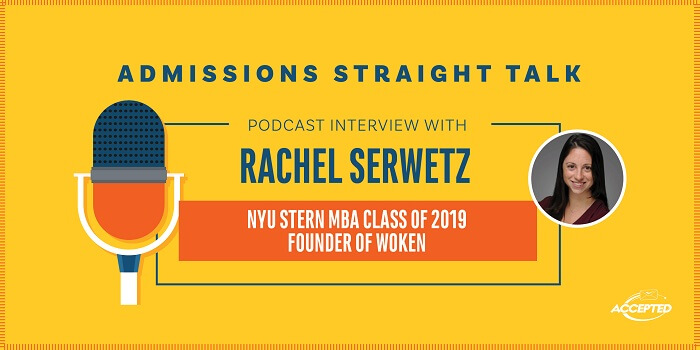
Are you wondering what your career path should be? How to create it? Our guest today is an NYU Stern MBA and associate-certified coach who is also providing assistance with career services at Columbia Business School. In addition, she is the founder and CEO of Woken, an online platform to help you discover and pursue a career you will love. Let’s learn her story and see how this interview will help you find that amazing career.

Interview with Rachel Serwetz, NYU Stern Tech MBA grad and Founder & CEO of Woken [Show notes]

Our guest today, Rachel Serwetz, graduated from Binghamton University after majoring in human development and minoring in Spanish, management, and global studies. She then worked for Goldman Sachs for three years, followed by shorter stints at other companies, and earned her MBA at NYU Stern in technology in 2019. She also founded Woken, way back in May, 2013, and has served as its CEO ever since. 

Let’s talk a little bit about your background. Where did you grow up? What do you like to do for fun? Things like that. [3:35]

I grew up in Long Island, New York, in Hewlett, a very exciting place. I’ve got a few jobs at the moment, so with my limited time outside of work, honestly I wish it was more exciting, but I try to just really hang out with family and friends, work out when I can, explore the city, travel. I wish there were times that I could fit in some more interesting hobbies, but work has sort of taken over this.

Let’s go back a little bit to your time at Goldman Sachs. Were you in a HR role there? Obviously that’s your focus now, but did you start out in HR? Were you an investment banker at Goldman Sachs? What were you doing there? [4:10]

So that was my first job, and I was in operations. I did cash management, I was part of the treasury and the liquidity team. And that doesn’t have much to do with what I do now. And it wasn’t really what I necessarily had an interest in, but when I started, I knew I liked the idea of operations. In hindsight, I think I probably should have gone more for those HR-type teams and path. But at the time I didn’t really know that that was right for me. So I was able to land in operations, and it was a really good experience, but I was lucky at that point to take on projects that ended up relating to HR.

But I took on those projects just because I found them interesting, I wanted to help our teammates develop skills, and to coach them and to help with recruiting, and so I just dove into things that seemed interesting to me. And then after a few years of doing that, I realized I was ready for the next thing, and I realized that a lot of what I had been doing was in the HR realm. And so I was lucky to be able to pivot more closely into that world after I left Goldman.

Did you go back to NYU Stern for your MBA to get specifically more training in, let’s say, career services and HR, or was there another goal? And if you were so interested in HR, why did you go for the one-year tech degree? HR isn’t known as the most techie of fields. [5:37]

There are a few answers to this. First and foremost, I always knew I wanted an MBA. I actually took my GMAT at my senior year of college. I wasn’t a business major; I just had this intuition that I really just wanted more education, and I had a strong interest in business. I didn’t really know where it would lead, or where I’d be at the time of getting that degree, but I just really knew there was more for me, and I knew I had that business orientation, even though it didn’t end up being my major. So I knew from early on that I wanted that experience.

Once I had ended up working more in HR, and learning about coaching and developing that, that’s when I started really getting interested in the problems I was helping people with when I was coaching. I was helping with career exploration, and I started to get interested in, how can I assist them at size and scale, and create products out of what I was doing. And that’s when I started to say, “Okay, I can combine my interests in coaching and career exploration with products and technology, creating a business concept out of that.” I had known I wanted the MBA, but then I found the tech MBA program, and it just seemed like this perfect mix of everything I wanted.

Linda: Are you, on some level, taking an operations approach to career management?

Yes. So it’s funny because, when I was at Bridgewater, they use a lot of digital tools to systematize people-oriented processes. Over there, it’s very much focused on feedback. But when I was there, I saw how they use tools to think about people processes, and that’s when my wheels started turning, because I’ve been helping people with career exploration ever since I graduated. So once I saw the problems people were facing, and then I saw how technology can really support people-oriented processes, I just started to explore, how can I systematize a process that I’m guiding people through manually, in a way that they can feel empowered to take these steps in their career on their own. So it’s a coaching perspective. It’s a coaching approach, by leveraging technology to facilitate a process for the individual.

The tech MBA that you did it at NYU Stern is a one-year program. Are you happy you had this tech focus, and did the one-year timeframe seem very pressurized? Did you have any second thoughts about pursuing the one-year as opposed to the two-year program? [8:29]

Am I happy I did this tech program? Yes. I think tech is the way of the future for every company. I think almost every company is becoming a tech company, whether they want to or not. And so, to me, it just felt like learning about the future of business, no matter what. I felt that was great, especially for me trying to build a tech business. So I was really happy to leverage that program.

NYU Stern: An Insider’s Perspective on Getting Accepted [Episode 340]

Thinking back to the one-year versus the two-year, of course there was pressure, but what’s funny is that I came out of that one-year with this new mindset of, you have to make the most of every single day, because we were jam-packing two years of value into one year’s time. So now I’ve got this amazing mindset of, live your life every day.

Yes, there was pressure to get so much done. I don’t regret it. I was able to save a little money on the time, and I think I got a lot out of it. You never know what would have happened with the second year. There’s so much that probably could have and would have happened, but I think I had an amazing MBA experience. I loved my cohort and yeah, I don’t have any regrets.

Do you remember anything particularly challenging about the MBA application process itself? What was the hardest part for you? [10:00]

It’s funny, even the undergrad application process was stressful for me. The part that I think was just most stressful was just the administrative nature of it. Just getting it all done, and one application felt like so much work that I wish I could have applied some more places, but I was so exhausted by the process that I only really ended up applying to very, very few places.

It’s a lot to do. It’s overwhelming. What’s funny is the essay itself was less of what was overwhelming for me, because if I’m in the career clarity game, you would hope I have some myself, and I did, and I do. So that part wasn’t as hard, but it was just a lot. It’s overwhelming, they say the hardest part’s getting in, right?

MBA Application Timeline: How to Get Accepted in 2020

Right. On some level, that’s true. Did you just make a schedule for yourself, make a list? How did you handle the time demands or, what did you do? [11:00]

I actually did apply two years in a row to a few different schools, that’s number one. And I always remind people that that’s okay. And what else did I do? I had some schedules. I tried to organize myself. I leveraged Accepted and it was super, super helpful, especially on the essay help. And honestly I just did my best to get as few applications done as I could. I was just like, “Just get one done,” or, “Just get two done,” and manage through it.

What did you like most about your MBA experience in NYU Stern? [11:39]

The people I was with were just so amazing. We had this small cohort, as part of the one-year program, and somehow there was still such diversity within our group. It felt like we were each a piece of a puzzle and I was the token HR person in our class. It was just so amazing to come together with a group who had a similar mindset and interest in innovation and technology and business, but different experiences and backgrounds, and different mindsets, and different perspectives on various things. So to be aligned with a cohort in terms of why we were there, and being able to have just stimulating conversations about lots of topics, was what I was there for. And there was a culture about our class that was just truly amazing.

Linda: Could you describe the culture?

Yeah, I think our class was a down to earth group who was just genuinely and deeply interested in the future of business, and innovation, and society, and where tech plays in. Does it play in, what are the impacts, how do we go about this? What is it already doing, and what is it not doing? What should it do, and when and how and why? And just really questioning all those things. It was just our shared interest, and yet we approached it in different ways. There was different ways that that played out, different industries that we were interested in. And yet there was a shared common feeling of, let’s question this stuff, together, and how it impacts our future in business and society, and all this stuff. So being a part of that conversation for a year was really cool and really special. And there was just a genuine bond amongst everyone. We also got along super well and had a lot of fun, and traveled, and did so many fun things together and just got along really well. So that’s invaluable.

What would you like to have seen improved about your MBA experience? [13:37]

We were the first year of the tech MBA, so we were guinea pigs, and there were certain things, of course, that weren’t perfect, but we knew that going in. We were able to laugh at certain things, when it didn’t go perfectly well. It’s hard for a new program to figure out the best way of teaching business students about technology — that’s not easy with a mixed variety of skills within technology. So there were challenges that we all had to come together on. For me, I was starting a business. So how do you teach somebody about business, and yet how do you teach somebody how to start a business, run a business? That’s what I was there for, and that’s not easy to execute on.

I try to teach entrepreneurship now, to undergraduate students and it’s not easy to do, but it’s also not easy to teach. I tried to grasp as much as I could, and I’m still learning. There’s always things you look back and say, “All right, I wish I focused more on this. I wish I learned more about that.” But I think, for as much as I could have gotten out of the one year, I tried to get as most as humanly possible. I leveraged every entrepreneurship program at NYU. So I did my best to take advantage of everything I could.

Can you tell us about Woken? What is it? How does it work? We’ve skirted around the edges of that, but can you tell us? Dive in? [14:56]

Woken is a web-based career exploration platform. We help guide professionals through a step-by-step process to figure out which career path they actually want to pursue.

The steps are based in learning and reflection, and that’s an iterative process, and that really leads somebody to find clarity and confidence in which path is right for them, which path they’ll be happy in, which path suits them. Whatever phrase you want to use, but we just see so many young working professionals, sometimes mid-career professionals, who are in the wrong spot, they’re in the wrong role, the wrong company, the wrong industry, and sometimes so drastically far from where they know they should be, or could be, but they don’t know what they want, or how to figure out what they want.

We just try to make that process easy and manageable, and hopefully fun and enjoyable, and give you the tools and the process so you can reach that outcome of clarity.

How did you think of this idea? [16:05]

It’s been a long time coming, in the works, so to speak because ever since I graduated, well even before I graduated, I was actively trying to figure out how to figure out my own career. How to land the Goldman? I did a ton of networking to think about job search myself. And then once I landed there I was referred to tons of friends, and friends of friends, to help them with their career journeys.

So over the years I was seeing the problems people were facing, and I realized they were struggling with job search because they didn’t know what job they wanted. And when you’re asked for help over the years, you come up with solutions, you come up with frameworks, and you’ve come up with ways of helping people. I was naturally good at it, and that just spiraled, and it builds on itself over time.

So, that helped me develop some frameworks. And then I got coaching training, so I learned the fundamentals of how to really help somebody achieve goals. And then I started exploring, what could this look like as a web platform. And how could we give somebody a tool to guide them through this process. So, it just keeps growing and developing and enhancing itself over time. It’s just been organic.

So if I were a young professional, struggling to figure out what I want to do, and I can remember a time when that was exactly when I was, I was probably a senior in college, and I had decided I didn’t want to be a lawyer, but I didn’t know what I wanted to be, or what I wanted to do. What I should have been thinking about? If I went to Woken, what would I pay? What would I do? What would I find? I want to use it. [17:21]

Our first step is helping you commit to the process. How is this going to fit into your life? Because it does take time. And then we really start by reflecting on your interests. So we have an assessment. It really just helps you think about what it is that you love doing, what types of content you love, things like that. We’ll tease that out in several ways. From there, we make sense of those interests when we actually translate your interest into potential roles and industries. So right away we’ve got options that directly relate to things you’re interested in.

And then, from there, we want you to learn more about those options. So we would guide you through different steps, ideally bite sized steps, that’s where you’re doing research, networking as a way to learn, and experiential learning, as well as work selection. Then it becomes an ongoing learning process, and as you’re learning, we’re helping you process what you’re learning and what it means and what to do about it. It’s a fluid process. You might learn about things you really like and things you don’t like. So we learn, and we reflect, and we iterate, over a few weeks or a few months, and that’s really what leads our clients to say, “Okay, I think I know which path I want to go pursue.”

Are you meeting with clients, or is it all online? Is it at all an automated process or is there some combination of online filling out forms, and feedback, and then human intervention? [19:03]

We want to use technology where it works, but we definitely don’t want to over-engineer or automate things that shouldn’t be automated. So we leverage technology to say, “Here’s your platform, here are the resources, here’s what you need to do.” But we’ve got myself as a coach, behind the scenes, reviewing the work that you’re doing and supporting you. So I’m still there checking in, answering questions, making sure you feel supported, accountable, motivated, and really answering your questions and helping you think through everything you’re doing. It’s a combination of both.

How have NYU Stern’s resources helped you with Woken or have they? [19:52]

There is a ton at NYU for entrepreneurship, so we leveraged the Leslie eLab for a bootcamp. We were part of the Stern Venture Fellowship over the summer. We participated in the Berkeley Lab $300K competition. We were part of the Tandon School competition intervention. We have leveraged so many different resources. I did classes and clubs, you name it. I could probably go on. Mentors. There was just so much, and I did as much as humanly possible when I was there, because this was my focus at school. They provided me with resources and knowledge, and workshops, and connections, and guidance, for the early stages of, “What can I do to begin?” and, “How can I get this off the ground?”

So when you were in NYU Stern, you already had started Woken. I think online I saw it started in 2013, right? [20:54]

The technology aspect of it. Basically the spring before I started the tech MBA. While I had been coaching people for years, the productization of it was newer to the process. So I was toying around with, “How do I start this company?” And we visualized our first prototype, the spring of 2018, so two years ago. And that was a few months prior to starting at Stern. I started in May, 2018, so I was doing my best to start beforehand, and then by going and attending Stern, I really was able to get even more resources, more support, more momentum to push forward.

Now on one hand, Stern was giving you all these tools and all these resources. On the other hand, it also takes time to pursue an MBA, right? How did you manage the demands of b-school and running a business? And you’re now out of school, but your business is not supporting you entirely, so you have multiple jobs. One is as a professor at the University of Binghamton, that we’ve discussed. You also mentioned to me before we went live that you’re working with Columbia Business School’s career services. So let’s do the b-school thing first, and then the second chapter. [21:46]

So, how did I manage the time? Well, an MBA in general is a game of prioritization and choosing your time wisely, especially in the one year. So, that was already there. And so, while my peers were recruiting, I was building a company. It was long days, every day was packed. But we wanted to gain that value anyway. So it was just a matter of how you choose your time. Before I had any clients, I was able to really decide the pace of the business, and how much we spent on it, and how fast we wanted to grow. The minute we started having clients, that changed a bit. And so the spring semester of my MBA, my peers will tell you I was a little more checked out then the fall. It’s all about choices, and that, I think, is one of the biggest lessons an MBA will teach you.

And so now how do I manage it all? We are a startup that is bootstrapping. So that means that I am bootstrapping myself, I support myself with different jobs, and the company was able to actually earn some money through different programs, right? So we’re just continuing to the best that we can. But of course our resources determine our pace. And so I just manage it all. I wish there was a better answer, but I just balance it all to the best of my ability.

Did you choose not to go for outside funding, or did that just not work out for you? [23:55]

I’ve never tried. In the MBA program, I tried to learn what to do and what not to do. And there’s a lot of horror stories that you will hear about raising institutional money. And I do think that that’s something that we will do. It’s just, from what I learned, many people will tell new founders, “As long as you can to be on your own, be on your own,” as long as you can build, and gain momentum, and make progress and provide value, and do the things you’re supposed to be doing, then do it, right, because investment brings in other factors. So that’s our goal right now, is to push forward as much as we can. And the rest will come down the line.

What top tips can you give listeners who are trying to clarify their professional goals before pursuing graduate education? I’m a big believer that every graduate student should have a professional goal. Grad school is not a place to discover yourself. There is a small percentage that can pursue a graduate degree just for personal interest, but most people can’t afford it, either the time or the money. So let’s deal with the 99% of people who are doing it because they want to get some professional benefit out of it. How do you determine what your goal should? Anyway, I know that’s your whole business, so I don’t expect you to do the whole thing, but, top tips? [24:46]

I agree with you. I always say that an MBA is a really expensive way to figure out your goal or your path. And I would say, if you’re going to do that experience, know what you want out of it, know why you’re there, know what your career clarity is. I’m happy to talk about how to get there, but I just really want to reiterate that, that you can find career clarity before you go, and you should, because you want to leverage this experience in the right ways. Leverage the time, leverage the classes, the clubs, the recruiting, in a way that will serve you. By having done the exploration beforehand, it will make everything else just so much better, and so much more worth the time and the money.

That being said, for career clarity, I take an interest-based approach. I believe that if you care about what you’re doing and you’re interested in it, you’ll be more successful and engaged in your job, and happy in your job. So think about your interests, think about what you love doing. And then secondarily, what types of content areas do you love? I like to separate those two, because one relates to the roles, and the second relates to the industries. And so reflect on your interests, and then think about, “What real world opportunities allow me to do those things, or be in those environments, or solve those problems, or act in that same vein?” So continue to reflect on those things, have some options in mind, and simply learn and reflect. If you can learn and reflect iteratively, you will reach a point of clarity and confidence. And if you’re not at 100% clarity yet, you haven’t learned enough, or reflected enough.

And to the extent you can, keep doing those two things. If you have multiple options, there’s going to be differences between those options. Learn. The more you can learn about those differences, the more you will realize which one’s better or worse for you. Research, networking, experiential learning and reflection. Those are the core steps. But approach those, use those steps as a way of learning, and then reflect, and stay fluid. If you learn about things you like, or you don’t like, just continue to get closer and closer and closer to what you think you want. And then, Steve Jobs says, “You’ll know when you find it, you’ll know when you get there.” So it’s a feeling, and you have to keep pursuing it with persistence and patience, until you know you’ve reached that outcome.

It seems like researching and figuring out what is a good field and a good industry for you is foundational, and really, really important. Can you give us some examples of good ways to do that exploration? [28:02]

Absolutely. So we will just start by a little bit of online researching. That can only get you so far, but it’s a great place to start when you’re first considering different options. There’s a lot of information out there, but it’s not always the real nuanced information. Then you really just want to hear from real people. The issue from hearing from real people is that you also want to connect the dots across companies, because one person might say one thing, and the other might say another. So if you can talk to five, 10, 20, 30 professionals in the options that you’re considering – that might be all it takes, 20 people – and that does take time. But that’s not crazy. The ROI on doing that is, if these are prospective employers, is so worth it. So talk to professionals, ask them lots of questions, just genuinely learn, what are the jobs like, what are the companies like, what are the industries like ask, treat it like a research project.

And then as you do that learning, if you think, “Okay, I think I want to pursue this path,” how can you gain some experience? Could you shadow somebody? Could you do an online course? Could you actually do a project where you start to do that type of work, and you make sure you actually really like it? And of course there’s reflection throughout this whole process, because you may learn about things or try things that you do or don’t like. So continuously stay fluid in what does that mean as you’re learning? It sounds simple, but if you commit to that process for roughly about three months, you just wouldn’t believe the outcomes and the insights, and the relief, and the excitement you could feel by the end of putting in that effort.

Linda Abraham: It’s also important to realize what you don’t like. Sometimes people try something and they don’t like it and they’re very disappointed, but actually it’s a very valuable lesson. If you learn that after you’ve done your MBA, or after you’ve gone to medical school, after you’ve gone to law school, it’s an extremely expensive lesson. I’m talking about doing that learning before you make a major commitment. I’m glad you mentioned that.

I see so many people who’ve gotten a graduate degree, sometimes two graduate degrees, sometimes working in careers for years on end, knowing that they don’t like it, putting in time and money. There are opportunity cost of what you’re doing, and each person has such amazing potential. So, where should your potential, your time and energy go? I see so many people who have wasted so much time and money. So that’s what pains me, and I don’t want people to do that.

Linda Abraham: Right. I can remember a couple friend of ours years ago, who as a result of parental pressure, became lawyers. Both of them didn’t want to do it, didn’t like it at all. And I’m not saying it was entirely wasted because obviously they learned something valuable, but it was not worth three years and whatever the tuition was at that time. And I think in both cases they also practiced for a little bit, which they also didn’t like. Yeah, they did it, but it was such a waste.

Yes. I think about the reason that people go into the wrong paths, and I think that, from a young age, we lack the right information. We lack the right support. We also have pressures, whether it’s on ourselves or from other people. There are so many reasons of why we might be directed in the wrong ways. That’s unfortunate, and we’re trying to do our best to fix that and get ahead of that, but it’s real. There are several reasons of why this is happening today, and right now we’re serving, sometimes it’s a bandaid approach to help people fix that. We want to help people from the beginning, but often that’s not the case, just for all these different reasons.

But to the extent you can really try your best to remove what feels like pressure from others, and really just focus on yourself, because the only person that matters in the end of the day is you, as an individual. What is your journey? You’re the one who’s going to do the work and get paid to do it and feel the feelings of either you hate it or love it, or somewhere in between. And you’re the person that matters.

And of course sometimes we have responsibilities to take care of our family, but I always say the most secure path is the one that you’re the most interested in, because I believe that that drives even more success than the path that you think is secure, and end up hating and not doing well at. So you have to really think about the impacts of these choices, and why you’re making the choices.

What would you have liked me to ask you? [33:03]

I think I shared a lot with you about what it is that I believe in. I just want everyone to know, it sounds fluffy, but it is possible to actually enjoy your job. And the reality is, we see people who hate their jobs and who think that that’s what work is, but it takes up too much time in our life to have it any other way. And if 85% of employees are disengaged at work, and 15% are engaged, that means 100% could be engaged at work. It’s just we have to figure out how those people got there, and how you can get there.

So just take your life into your own hands and figure out what you need to get you there, and really know what it is that you want, and what you deserve, what you think work should feel like. And just question that journey for yourself, versus looking around you and seeing what you think other people are accepting as the status quo, or what paths they’re pursuing, especially in an MBA program. There’s three paths people think they can pursue.

But the MBA is such an amazing place to pivot. So figure out what it is you care about, and then it’s somewhere in the world. Everything is an option to you, so what is it that you care about? What problems do you want to solve, and who else is solving them and thinking about them and how can you go join them? It’s as simple as that, but you have to open yourself up to that question.

Linda Abraham: So questioning, that questioning is valid. Whether you’re thinking of an MBA or an MD or a JD or the whole alphabet soup of graduate degrees. Or career paths, period. Maybe you don’t need the graduate degree. Maybe your career path is one where you can be perfectly happy and achieve your professional and life goal, personal goals, without a graduate education.

I help people reposition themselves and pivot without a graduate degree. Yes, you need to ask yourself, “What do I want? Is a degree necessary to get there? If it’s not necessary, do I still want the experience or not?” But figure out what you want first. Don’t just see a degree as a way out, or a way to choose a path. Yes, it is a path, but learn about that path before you invest the time and the money. Especially, all of this will also make your applications and your essays a million times easier, and the job search, because if you know where you want to go and why, your essay wrote itself. Your interview speaks for itself. The candidate who knows what they want and why they’re there is the person that I believe gets hired. That’s all. That’s the bottom line.


Related links:


Related shows:


Subscribe:


Podcast Feed

Tags: Admissions Straight Talk, College Admissions, Grad School Admissions, Law School Admissions, MBA Admissions, Medical School Admissions

The post Wake Up to Your Amazing Career Possibilities [Episode 354] appeared first on Accepted Admissions Blog.
This Blog post was imported into the forum automatically. We hope you found it helpful. Please use the Kudos button if you did, or please PM/DM me if you found it disruptive and I will take care of it. -BB
User avatar
Accepted.com
User avatar
Major Poster
Joined: 20 Apr 2003
Last visit: 18 Dec 2022
Posts: 6,466
Own Kudos:
Given Kudos: 92
Location: Los Angeles CA
Posts: 6,466
Kudos: 859
Kudos
Add Kudos
Bookmarks
Bookmark this Post
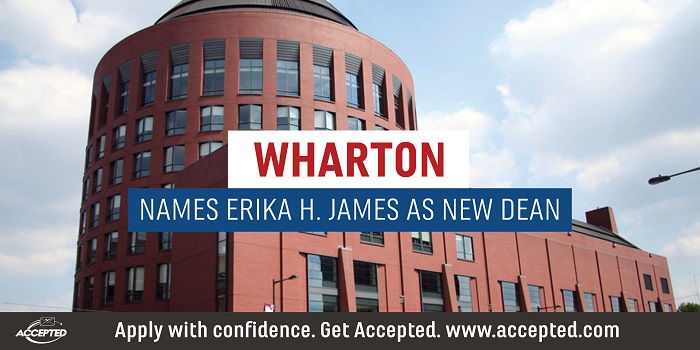
FROM Accepted.com Blog: Wharton Appoints First Female and First African American Dean


Penn President Amy Gutmann and Provost Wendell Pritchett have announced that Erika H. James will assume the post of Wharton’s dean, effective July 1, 2020.

According to the Wharton website, James is looking forward to the change: “This is an exciting time to be in business education. The scope and platform of the Wharton School provides an opportunity to create far reaching impact for students, scholars and the business community.” James will be Wharton’s first female and first African American dean.

James has served as dean of Emory University’s Goizueta Business School since 2014. While in that post, she spearheaded an endeavor to build an entrepreneurship lab for all students at the university, as well as increasing the size of the faculty by 25%. James headed faculty and student workshops, which included themes like unconscious bias and building trust across divides, concepts that are becoming more important to business schools. She also increased corporate engagement by establishing a research-based corporate think tank. James’ efforts led to a major overhaul of the undergraduate business curriculum, which now combines immersive learning, technology, and collaborations with Emory College’s liberal arts curriculum.

How to Present a Winning Wharton Application [Episode 342]

Prior to her position at Goizueta, James was the senior associate dean for executive education at the University of Virginia Darden School of Business. She worked closely with faculty to redefine executive education and lifelong learning prospects. She was also an assistant professor at Tulane University’s Freeman School of Business and a visiting professor at Harvard Business School.

James received her PhD and master’s degree in organizational psychology from the University of Michigan and a bachelor’s degree in psychology from Pomona College of the Claremont Colleges, in California. 

She is an active member of the SurveyMonkey Board and the Graduate Management Admissions Council. Before that, she held a position on the board of the Association to Advance Collegiate School of Business, the premier accrediting organization in business education. James has been named one of the Top 10 Women of Power in Education by Black Enterprise and as one of the Power 100 by Ebony Magazine. 

James is most likely the only dean to have been the subject of a case study. The 2008 study explored the life and career of an associate professor and portrayed her as “a successful professional, a loving spouse, an adoring parent, physically fit, emotionally upbeat, socially polished, and seemingly cool, calm, and collected.” 

Wharton’s current dean, Geoff Garrett, will take over as dean of the University of Southern California’s Marshall School of Business

For more information, check out these WSJ and P&Q articles.

Our experienced advisors have helped applicants get accepted to Wharton and other top MBA programs in the United States and around the world. Now is the ideal time to start working on your admissions strategy. Explore our MBA Admissions Consulting Services and work one-on-one with an expert consultant who will help you GET ACCEPTED.


For 25 years, Accepted has helped business school applicants gain acceptance to top programs. Our outstanding team of MBA admissions consultants features former business school admissions directors and professional writers who have guided our clients to admission at top MBA, EMBA, and other graduate business programs worldwide including Harvard, Stanford, Wharton, Booth, INSEAD, London Business School, and many more. Want an MBA admissions expert to help you get Accepted? Click here to get in touch!

Related Resources:


Tags: MBA Admissions

The post Wharton Appoints First Female and First African American Dean appeared first on Accepted Admissions Blog.
This Blog post was imported into the forum automatically. We hope you found it helpful. Please use the Kudos button if you did, or please PM/DM me if you found it disruptive and I will take care of it. -BB
User avatar
Accepted.com
User avatar
Major Poster
Joined: 20 Apr 2003
Last visit: 18 Dec 2022
Posts: 6,466
Own Kudos:
Given Kudos: 92
Location: Los Angeles CA
Posts: 6,466
Kudos: 859
Kudos
Add Kudos
Bookmarks
Bookmark this Post
FROM Accepted.com Blog: Ace Your Summer Business Internship: Tips for College Students


This post is aimed at college sophomores and juniors who are thinking about earning an MBA in the future, and who will be working as an intern this coming summer.

In my opinion, there isn’t a better way to test out your career interests than by working in your intended field for a few months. From a company’s perspective, it is the most effective way to determine your leadership potential.  

If you are serious about pursuing an MBA in the future, it is important to note that many companies that hire MBAs value quantitative and analytical skills. During your internship, volunteer for assignments that will allow you to gain experience in quantitative analysis.

8 skills to boost during your internship

What are additional skills employers seek and what can you do to earn that full-time job offer upon completion of your internship?

1. Ability to execute

Good leaders not only have creative ideas; they know how to execute and transform those ideas into action. Accept every assignment with a positive attitude and work hard to produce the best results. If you find yourself with extra time, ask for an assignment, or make a suggestion for work you can do that fills a gap.

2. Teamwork

The most effective leaders help others to shine. Offer assistance to fellow interns, co-workers, and your boss. Commend others for work well done.

3. Showing commitment

Show your commitment to your work and the company by arriving early, staying late if there is work to be done, and most importantly, completing your projects with creativity, thoroughness, and excellence.

MBA Admissions: Does Extracurricular Equal Extra Credit?

4. Communication

Make the effort to be social and communicate with your co-workers, administrative assistants, and managers. Effective communicators appreciate differences and learn how best to motivate and inspire a diverse workgroup. 

5. Asking questions

When you don’t know how to do something, ask for clarification. It’s important to be able to work independently, but sometimes you need more information before you can move forward.

6. Professionalism

When you answer a phone at work, say your name and department. When you leave a phone message, speak clearly, and again, say your name, department and phone number. 

Dress similarly to the full-time staff and skip the perfume and cologne. Cubicles are often shared and are small!

7. Precision, carefulness, attention to detail

Double-check your emails to eliminate all typos and use a spelling and grammar tool.

8. Friendliness

Smile! Display your positive attitude with body language and energy.

Pay attention to timing

If you receive a full-time job offer from your internship employer, ask for the time you need to compare your offer to other upcoming opportunities (fall semester job interviews). Companies will often pressure you to respond right away, but there is nothing wrong with using your negotiation skills and informing them of a date by which you will respond. Many career management centers have policies in place, including offer decision deadlines, with which companies are asked to comply.

Securing an impressive internship is just one step – but an important one! – of putting together a competitive MBA application. It’s never too early to begin planning and strategizing! Accepted’s advisors are ready to guide you through the process of creating a winning b-school strategy. Explore our services for more information on how we can help you get ACCEPTED. 


With 30 years of career and admissions experience at four universities, including Cornell’s College of Engineering and Johnson Business School, Dr. Karin Ash facilitated students’ entry into the world’s best companies. As a member of the adcom she also evaluated applications; she knows what schools and employers seek. Want Karin to help you get Accepted? Click here to get in touch!

Related Resources:


Tags: MBA Admissions

The post Ace Your Summer Business Internship: Tips for College Students appeared first on Accepted Admissions Blog.
This Blog post was imported into the forum automatically. We hope you found it helpful. Please use the Kudos button if you did, or please PM/DM me if you found it disruptive and I will take care of it. -BB

User avatar
Accepted.com
User avatar
Major Poster
Joined: 20 Apr 2003
Last visit: 18 Dec 2022
Posts: 6,466
Own Kudos:
Given Kudos: 92
Location: Los Angeles CA
Posts: 6,466
Kudos: 859
Kudos
Add Kudos
Bookmarks
Bookmark this Post
FROM Accepted.com Blog: Thriving in Medical School, in Business School, and as a Professional Athlete


Future orthopedic surgeon, MD/MBA Aiming for olympic fencing [Show summary]

You think you have a lot to do? Our guest today is an MD/MBA student who happens to be training to join the U.S. Olympic fencing team and compete this summer in Tokyo. How does she do it all? Let’s find out.

Interview with Kamali Thompson, MD/MBA student and sabre fencer for Team USA [Show notes]

Our guest today is Kamali Thompson, a fourth-year MD/MBA student at Rutgers Robert Wood Johnson Medical School in New Jersey. Kamali attended Temple University as an undergrad, and graduated with honors after majoring in biology and minoring in psych. She has been fencing since 2006 when she was in high school. Kamali is a member of the 2019 national team completing research in the sports medicine division in the department of orthopedic surgery at NYU, and starting to become an orthopedic sports medicine surgeon. She’s also a 2018, 2019 author for Doximity, and Kamali is currently training for the 2020 U.S. Olympic Team.

Can you tell us a little bit about your background outside of medicine and where you grew up? How and when did you get involved in fencing, and medicine for that matter?

I’m from a town in New Jersey called Teaneck, New Jersey. It’s 20-ish minutes away from New York City. I grew up like a regular kid. I was interested in ballet, and I danced for a really long time from the age of three. I have a younger brother, and when I was in eighth grade I was on my way to go into the normal high school in our town, Teaneck High School. And I was at our Teaneck High School open house and my mother was with me, and I was actually dragging her to the dance room because I was so excited about getting to high school and dancing and being on the dance team and all that.

We got to the cafeteria and there was a fencing demonstration going on. And my mom, she stuck her head in. She’s like, “Ooh, what’s this? What’s going on?” And I was saying, “Mom, who cares? Come on, let’s go.” And she spoke to the coach, the high school coach, and the high school coach told her about the pros, saying how fencing is really unique, and how if I was able to get involved with a team, it could really help me get a college scholarship. And that coming from a dance background, I would have the basics, like footwork and bouts and all that stuff. So my mom was sold immediately, and she told me that I was going to be fencing in the fall with the high school team.

When I started fencing on the high school team, I did that for two years, and then after two years I really started to like it. I wanted to get better. And for fencing, what you have to do is you have to go to a fencing club where you get a coach, and you take private lessons and you fence several days a week. My coach recommended that I go to a club in New York City called the Peter Westbrook Foundation, and that is a club that was created by a six-time Olympian, Peter Westbrook, who wanted to help minority kids in the New York City area get involved with fencing. Fencing is very expensive, so it’s not something that a lot of inner city kids are looking to do. When you start off at The Peter Westbrook Foundation, you go on the Saturday morning program where you learn the basics of fencing, and they have different ages and different skill levels. So I started off in the advanced class, and my mom said, “Well, I’m going to go to New York City on Saturday. I’m not leaving this nine year old at home.” So Khalil, my brother, had to come by default. But after the first day he’s like, “This is crazy. This is great. I want to go fence too.”

<< Check out our What Med School is Really Like Series to hear what real students are saying about med school! >>

How did you get interested in medicine and becoming a doctor?

I wanted to be a pediatrician from as long as I could remember. My mom had this little dress up box where she put all her old clothes and old old high heels and stuff in it. And I remember when I was young, there was a pair of scrubs, so I walked around the house in scrubs, and I can only imagine me, four years old, this pair of scrubs is drowning me.

My pediatrician — I loved her and I loved getting shots, and every time I went there I was super excited. I wanted a shot, a lollipop, a sticker. I just loved everything about it. So I always wanted to be a pediatrician, and when I got to high school I was really passionate about helping childhood obesity and combating that issue and figuring out how to help kids lead a healthier lifestyle. So I was very dead set on becoming a pediatrician until third year of med school. That was the plan. So my emphasis was definitely on medicine. I knew I wanted to be premed, I knew I wanted to go to med school pretty much immediately after college.

And then fencing … I fell into it. It was a really cool opportunity. And once I started training at the Peter Westbrook Foundation, all of the kids who I was fencing with were national champions, international champions. They had been on world championship teams, and they were all getting recruited to go to schools, D1 schools. They were getting full scholarships. So that was the first time that I realized that this would be possible, because my mom wasn’t even thinking about that. She was thinking, “Someone will throw you a bone and give you $5,000 a year,” or something. But these kids were getting full rides to amazing schools. Notre Dame, Penn State, Ohio State. A lot of kids were going to Columbia because we were in the city. So I wanted to be like them, and I wanted to keep fencing especially because it was a lot of fun. We’re 18 years old, we’re traveling around the country by ourselves. It was great.

I got into Temple University. I got into several schools. I decided to go to Temple University because their fencing program was really strong. I got into the honors program. I really liked the diversity of the campus; it just seemed like the right fit for me. That’s when I started getting really, really good, and I was 40th in the country when I got to school, and then by my junior year I was sixth in the country in my age group. So I got really, really good.

And my senior year a lot of students, they have to make the decision: Do I want to keep doing my sport or do I want to go into the real world to get a real job? But I knew for sure that for med school was happening because from day one I’d wanted to give those kids their shots, that was my plan. But I didn’t really feel like I’d accomplished anything in fencing. I had done pretty well my senior year. I was All-American after the NCAA championships, but I didn’t really have anything to claim. So I just decided to keep fencing. But if you’re going to keep fencing after college, the only thing for you to really strive for is the Olympics. So I guess I’m going to try and make the Olympic team and let’s see how it goes.

What was the hardest part of the med school application process for you?

The hardest part for me was the essay. I actually had a great mentor who was the director of the honors program, and we had 20 drafts of my personal statement. And just the fact that she was able to sit with me and go through that because by draft three you’re like, “This is great.”

So we write this essay over and over again, but the supplemental essays were just so draining for me, and I didn’t get those until August when I’m going back to school and I’m starting the new year. So I’m trying to do my classwork, I’m trying to go to practice, and then I get an email asking me for six separate, one-page essays. So that was a lot. And I definitely missed a couple of deadlines, but I got into school so it worked out. It all worked out.

About how much time were you spending in fencing both as an undergrad and as a medical school student?

So undergrad, we have practice from three to six, and we did that five days a week. And then on the weekends, during the season, I went back home to train because no one’s fencing on the weekends in college. So I was spending at least 20 hours a week. And then once I got to medical school and I made the decision to train for the Olympics, I just increased. So I now was going to the gym for an hour each morning before classes started. And then the commute to and from practice really killed me because I was in New Jersey traveling to New York. That’s an hour both ways, and then practice itself with at least three hours, at least four days a week.

What did you like best about your medical school experience at Robert Wood?

So Robert Wood Johnson is amazing. And the reason I chose it was because I felt like when I went for my interview, that school was interested in me as a person, not just me in terms of my stats, like my MCAT score and all that stuff. And I thought it translated really well to everyone that they chose to be a medical student. Everyone that I’ve gone to school with, and I’ve been in three different classes at this point, they’ve all been amazing individuals. We’ve had people who started their own business. We’ve had people that came from Wall Street. We’ve had people who have done mission trips and made a huge impact in the world.

But when you talk to them, like when you’re talking to me, we’re normal people. We’re not extra smart where we’re really awkward around people. We’re not super arrogant because we’ve accomplished a lot. We’re just really normal people who have great goals and are really ambitious. So being surrounded by people in that environment was great, because medical school can be super competitive; it can be very cut-throat. I’ve never felt like that with any of my classmates. It’s always been very friendly. Everyone wants to help each other out. Everybody genuinely wants everyone else to succeed. And I think the way Robert Wood picks their students, they have a great way of maintaining that environment. If you’re thinking about applying to Robert Wood, you definitely should. I absolutely love it.

My first year, we had a presentation on different things you could do through the school and there were dual degrees. MPHs, MBAs, JDs. And MBAs just got to me for some reason because my mom always told me knowing business, understanding business, will be crucial for any adult. And they were offering a one-year program instead of two years. So I was like, “Wait, this is  great. Why would I not take advantage of this?” And so I applied to the MBA program, and I did it between my second and third year, and I think it was a great, great opportunity.

Do you see yourself using this degree at all?

For sure. I think one of the most important things I actually learned was more about personal finance. And especially right now, Millennials, we are behind in terms of how much income we’re making compared to our parents and our grandparents. That combined with student loans, it’s really easy for someone my age to fall behind in terms of financial planning. But business school was great in terms of teaching me what I should be doing. Even if you can’t do that much, you can still do a little bit here and there, which adds up. So that was great. And then I learned a lot about healthcare, pharmaceutical decision, supply and demand of healthcare, and just amazing things that I think everyone should learn in medical school, but we already have so much crammed in it. It’s hard to fit one more semester of business stuff in there.

What could be improved at Robert Wood in terms of your medical school experience?

I decided that I was going to go into orthopedics during my third year of medical school, and that was really difficult. It was a huge transition. And I feel like if I would’ve had a little bit more exposure to ortho or any other field, maybe anesthesiology, those rotations that we don’t have third year and those things that we don’t get to see until the last minute, I think I would’ve been more prepared earlier. So, if there was a way that we could just have more exposure to every single field. I don’t think I have any interest in radiology, but you never know. So if I would’ve seen something first or second year, maybe I would’ve gotten radiology. I don’t think our school and a lot of other schools have a great way of introducing students to every single field.

You had this dream to be a pediatrician, and year three, you switched to orthopedic sports surgery, which is quite a switch. How did you go through that switch and why? And then the other question is, you seem to be taking a rather long time to get through medical school. How has that worked?

The way our schedule is for third year of med school, things are grouped differently. So pediatrics, family medicine, OB-GYN and psych are in a different semesters then internal medicine and surgery. So my strategy was to do the rotation that I was most interested in last, so I could show them how smart I was after third year; “I know all this stuff.” Which meant that internal medicine and surgery were first for me.

So I finished internal medicine but was not feeling it at all. And then I get to surgery, I’m super nervous. Surgeons have this reputation for being really blunt, really mean, really forward, moving at a really fast pace. And I have no interest in this. So I’m just going to sit here. I don’t even care what’s going on. But little did I know, it was amazing. The first day, these people were moving like me. I’m very Type A: “Let’s get this done. Why is it taking so long?” So I saw me, and all of the surgeons that I encountered and the residents and all the stuff I was seeing was just so cool. I’m cutting into abscesses, I’m holding people’s intestines, I’m taking out spleens and gallbladders. I was like, this is really awesome!

And so I was telling my mom every day I have another cool story for her and after two weeks (orientation was eight weeks), she said, “I think you should really consider going into surgery because I’ve never heard you sound so passionate about this.” It just so happened, the people who I actually follow the most are pediatric surgeons, so maybe that was adding to it too. The little kids, they’re so adorable, and we’re fixing their hernias, I love this.

So we had electives that we could choose for the last two weeks of our rotation. And I chose ortho, because even though I wanted to do pediatrics, I was thinking about sports medicine, pediatrics and sports medicine. So I said, “All right. Well, ortho, it’s kind of like the surgical side. Let me see how that goes. That should be interesting.” And my whole class apparently wanted to do ortho, so all these people were trying to take my elective from me. So after six weeks of people wanting my elective, I was like, “No, I want to see what this is about, because what’s so exciting, what’s the hype about?”

So my first day, I’m doing an osteotomy and we’re cutting this 16-year old girl’s leg, and there’s two surgeons. And one of the surgeons is like, “I don’t know if she’ll be able to put the screw in.” And then the other says, “I think she can do it, I think she can put it in. Do you want to put this screw in?” I said, “Of course I want to put the screw in.” So I put this screw into this girl’s leg, and half of me is like, “I’ve got to do this because this man over here doesn’t think I can,” but the other half is thinking, “This is the coolest thing I’ve ever done in my life.” And then that’s when it happened. I was like, “I can do this every day for the rest of my life. Just fix people and cut into them and put screws and drills, and this is amazing.” So, that was it.

All You Need to Know About Residency Applications and Matching

I would say about 50% of my long path through medical school is because of fencing. So I try to make the 2016 Olympic team, and in pursuing that, the year of the qualifying year, I was going to be in my third year of medical school, and that just wasn’t really conducive to me training. Third year of medical school, you have all these rotations. For me, a lot of them were in South Jersey, which means it would be much harder to get to New York City to train. You’d never know when you’re going to get let out. And more importantly, you have to be present. So you look at the clock and, “Well, can you let me out now so I can make the train and get to practice,” and all this stuff, and you’re only allowed a certain number of absences. And I have eight World Cups that we’ve traveled to Europe and Asia and all the other places, so that wasn’t going to fly either, me asking, “Oh, I know I have to be here, but do you mind if I go to Korea for a second?”

So I decided to get my MBA in that time because it would be a very useful degree for me to have. It’d be a great use of my time. It’d be closer to practice, and I wouldn’t feel stressed out trying to juggle too much stuff. So then I come back to med school after the Olympics. I didn’t make that team, but I was the alternate. I come back to med school, I finish my third year, and then I decide on orthopedic surgery.

It was advised to me that I should not graduate medical school, especially entering a competitive specialty, until I’m ready to apply to residency. But it’s 2017 and I’m trying to make the 2020 Olympics. A lot of my mentors and my Dean told me the best thing for me to do anyway, to match an orthopedic surgery, would be to do research, and that’ll be perfect for me needing to wait until after 2020 to apply residency because it would just take a couple of years. So that’s why I’ve been in med school for a very, very, very long time. But it’s worked out really well, and I think all the decisions that I’ve made have been beneficial to my career in fencing. Not being able to graduate until 2020 has actually helped me realize all these things are useful and I’m glad that I’ve done it.

So Robert Wood has been fairly supportive of your ambition?

Oh, they’ve been extremely supportive. Every time this happened, I was so nervous because I was like, “Well, what if they say no? What if they’re just like, ‘No, you need to finish medical school and we’re not going to do this.'” But my dean has been very supportive of my dreams, and she knows that I have huge dreams. I’m sitting here telling you I just want to go into orthopedic surgery out of nowhere. All of my deans have been very supportive. They guide me along the process. So I did two years of orthopedic surgery research at NYU, and this year I’m taking off of school cause I’m just training. And my Dean still checks in with me and reminds me that I need to start applying for certain things, like away electives and all that. So they’ve been great. I definitely could not have gotten this far if my school did not want me to get this far.

Right now, I’m fencing full-time. It’s been amazing. I’m so used to running around like a crazy person; “I only have six hours.” This research stuff that I have to be as efficient as possible and now I can get sleep, because I definitely did not get sleep before. I’m always super early everywhere I have to go. But before I was always just making it because I’m trying to maximize my time in every location. Now I’m meal prepping. I’m bringing my food with me. I’m not eating out all the time. This is a great life.

Are you currently also writing for Doximity or not this year?

No. I was a Doximity author last year, which was a really great experience. But the only reason I didn’t want to do it this year is because I’m not in the medical field. I’m a summer blogger. I have a blog called Saber & A Stethoscope. And because I’m not in the medical field right now, I thought it would be a little difficult to get ideas to be blogging about just because I’m removed. But I will love to do it again in the future.

Was there ever a time, in either medical school or even when you were doing research or now that you’re fencing, when you thought about leaving medicine?

No, thank goodness. Especially because there are people that get to medical school and say, “This is actually not what I wanted to do.” One of my research colleagues at NYU had just graduated, and he said he did not want to be a physician. He just didn’t want to practice. So, no. 

I think that it’s going to be exciting for me in my career because I don’t know if I’m going to be only a doctor for 30, 40 years. I definitely know I’m going to have my hands in other pots. I’m not sure what those pots are, but I think we live in a great time now where Millennials, we can pick and choose what we want to do, and when we get tired of something, we just move on.

I love medicine, and especially going to orthopedics, I haven’t decided what I want to do, if it’s pediatrics or sports or whichever. But whichever I pick, probably sports, I’m going to have a lot of variety, and I’m going to see different types of patients and be in different types of arenas, hopefully literally and figuratively. So I won’t be tired of medicine at all.

Do you see yourself continuing to fence after the Olympics in 2020?

Yes and no. It’s funny because a lot of people who stopped fencing still fence. They’ll come to the fencing club. My fencing club, we have a lot of Olympians, like a lot, a ridiculous amount of Olympians. They’ll throw their stuff on for fun, and they actually have a veterans’ category that starts at 40 years old where they go to world championships and stuff like that. I’m definitely not going to go to the Olympics and then leave the Olympics and leave my fencing stuff in the venue. I’m definitely going to keep fencing. It’s just a matter of on what type of level, and I don’t know. We’ll figure it out.

You mentioned your blog, Saber & A Stethoscope, and you also have a very active social media presence. When did you start writing the blog and why?

Originally, I wanted to start writing my blog the qualifying year of the 2016 Olympics because we’re traveling all over the place. Like I said, we have eight world cups and we have four national competitions. We’re all over the world, and I just thought it’d be really cool to write about. But there was just so much going on, I was exhausted, and I couldn’t get it done. So my third year of medical school I was like, “Okay, this is great, this is a great time to start my blog. I’m going to see a lot of things on my rotation in the hospital.” I started my blog third year. 

There’s an education aspect, a fitness aspect, and this year there’s a Road to Tokyo aspect. It’s just been a great outlet for me to see things and write about what I see. And a lot of my fitness blog posts that I write are struggles that I have. How do you maintain a workout regimen when you are traveling all over the world or just working all the time? And it just seemed like so much work to get to the gym. For me, I feel the same way, but it’s so important, if anything, I have to find a way. So I write a lot of posts I think are relatable to other people. And then I have travel pictures. All the places that I go, I post in my travel gallery and I’ve been to some really, really cool places. So it’s just been great to, also, for me, just look back and see all the crazy stuff I’ve done in the last four years.

How do you see your career evolving? You obviously have several years of residency. Do you see yourself working for a large practice? Going into your own practice? Working for HMO?

A lot of fellows that I’ve spoken to in orthopedics suggest going to a private group practice. It’s just how you can recoup your funds quicker. Also, after my two years of research, I actually really like research. So going into academic medicine is definitely an option too. And then I really, really, really, really, really want to work for an NBA or a WNBA team. So whichever avenue helps me get there faster, that’ll be really cool too. I really like, obviously, being around athletes, so just to be around high-caliber athletes, it would just be amazing.

What would you have liked me to ask you?

It takes about $30,000 for athletes to become Olympians in the U.S., so a lot of things that we have to do are funded by ourselves. And I have an athletic trainer, I have a sports psychologist, nutritionist, my own personal coach, and we have to pay for all that out of pocket. Thankfully some of our trips are paid for, but then a lot of times this year, I’m doing international camps where I just go to another country and fence with their national team, and that’s on my own accord.

So I’m looking for people to help me raise $40,000. You can find my link, the donate page is on the homepage of my website. And if you go to www.kamalithompson.com, it says “donate” at the first button, and it’s got exclamation points!


Related Links:


Related Shows:


<!–[if lte IE 8]>
<![endif]–>>”> hbspt.cta.load(58291, ‘a7557f96-9375-4222-820e-df1ec528b382’, {});

Subscribe:


Podcast Feed

Tags: Admissions Straight Talk, MBA Admissions, Medical School Admissions

The post Thriving in Medical School, in Business School, and as a Professional Athlete [Episode 355] appeared first on Accepted Admissions Blog.
This Blog post was imported into the forum automatically. We hope you found it helpful. Please use the Kudos button if you did, or please PM/DM me if you found it disruptive and I will take care of it. -BB

User avatar
Accepted.com
User avatar
Major Poster
Joined: 20 Apr 2003
Last visit: 18 Dec 2022
Posts: 6,466
Own Kudos:
Given Kudos: 92
Location: Los Angeles CA
Posts: 6,466
Kudos: 859
Kudos
Add Kudos
Bookmarks
Bookmark this Post
FROM Accepted.com Blog: Chicago Booth EMBA Class Profile [June 2019 Incoming Class]


Here’s a look at the Chicago Booth EMBA class of June 2019 incoming students taken from the Booth website

Chicago Booth EMBA class stats

Total number of students: 240

Nationalities represented: 48

Average years of work experience: 13

Students with advanced degrees: 121

Average age: 37

Gender

  • Male: 78%
  • Female: 22%

Average GMAT score: 683

Average Executive assessment: 153

Booth EMBA student industries:

IndustryPercent

Technology9%

Manufacturing8%

Investment Banking/Brokerage

8%

Consulting7%

Healthcare7%

Government/Non-profit/Education

7%

Private Equity/Venture Capital

6%

Investment Management/Research

6%

Other5%

Financial Services

4%

Consumer Products3%

Commercial Banking3%

Energy/Oil/Utilities3%

E-commerce/Internet3%

Law3%

Pharmaceutical/Biotechnology3%

Arts/Media/Entertainment2%

Food/Beverage/Tobacco2%

Chicago Booth Executive MBA Essay Tips & Deadlines [2019 – 2020]

Booth EMBA student functions:

FunctionPercent

General Management15%

Company Finance10%

Other9%

Business Development8%

Consulting5%

Information Systems/Technology5%

Law5%

Investment Management/Research5%

Marketing/Brand/Product Management4%

Sales and Trading4%

Venture Capital/Private Equity4%

Investment Banking3%

Engineering3%

Strategic Planning3%

Project Management3%

Operations/Production3%

Accounting3%

Entrepreneurial/Self-employed3%

Real Estate2%

Healthcare2%

Research2%

Human Resources2%

Private Client Services1%

Commercial Banking/Lending1%

We’ve helped thousands of EMBA applicants gain admittance to top programs, and now we can help you too. Learn how you can secure your spot in the Booth EMBA program when you work one-on-one with an expert Accepted advisor. Explore our EMBA Admissions Services for information on how we can help you GET ACCPETED!


For 25 years, Accepted has helped business school applicants gain acceptance to top programs. Our outstanding team of MBA admissions consultants features former business school admissions directors and professional writers who have guided our clients to admission at top MBA, EMBA, and other graduate business programs worldwide including Harvard, Stanford, Wharton, Booth, INSEAD, London Business School, and many more. Want an MBA admissions expert to help you get Accepted? Click here to get in touch!

Related Resources:


Tags: MBA Admissions

The post Chicago Booth EMBA Class Profile [June 2019 Incoming Class] appeared first on Accepted Admissions Blog.
This Blog post was imported into the forum automatically. We hope you found it helpful. Please use the Kudos button if you did, or please PM/DM me if you found it disruptive and I will take care of it. -BB

User avatar
Accepted.com
User avatar
Major Poster
Joined: 20 Apr 2003
Last visit: 18 Dec 2022
Posts: 6,466
Own Kudos:
Given Kudos: 92
Location: Los Angeles CA
Posts: 6,466
Kudos: 859
Kudos
Add Kudos
Bookmarks
Bookmark this Post
FROM Accepted.com Blog: Ross EMBA Class of 2021 Profile


Here’s a look at the Ross EMBA Class of 2021 profile taken from the Michigan Ross website.

Michigan Ross EMBA class stats

Class size: 114 (Ann Arbor and Los Angeles combined)

Geography: States represented: 20

        Countries represented: 7

Average years of work experience: 14

Average salary (not including bonus): $186,303

Average age: 39

          Under 30: 4%

          Over 40: 37%

Women: 28%

International: 15%

Advanced degrees: 39%

Sponsored at 50% or more: 38%

University of Michigan Ross Executive MBA Essay Tips & Deadlines [2019 – 2020]

Industries and sectors: more than 30 including

  • Advertising
  • Aerospace
  • Agri-business
  • Automotive
  • Construction
  • Consulting
  • Consumer Goods
  • Energy
  • Entertainment
  • Financial Services
  • Government
  • Healthcare
  • Hospitality
  • Law
  • Manufacturing
  • Media
  • Media
  • Military
  • Non-profit
  • Real Estate
  • Retail
  • Tech
  • Telecommunications
  • Utilities

Do you see yourself as part of the Ross EMBA class of 2022? Check out our Admissions Consulting & Editing Services and work one-on-one with an expert consultant to create an application that will get you ACCEPTED to Ross or your top-choice EMBA program!


For 25 years, Accepted has helped business school applicants gain acceptance to top programs. Our outstanding team of MBA admissions consultants features former business school admissions directors and professional writers who have guided our clients to admission at top MBA, EMBA, and other graduate business programs worldwide including Harvard, Stanford, Wharton, Booth, INSEAD, London Business School, and many more. Want an MBA admissions expert to help you get Accepted? Click here to get in touch!

Related Resources:


Tags: MBA Admissions

The post Ross EMBA Class of 2021 Profile appeared first on Accepted Admissions Blog.
This Blog post was imported into the forum automatically. We hope you found it helpful. Please use the Kudos button if you did, or please PM/DM me if you found it disruptive and I will take care of it. -BB
User avatar
Accepted.com
User avatar
Major Poster
Joined: 20 Apr 2003
Last visit: 18 Dec 2022
Posts: 6,466
Own Kudos:
Given Kudos: 92
Location: Los Angeles CA
Posts: 6,466
Kudos: 859
Kudos
Add Kudos
Bookmarks
Bookmark this Post
FROM Accepted.com Blog: MBA Early Birds: Don’t Miss This Opportunity!


MBA season is almost here, and you’re probably already feeling a little overwhelmed when you think about the next few months. Wouldn’t it be great if you could jump start the application process now? You can, and we’ve got a way to make it even more stress-free!

Purchase any MBA application package by March 31, 2020 and you’ll have the option to split the cost into 6 monthly payments — no credit check, no service fees, and no interest! Take advantage of our comprehensive approach and give yourself the opportunity to work steadily toward your MBA goals right away without breaking the bank.

What are the advantages of starting your journey to acceptance early?

    • Time to work on your profile with your consultant before applications even go out
    • No rushing as Round 1 deadlines approach 
    • The ability to work out any potential hiccups in your application
    • Confidence that you’re putting your best foot forward to the adcoms 
If you’re interested in taking advantage of this game-changing offer, contact us today at [email protected]. This payment plan is available to all applicants for all MBA application packages, but it is only available through the end of March, so don’t delay!


For 25 years, Accepted has helped business school applicants gain acceptance to top programs. Our outstanding team of MBA admissions consultants features former business school admissions directors and professional writers who have guided our clients to admission at top MBA, EMBA, and other graduate business programs worldwide including Harvard, Stanford, Wharton, Booth, INSEAD, London Business School, and many more. Want an MBA admissions expert to help you get Accepted? Click here to get in touch!

Tags: MBA Admissions

The post MBA Early Birds: Don’t Miss This Opportunity! appeared first on Accepted Admissions Blog.
This Blog post was imported into the forum automatically. We hope you found it helpful. Please use the Kudos button if you did, or please PM/DM me if you found it disruptive and I will take care of it. -BB
User avatar
Accepted.com
User avatar
Major Poster
Joined: 20 Apr 2003
Last visit: 18 Dec 2022
Posts: 6,466
Own Kudos:
Given Kudos: 92
Location: Los Angeles CA
Posts: 6,466
Kudos: 859
Kudos
Add Kudos
Bookmarks
Bookmark this Post
FROM Accepted.com Blog: How to Prepare for a Successful Round 1 MBA Application
[img]https://blog.accepted.com/wp-content/uploads/2020/03/How-to-prepare-for-a-successful-Round-1-MBA-application.jpg[/img]
[url=https://media.blubrry.com/admissions_straight_talk/p/www.accepted.com/hubfs/Podcast_audio_files/Podcast/356_How-to-Prepare-for-a-Successful-Round-1-MBA-App_2020.mp3][img]https://blog.accepted.com/wp-content/uploads/2020/03/How-to-prepare-for-a-successful-Round-1-MBA-application.jpg[/img][/url]

Is there a secret recipe for MBA application success?

Linda Abraham lays out seven steps that MBA applicants can take now to enhance their chance of success when the MBA applications come out over the summer. [url=https://media.blubrry.com/admissions_straight_talk/p/www.accepted.com/hubfs/Podcast_audio_files/Podcast/356_How-to-Prepare-for-a-Successful-Round-1-MBA-App_2020.mp3]Listen to the show![/url]

What steps can you take NOW to improve your chances of acceptance to top MBA programs?

The content I’m about to explore mirrors the training I offered in [url=https://reports.accepted.com/7-steps-to-mba-acceptance]7 Steps to a Successful MBA Application in 2021[/url], a recent webinar. I feel that this material is so valuable that I don’t want my podcast listeners to miss it. 

What motivates me to provide this training?

[list][*]A frustration with applicants who start the process too late and shortchange their chances at their dream schools. We love to start working with applicants now because our clients can improve their profile, qualifications, and chances of acceptance when they [url=https://blog.accepted.com/mba_application_timeline_how_to_get_accepted/]start early[/url]!

[/*][*]The amount of limiting and misleading imagery in MBA advising from adcom directors, consultants, and sometimes MBA applicants and students themselves.

[/*][*]The paradox of MBA admissions. After 25 years in this business, I’ve seen a lot of metaphors used in describing the MBA admissions process. “It’s an accounting exercise, not a marketing exercise,” or, “It’s all about personal branding,” or, “It’s all about marketing.” While I believe metaphors and similes can be useful, I think they have been abused in MBA admissions, obscuring the process.[/*][/list]

I do not promise an image-free training! I do promise that this training will provide you with a purpose-driven, goal-centered approach to the MBA application, including what you should be doing now (six to nine months before you submit your application) to [url=https://www.accepted.com/mba/services?utm_campaign=Blog&utm_medium=prepare_successful_round1_app_podcast&utm_source=blog]maximize your chances of acceptance at top MBA programs[/url] when you apply in Round 1 or Round 2 of the 2020–21 application season.

Let’s cultivate those three seeds into a flourishing, healthy MBA application. (Not bad for someone who just complained about abuse of metaphors in MBA admissions!)

When applicants come to us at the last minute

Yes, we can polish your essays during the week before the essays are due, but we can do so much more if you start early. Use the next few months before the applications come out to improve your profile and maximize your chances of acceptance.

Step 1: Define your goals, the foundation of your application

Begin with the end in mind: [url=https://reports.accepted.com/mba/why-mba]Clarify your post-MBA goal[/url], the foundation for your entire MBA application strategy, even if it changes while in B-school.

In [url=https://blog.accepted.com/make-a-difference-at-michigan-ross-an-interview-with-soojin-kwon-episode-185/]Admissions Straight Talk Episode 185[/url], I asked Ross Admissions Director Soojin Kwon, “What makes an application really stand out for you?” She responded, “People who seem to really know what they want and know themselves, and who can articulate it well. They can connect the dots.”

Define your post-MBA goals, both short-term and long-term. Short-term goals include your industry and functional focus (something you do, not something you study). Long-term goals, those five to ten years down the road, are your aspirations or dreams  –perhaps a way of contributing to the betterment of society on a larger scale. These are less critical from an admission perspective, but if you have something like this, don’t hide it. Prepare to discuss.

[url=https://blog.accepted.com/how-to-clarify-your-goals-for-your-mba-and-beyond/]If your goals are fuzzy[/url], look at what you like and are good at. Talk to people in positions that you find attractive. What do they actually do? What education do they believe was useful to them? Do they wish they would have had before they started? From what programs do they want to hire people for the positions you find appealing? Then take time to think about what you want to do. Reflect. Once you have a clearly defined goal, it will be a substantive and meaningful guide in the process of choosing schools—your North Star.

Realize that at many schools, a clearly defined, realistic post-MBA goal is as much a requirement of admission as a competitive GMAT or quality work experience. [url=https://reports.accepted.com/mba/chicago_booth_mba]Chicago Booth[/url] explicitly says that it seeks a “sense of personal direction” and “realistic expectations for the MBA.” That’s why so many schools ask about your goals. They care!

Step 2: Assess your qualifications

What about your qualifications? Those qualifications are partly about what you want and partly about what you bring to the table, which includes evidence of your potential for success in a given school’s program and beyond. What different elements make up those qualifications? There are four basic areas to examine.

[list][*][b]Pillar 1: Academics[/b]. Show that you can and will do the work. Grades and test scores are the most common ways to show academic ability, but not the only ways.

[/*][*][b]Pillar 2: Work experience. [/b]Both quality and quantity are important here. In terms of quantity, three to six years is ideal (two to eight on the outside). In terms of quality, schools look for responsibility, growth, impact, and demonstrated managerial ability. They may also like to see a global or multi-cultural perspective.

[/*][*][b]Pillar 3: Personal qualities.[/b] [url=https://reports.accepted.com/leadership-in-admissions-2]Leadership, leadership, leadership[/url] is most important. You also want to show you possess teamwork, organizational, analytical and communications skills, initiative, and an entrepreneurial mindset. Demonstrate that you are a contributor, a giver, and a person of impact and consequence.

[/*][*][b]Pillar 4: Fit. [/b]Show you identify with the school’s values, fit well into its culture, meet its qualifications, and add to its community. On some level, the first three pillars are also about fit, but I added this one because a school’s mission and stated criteria or values are absolutely crucial. Since they are less quantitative and concrete, applicants tend to overlook them.[/*][/list]

Can any of these elements be improved or mitigated? Enhanced? Yes, because you are starting early. Can you improve your profile to make yourself more competitive? That’s the next step.

Step 3: Research the schools to which you’ll apply

Which elements are least important to you when selecting an MBA program to apply to? Career placement? Curriculum? Ranking? Extra-curricular activities? 

I’d choose Rankings, as being least important.

When selecting which schools are best suited to help you achieve your goals, consider recruiting and placement, educational preferences, extra-curricular activities and opportunities, and personal preferences. Look at career services employment reports and the school’s website or blog. Contact current students and recent alumni. Take advantage of MBA tours and school-sponsored events. If possible, [url=https://blog.accepted.com/top-6-tips-for-visiting-business-schools/]visit campus[/url].

Ask yourself two questions: Does the school support your goals? And are you competitive?

Get specific about the answer to that second question. Rejection happens when you don’t consider your competitiveness objectively.

Consider a Venn diagram, featuring one circle that reads “Schools you are interested in” and “Schools likely to be interested in you.” Choose schools that lie at the intersection of those two circles.

Step 4: Improve your profile 

Let’s go through the pillars and see how to improve, if that’s necessary.

Pillar 1: Academics

If your undergrad grades were low, you’ll need to provide evidence you have the ability and the discipline to succeed. If your quant skills are weak but your grades are good, consider something like MBMath.com, HBSOnline, or MOOCs.

The best way to handle a low GMAT or GRE is to retake and raise it. If you’re not sure if you should retake, or if you’ve taken the GMAT three or more times, please see [url=https://www.youtube.com/watch?time_continue=6&v=kgUEh41lczY&feature=emb_logo]our video on whether or not you should retake[/url]. 

Pillar 2: Work experience

If you have less than two years of work experience, perhaps wait a year, or aim for schools with lower average ages at matriculation. Note that schools seem to be turning away from admitting and matriculating MBA students straight from college and with less than two years of experience. Consider an MS in Management like that offered by Duke or LBS, Kellogg, or Ross, or a deferred admission program if you are currently in college (HBS, Stanford, Chicago, Yale, MIT Sloan, Wharton, Columbia, Darden).

If you have too much work experience (six to eight years), aim for programs with higher ages at matriculation. (This is common in many European programs.) Consider EMBA and [url=https://blog.accepted.com/mit-sloan-fellows-essay-tips-deadlines/]Sloan Fellows[/url] if you have 10 or more years of work experience. Be extra clear about why you want an MBA now at your level. Show you are not relying on the school to find you a post-MBA job; you have the contacts to achieve your dreams or perhaps already have an offer. Also, an international component isn’t required at most schools, but sure can be nice to have.

Pillar 3: Community service

Take on responsibilities at work that will allow you to demonstrate compelling qualities at work. Frequently, this is not so easy to do at work; it’s often much easier to assume leadership roles in volunteer commitments.

When it comes to [url=https://blog.accepted.com/why-extracurricular-activities-make-a-difference-in-your-mba-application/]community service[/url], better late than never, if you haven’t previously been involved. If you have, continue what you have been doing, and if possible, expand your responsibilities. Remember that community service is an opportunity to demonstrate personal qualities desired by schools.

Until now, we’ve been talking pre-application strategy and tactics more than implementation and application, but I’d like to shift gears here and discuss three to-dos that will directly contribute to your application.

Step 5: Prepare to write your essays

Start jotting down notes and ideas. I wouldn’t start writing application essays yet, but I would create a file where you can jot down ideas for topics to include, notes from your informational interviews and school research, and thoughts about schools and possible [url=https://www.accepted.com/mba/applicationessays]essays topics[/url]. 

What experiences are you most proud of? Make a few notes. What was the challenge faced? What did you do? What was the impact? What character traits did you reveal through your actions?

Once applications are out, you can start working on the essays, but for now, I would nail the other stuff. Start work on the essays in June or July if you are aiming for R1 deadlines.

Step 6: Polish your resume

[url=https://www.accepted.com/mba/services/resume?utm_campaign=Blog&utm_medium=prepare_successful_round1_app_podcast&utm_source=blog]This is something you can nail now.[/url] Keep it to one page. Focus on achievements and outcomes, not just descriptions of responsibilities. Quantify when possible. And please, don’t use bullet points to repeat what your job title implies!

Step 7: Choose your recommenders

[url=https://blog.accepted.com/mba-letters-of-recommendation-who-what-where-when-how/]Recommenders[/url] should have supervised you directly and really know what you’re capable of based on personal experience. Ask them if they are willing to write a strong, supportive letter of recommendation for you. Tell them you will give them material they can use (your resume, a brief summary of accomplishments, access to the recommendation, and a one-paragraph summary of what the school is looking for) as well as about four weeks notice. Give them a time frame.

You don’t need to ask now. You can wait until May or June when you have even more achievements under your belt.

Reviewing the 7 actions for a successful application

[list][*]Hone your goal.

[/*][*]Evaluate your qualifications (GMAT, GPA, work experience, community service, leadership) to see if anything needs work.

[/*][*]Research the schools to determine which best support your goals.

[/*][*]Improve those areas that need improving.

[/*][*]Essay prep (no pressure).

[/*][*]Polish your resume.

[/*][*]Decide on and ask recommenders if they will help you.[/*][/list]

Some of you will look at this list and wisely decide to apply in the second round or even wait a year. Others will have only a few action items because you’ve already started on many of these tasks (congrats!), but you all should have something to do, and whatever you do now will improve your chances of acceptance.

Right now, I’d like you to write down at least one action item you’re going to start on this week based on today’s training. And set yourself a deadline for completion.

Let’s discuss that third seed, the one I mentioned way back at the beginning of this episode, the stress-inducing paradox of MBA admissions: You have to show that you fit in at your target programs and at the same time are a unique individual, a stand out, in the applicant pool. And it’s not easy. We understand that.

We have a free download that addresses that part of the MBA application process: [url=https://accepted.com/FISO]Fitting In and Standing Out: The Paradox at the Heart of Admissions[/url]. This guide will show you how to do both. Master this paradox, and you are well on your way to acceptance. Download this free guide at accepted.com/FISO.

[url=https://media.blubrry.com/admissions_straight_talk/p/www.accepted.com/hubfs/Podcast_audio_files/Podcast/356_How-to-Prepare-for-a-Successful-Round-1-MBA-App_2020.mp3][img]https://blog.accepted.com/wp-content/uploads/2019/10/ListenToTheShow.png[/img][/url]

[b]Related Links:[/b]

[list]
[*][url=https://reports.accepted.com/how-to-fit-in-stand-out-during-the-admissions-process]Fitting in and Standing Out: the Paradox at the Heart of Admissions[/url], a free guide[/*]
[*][url=https://blog.accepted.com/importance-defining-mba-goal/]The Importance of Defining Your MBA Goal[/url][/*]
[*][url=https://www.accepted.com/mba/selectivity-index]Accepted’s MBA Selectivity Index[/url], a tool to assess your competitiveness at your dream programs[/*]
[*][url=https://www.accepted.com/mba/services?utm_campaign=Blog&utm_medium=prepare_successful_round1_app_podcast&utm_source=blog]Accepted’s MBA Admissions Consulting Services[/url][/*]
[/list]
[b]Related Shows:[/b]

[list]
[*][url=https://blog.accepted.com/mba-insider-shares-his-secrets-in-new-book/]MBA Insider Shares His Secrets in New Book[/url][/*]
[*][url=https://blog.accepted.com/when-is-the-mba-worth-the-time-and-money]Is the MBA Worth It, or Is the Sky Falling Down on the MBA Degree?[/url][/*]
[*][url=https://blog.accepted.com/how-to-get-accepted-to-a-top-emba-program-the-experts-speak/]How to Get Accepted to a Top EMBA Program: The Experts Speak[/url][/*]
[/list]
[b]Subscribe:[/b]

   [url=https://www.accepted.com/stitcher][img]https://blog.accepted.com/wp-content/uploads/2018/06/admissions-straight-talk-stitcher.png[/img][/url]
     [url=https://www.stitcher.com/s?fid=34489&refid=stpr][img]https://assets.blubrry.com/soa/BadgeLarge.png[/img][/url]

[url=https://blog.accepted.com/feed/podcast/][b]Podcast Feed[/b][/url]

[url=https://cta-redirect.hubspot.com/cta/redirect/58291/27a53f66-11aa-4ee4-8459-c8b3a9f7330d][img]https://no-cache.hubspot.com/cta/default/58291/27a53f66-11aa-4ee4-8459-c8b3a9f7330d.png[/img][/url]


Tags: [url=https://blog.accepted.com/category/admissions-straight-talk/]Admissions Straight Talk[/url], [url=https://blog.accepted.com/category/mba-admissions/]MBA Admissions[/url]

The post [url=https://blog.accepted.com/how-to-prepare-for-a-successful-round-1-mba-application-episode-356/]How to Prepare for a Successful Round 1 MBA Application [Episode 356][/url] appeared first on [url=https://blog.accepted.com]Accepted Admissions Blog[/url].
This Blog post was imported into the forum automatically. We hope you found it helpful. Please use the Kudos button if you did, or please PM/DM me if you found it disruptive and I will take care of it. -BB

User avatar
Accepted.com
User avatar
Major Poster
Joined: 20 Apr 2003
Last visit: 18 Dec 2022
Posts: 6,466
Own Kudos:
Given Kudos: 92
Location: Los Angeles CA
Posts: 6,466
Kudos: 859
Kudos
Add Kudos
Bookmarks
Bookmark this Post
FROM Accepted.com Blog: Don’t Let Low Stats Derail Your MBA Dreams


No matter where you are in the MBA application process, your GPA and GMAT score are going to play a large role in whether or not you get accepted. But if your stats aren’t as impressive as you’d like them to be, you don’t have to settle for a school that isn’t a fit. 

Join us on Thursday, April 2nd for our free one-hour webinar, Get Accepted to Top MBA Programs with Low Stats, and learn what “low” really means (it’s all relative!). We’ll also discuss ways to mitigate those lackluster numbers and land a spot in your chosen program. 

There is no fee for this session, but you do need to register to join in. Save your seat today!

Register for the webinar:


For 25 years, Accepted has helped business school applicants gain acceptance to top programs. Our outstanding team of MBA admissions consultants features former business school admissions directors and professional writers who have guided our clients to admission at top MBA, EMBA, and other graduate business programs worldwide including Harvard, Stanford, Wharton, Booth, INSEAD, London Business School, and many more. Want an MBA admissions expert to help you get Accepted? Click here to get in touch!

Tags: MBA Admissions

The post Don’t Let Low Stats Derail Your MBA Dreams appeared first on Accepted Admissions Blog.
This Blog post was imported into the forum automatically. We hope you found it helpful. Please use the Kudos button if you did, or please PM/DM me if you found it disruptive and I will take care of it. -BB

User avatar
Accepted.com
User avatar
Major Poster
Joined: 20 Apr 2003
Last visit: 18 Dec 2022
Posts: 6,466
Own Kudos:
Given Kudos: 92
Location: Los Angeles CA
Posts: 6,466
Kudos: 859
Kudos
Add Kudos
Bookmarks
Bookmark this Post
FROM Accepted.com Blog: Columbia Business School Extends Application Deadline to June 1


Coronavirus and fears of the unknown future have prompted Columbia Business School to extend their application deadline for the August 2020 entering class to June 1, 2020.

Assistant Dean for Admissions, Amanda B. Carlson, states that this uncertainty may be a barrier to applying to b-school. “You may feel unsettled in these uncertain times. Perhaps applying to an MBA program is not exactly at the top of your mind right now. I can totally understand that sentiment. However, in my years at Columbia and as an alumna of the School, I have seen skills developed through the MBA program and the incredible community carry our students and alumni through the financial crisis and major changes in the business environment. Given that there is such uncertainty, perhaps you should consider that this could be the right time to get your MBA.”

Columbia Business School MBA Essay Tips & Deadlines [2019 – 2020]

Making decisions in uncertain times

The uncertainty of what will happen to the incoming CBS class has led Columbia to extend the application deadline. The coronavirus situation is constantly changing, and CBS is doing its best to anticipate what comes next with their incoming class. There is an assumption that some of the admitted students will not be able to begin their studies in August. 

For assurance, remember: “If you are thinking about submitting an application to Columbia Business School, and wonder if it’s too late, it’s not. We are extending the deadline and plan to admit more candidates who will be a great fit in our community.”

Accepted can help

Do you want to be a part of CBS’s incoming August 2020 class? Check out these Accepted resources:


Looking for more personalized guidance? Working one-on-one with one of our admissions consultants is a great way to be sure that you stand out in everything from your application to your interview. Click here to get started.


For 25 years, Accepted has helped business school applicants gain acceptance to top programs. Our outstanding team of MBA admissions consultants features former business school admissions directors and professional writers who have guided our clients to admission at top MBA, EMBA, and other graduate business programs worldwide including Harvard, Stanford, Wharton, Booth, INSEAD, London Business School, and many more. Want an MBA admissions expert to help you get Accepted? Click here to get in touch!

Related Resources:


Tags: MBA Admissions

The post Columbia Business School Extends Application Deadline to June 1 appeared first on Accepted Admissions Blog.
This Blog post was imported into the forum automatically. We hope you found it helpful. Please use the Kudos button if you did, or please PM/DM me if you found it disruptive and I will take care of it. -BB

User avatar
Accepted.com
User avatar
Major Poster
Joined: 20 Apr 2003
Last visit: 18 Dec 2022
Posts: 6,466
Own Kudos:
Given Kudos: 92
Location: Los Angeles CA
Posts: 6,466
Kudos: 859
Kudos
Add Kudos
Bookmarks
Bookmark this Post
FROM Accepted.com Blog: How Will Coronavirus Impact Testing? [GRE, GMAT, LSAT, MCAT, ACT, SAT, TOEFL]


As part of the global effort to contain the spread of COVID-19, many businesses and universities have closed down or are functioning remotely. Additionally, numerous test sites have been closed and test dates or rescheduled.

Here is the most up-to-date information on admissions tests and their responses to coronavirus.

GMAT

Testing is suspended in many testing centers worldwide. Enhanced health and safety measures, including improved cleaning procedures, hand sanitizer, and wipes, have been provided for those taking tests in those centers that remain open. Visit https://www.mba.com/articles-and-announcements/announcements/update-on-coronavirus to determine if test centers near you are open or closed.

GRE

Testing has been postponed in locations throughout the United States and internationally. The decision to postpone testing has been made with the input of local governments, test centers, and others locally. There have also been test center closures in response to local public health concerns. You will be notified via email if your test is postponed. Your test will be rescheduled. Please see https://www.ets.org/s/cv/gre/the-americas/ for more information.

LSAT

The March LSAT has been canceled in all locations worldwide. All March registrants in the US, Canada, Puerto Rico, and the US Virgin Islands have been automatically registered for the April 25th test in the same location where they were registered for the March test. Anyone registered in other locations has been automatically registered for the June test in their locations. For further information, please see https://www.lsac.org/update-coronavirus-and-lsat

MCAT

The March 27th and April 4th MCAT exams have been canceled worldwide. Flexible rescheduling has been extended for exams scheduled through the end of May. According to Pearson VUE, owner of the MCAT test centers, students will be able to reschedule their exam appointments starting April 16th if conditions allow. Students who have already scheduled an exam will receive a cancellation notice by email and will either receive a full refund (if paid to Pearson VUE) or an extension to be decided on by their exam sponsor. For the latest from AAMC, please see https://www.aamc.org/services/coronavirus .

ACT

The April 4th national test date has been rescheduled to June 13th throughout the US. Everyone registered for the April 4th test date will receive an email notifying them of the postponement with instructions for free rescheduling to June 13th or a future national test date. For updates, please see https://leadershipblog.act.org/2020/03/act-reschedules-april-2020.html .

SAT

The May 2nd SAT and SAT Subject Test administrations have been canceled. Makeup exams for the March 14th test date (scheduled for March 31st) have also been canceled. Students who have already signed up for May, whose March test centers were closed, or who do not receive March scores due to any irregularities, will receive refunds. For more information, please see https://pages.collegeboard.org/natural-disasters .

TOEFL

Test administrations have been postponed in some locations. This decision has been made in consultation with local governments, test centers, and other resources on the ground. You will be notified by email if your test has been postponed, and your test will be rescheduled in your account. For the latest developments, please see https://www.ets.org/s/cv/important-update/ .

Disclaimer: please check each testing service’s website for the latest updates.

For some test-takers, this will come as frustrating news, while for others this may be a welcome delay. But like so many things during this time of turbulence, we have little control over what is and what will be. But one thing is constant – we are here for you. The expert consultants at Accepted always work virtually, via phone, email, and video, and now is no different. Be in touch if you need help with this or any other stage of the admissions process.


For 25 years, Accepted has helped applicants gain acceptance to top undergraduate and graduate programs. Our expert team of admissions consultants features former admissions directors, PhDs, and professional writers who have advised clients to acceptance at top programs worldwide including Harvard, Stanford, Yale, Princeton, Penn, Columbia, Oxford, Cambridge, INSEAD, MIT, Caltech, UC Berkeley, and Northwestern.
Want an admissions expert to help you get Accepted? Click here to get in touch!

Related Resources:


Tags: College Admissions, Grad School Admissions, Law School Admissions, MBA Admissions, Medical School Admissions

The post How Will Coronavirus Impact Testing? [GRE, GMAT, LSAT, MCAT, ACT, SAT, TOEFL] appeared first on Accepted Admissions Blog.
This Blog post was imported into the forum automatically. We hope you found it helpful. Please use the Kudos button if you did, or please PM/DM me if you found it disruptive and I will take care of it. -BB

User avatar
Accepted.com
User avatar
Major Poster
Joined: 20 Apr 2003
Last visit: 18 Dec 2022
Posts: 6,466
Own Kudos:
Given Kudos: 92
Location: Los Angeles CA
Posts: 6,466
Kudos: 859
Kudos
Add Kudos
Bookmarks
Bookmark this Post
FROM Accepted.com Blog: U.S. News Announces 2021 Ranking of Best MBA Programs


U.S. News just released its 2021 ranking of full-time and part-time MBA programs. The rankings are based on expert opinions about the quality of each program and statistical indicators that calculate the quality of a program’s faculty, research, and students. The reputation surveys were sent to academics and professionals in fall 2019 and early 2020. This year, for the first time, the specialties of business analytics, real estate, and project management are ranked.

In order to rank each school. U.S. News assessed the data for each quality indicator and then standardized the value of each indicator about its mean. Each indicator has a weight assigned to it, which indicates U.S. News’ judgment about their relative importance, after consulting with experts in the field. 

<< Are you competitive at your dream school? Check out the Selectivity Index to find out! >>

These final scores were rescaled to give the highest-scoring school a score of 100, with the other schools’ scores recalculated as a percentage of the top score. A school with a score of 100 did not necessarily receive the highest score on every indicator, it merely accrued the highest composite score.

Highlights of the 2021 MBA Ranking

  • The biggest news of all is that Harvard Business School slipped down to sixth place this year from third in the 2019 full-time rankings. 

  • Stanford University gained a position this year to tie the University of Pennsylvania for the top slot for full-time MBA programs. 

  • Northwestern University jumped from a three-way tie for 6th place last year to a two-way tie this year at #3 with the University of Chicago

  • New York University broke into the Top 10 this year, jumping from a three-way tie for #12 to the #10 spot. 

  • Further down in the rankings, North Carolina State University leapt more than 30 spots, from a tie at #85 to #52 this year.

  • Chicago Booth maintained the top position among part-time MBA programs. 

  • Also in the part-time rankings, the University of Washington joined the Top 10 this year, rising from a two-way tie at #12 to #10 this year.  

2021 Top 10 full-time MBA programs

RankSchoolLocation

1Stanford UniversityStanford, CA

1UPenn WhartonPhiladelphia, PA

3Northwestern KelloggEvanston, IL

3Chicago BoothChicago, IL

5MIT SloanCambridge, MA

6Harvard Business SchoolBoston, MA

7UC Berkeley-HaasBerkeley, CA

8Columbia Business SchoolNew York, NY

9Yale SOMNew Haven, CT

10New York University SternNew York, NY

2021 Top 10 part-time MBA programs

RankSchoolLocation

1Chicago BoothChicago, IL

2UC Berkeley-HaasBerkeley, CA

3Northwestern KelloggEvanston, IL

4NYU SternNew York, NY

5UCLA AndersonLos Angeles, CA

6Michigan RossAnn Arbor, MI

7UT McCombsAustin, TX

8Carnegie Mellon University TepperPittsburgh, PA

9Indiana KelleyBloomington, IN

10Emory GoizuetaAtlanta, GA

Would you like to be a member of the class of 2022 in one of these top programs? Check out our MBA Admissions Consulting & Editing Services and work one-on-one with an expert consultant to create an application that will get you ACCEPTED!


For 25 years, Accepted has helped business school applicants gain acceptance to top programs. Our outstanding team of MBA admissions consultants features former business school admissions directors and professional writers who have guided our clients to admission at top MBA, EMBA, and other graduate business programs worldwide including Harvard, Stanford, Wharton, Booth, INSEAD, London Business School, and many more. Want an MBA admissions expert to help you get Accepted? Click here to get in touch!


Related Resources:


Tags: MBA Admissions

The post U.S. News Announces 2021 Ranking of Best MBA Programs appeared first on Accepted Admissions Blog.
This Blog post was imported into the forum automatically. We hope you found it helpful. Please use the Kudos button if you did, or please PM/DM me if you found it disruptive and I will take care of it. -BB
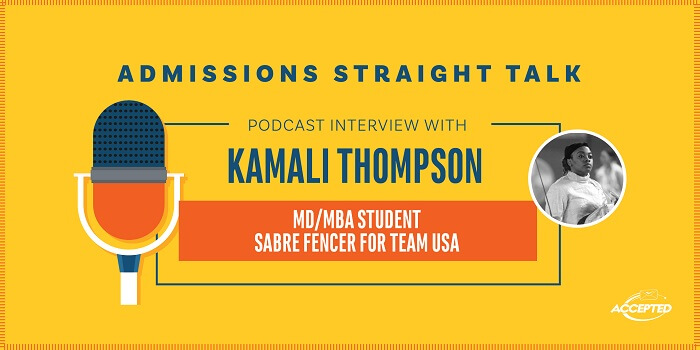
User avatar
Accepted.com
User avatar
Major Poster
Joined: 20 Apr 2003
Last visit: 18 Dec 2022
Posts: 6,466
Own Kudos:
Given Kudos: 92
Location: Los Angeles CA
Posts: 6,466
Kudos: 859
Kudos
Add Kudos
Bookmarks
Bookmark this Post
FROM Accepted.com Blog: Only a Few Days Left to Enroll in Our MBA Payment Plan!


Time is running out for you to take advantage of our fee-free, no credit check, and no interest MBA Application Package payment plan!

Give yourself the best chance of acceptance by getting a jump on the process early — our comprehensive approach to application success is even more effective when you have time on your side! Start right away improving your profile with your carefully-chosen admissions expert, and work steadily toward your MBA goals with the support you can only get from Accepted.

March 31 will be the last day you’ll be able to take advantage of this incredible opportunity to work one-on-one with an experienced admissions consultant via our budget-friendly 6-month payment plan.

Contact us today at [email protected] to set up your plan, and give your applications the time and consideration they deserve!


Tags: MBA Admissions

The post Only a Few Days Left to Enroll in Our MBA Payment Plan! appeared first on Accepted Admissions Blog.
This Blog post was imported into the forum automatically. We hope you found it helpful. Please use the Kudos button if you did, or please PM/DM me if you found it disruptive and I will take care of it. -BB

User avatar
Accepted.com
User avatar
Major Poster
Joined: 20 Apr 2003
Last visit: 18 Dec 2022
Posts: 6,466
Own Kudos:
Given Kudos: 92
Location: Los Angeles CA
Posts: 6,466
Kudos: 859
Kudos
Add Kudos
Bookmarks
Bookmark this Post
FROM Accepted.com Blog: ETS Announces GRE General Test at Home Option
[img]https://blog.accepted.com/wp-content/uploads/2020/03/ETS-Announces-GRE-General-Test-at-Home-Option.jpg[/img]
[img]https://blog.accepted.com/wp-content/uploads/2020/03/ETS-Announces-GRE-General-Test-at-Home-Option.jpg[/img]

Due to the sweeping effects of the coronavirus, ETS will be temporarily offering an option to [url=https://www.ets.org/s/cv/gre/at-home/]take the GRE General Test at home[/url]. This option will be available in selected countries and is for students who, due to public health concerns, cannot take the GRE General Test at a test center.

Who will be able to take the GRE General Test at home?

The option to take the test at home is available to those who live in an area where the test is offered. As of March 23. 2020 (13:00 UCT), home tests are available in the United States, Canada, Colombia, France, Germany, Italy, Spain, Hong Kong (China), and Macau (China).

What equipment is required for the at-home exam?

You have computer equipment that meets the requirements for the test:

[list][*]Desktop/laptop computer

[/*][*]Cannot be a Mac computer or use an iOS operating system

[/*][*]Must have Windows OS, versions 10, 8, 7, Vista™, or XP

[/*][*]Must use a standard QWERTY keyboard

[/*][*]Must have a speaker to hear proctor

[/*][*]Cannot use a headset or wireless earphones

[/*][*]Must have an internal or external microphone that is not part of a headset to communicate with the proctor

[/*][*]Must have a built-in camera or a separate webcam

[/*][*]Camera must be able to move in order to show the proctor a 360-degree view of the room, including your tabletop surface, prior to the test.[/*][/list]

[url=https://cta-redirect.hubspot.com/cta/redirect/58291/3d0df5fd-7a7c-4d62-be61-35707e60f5c0][img]https://no-cache.hubspot.com/cta/default/58291/3d0df5fd-7a7c-4d62-be61-35707e60f5c0.png[/img][/url]

How must one prepare their at-home testing room?

You must have a room that provides an acceptable environment for the test.

[list][*]You must be in the room alone. No one may enter the room during the test.

[/*][*]You are not permitted to take the test outdoors or in a public place.

[/*][*]You must have your computer and keyboard on a tabletop surface.

[/*][*]The tabletop and area around it must be clear of any items not approved for use during the test.

[/*][*]You must sit in a standard chair. You may not sit or lie on a bed, couch, or overstuffed chair.

[/*][*]Food and drinks are not allowed during the test.

[/*][*]Your ears must remain visible during the test. 

[/*][*]You must be suitably dressed for the test. Your proctor will monitor you via your camera during the test and your photo will be sent to schools that receive your scores. 

[/*][*]You may ONLY take notes using a whiteboard with erasable marker or paper with clear sheet protector and erasable marker. 

[/*][*]The proctor will watch you erase all notes at the end of the test.[/*][/list]

Next steps

To see if you meet ETS’s requirement to take the test at home, visit [url=https://www.ets.org/s/cv/gre/at-home/]https://www.ets.org/s/cv/gre/at-home/[/url]. Once “approved,” you will need to install the ETS secure browser and register with ETS. 

Your scores will be available in your ETS account and sent to your chosen schools 10-15 days after your test date. 

What about the GRE’s competitors?

Both [url=https://blog.accepted.com/how-will-coronavirus-impact-testing-gre-gmat-lsat-mcat-act-sat-toefl/]GMAC and LSAC[/url] announced this week that they are moving towards a remote proctoring option. GMAC plans to have it in place by mid-April. LSAC has not announced an estimated date when the remote option will be available.

The GRE is accepted widely today by almost all graduate business schools in addition to the GMAT, which had dominated business school admissions until about 10 years ago. 

A growing number of law schools accept the GRE as well as the LSAT. Acceptance of the GRE among law schools will accelerate if it is the only option available for law school applicants.

[b]Will you be taking the GRE at home or preparing to take it at a test center? Wherever you will be taking the GRE, [url=https://www.accepted.com/grad/gre-prep-tips]check out our GRE prep tips[/url] to get a score that will get you ACCEPTED! Additionally, now is a great time to focus on building your admissions strategy. [url=https://www.accepted.com/services?utm_campaign=Blog&utm_medium=gre_covid19&utm_source=blog]Take a look at our services[/url] and take advantage of our personalized, remote, virtual one-on-one counseling. [/b]

[url=https://cta-redirect.hubspot.com/cta/redirect/58291/3d0df5fd-7a7c-4d62-be61-35707e60f5c0][img]https://no-cache.hubspot.com/cta/default/58291/3d0df5fd-7a7c-4d62-be61-35707e60f5c0.png[/img][/url]

[url=https://www.accepted.com/services?utm_campaign=Blog&utm_medium=blog_bio_gen&utm_source=blog][img]https://blog.accepted.com/wp-content/uploads/2019/05/accepted_admissions_consulting.jpg[/img][/url]
For 25 years, Accepted has helped applicants gain acceptance to top undergraduate and graduate programs. Our expert team of admissions consultants features former admissions directors, PhDs, and professional writers who have advised clients to acceptance at top programs worldwide including Harvard, Stanford, Yale, Princeton, Penn, Columbia, Oxford, Cambridge, INSEAD, MIT, Caltech, UC Berkeley, and Northwestern.
[url=https://www.accepted.com/services?utm_campaign=Blog&utm_medium=blog_bio_gen&utm_source=blog][b]Want an admissions expert [/b][b]to help you get Accepted? Click here to get in touch![/b][/url]

[b]Related Resources:[/b]

[list][*] [url=https://reports.accepted.com/grad/admissions]Get Your Game On[/url], a free guide to creating a successful grad school application [/*][*][url=https://blog.accepted.com/how-will-coronavirus-impact-testing-gre-gmat-lsat-mcat-act-sat-toefl/]How Will Coronavirus Impact Testing? [GRE, GMAT, LSAT, MCAT, ACT, SAT, TOEFL][/url][/*][*][url=https://blog.accepted.com/why-the-gre-matters-and-what-it-means-for-your-prep/]Why the GRE Matters (And What it Means for Your Prep)[/url][/*][/list]

Tags: [url=https://blog.accepted.com/category/grad-school-admissions/]Grad School Admissions[/url], [url=https://blog.accepted.com/category/law-school-admissions/]Law School Admissions[/url], [url=https://blog.accepted.com/category/mba-admissions/]MBA Admissions[/url]

The post [url=https://blog.accepted.com/ets-announces-gre-general-test-at-home-option/]ETS Announces GRE General Test at Home Option[/url] appeared first on [url=https://blog.accepted.com]Accepted Admissions Blog[/url].
This Blog post was imported into the forum automatically. We hope you found it helpful. Please use the Kudos button if you did, or please PM/DM me if you found it disruptive and I will take care of it. -BB
User avatar
Accepted.com
User avatar
Major Poster
Joined: 20 Apr 2003
Last visit: 18 Dec 2022
Posts: 6,466
Own Kudos:
Given Kudos: 92
Location: Los Angeles CA
Posts: 6,466
Kudos: 859
Kudos
Add Kudos
Bookmarks
Bookmark this Post
FROM Accepted.com Blog: Lackluster GPA? Disappointing GMAT score? We can help!


We know how overwhelming the MBA application process is. And it’s even worse if you feel like you’re already lagging behind because of low stats. But those numbers don’t have to define your application journey. 

What is low for one school may be average – or even high – for another. And while you might think your GPA is an unchangeable figure after graduation, there are ways to mitigate these less-than-ideal numbers. There are also ways to use other application elements effectively to help lessen the blow of low stats.

We’ll go into detail about all of this in our upcoming webinar, Get Accepted to Top MBA Programs with Low Stats. If you’re worried about not having the stats to compete for a spot at these elite programs, you can’t afford to miss this session. 

This valuable resource is offered to you cost-free, but you do need to reserve your spot. Register today!

Register for the webinar:


For 25 years, Accepted has helped business school applicants gain acceptance to top programs. Our outstanding team of MBA admissions consultants features former business school admissions directors and professional writers who have guided our clients to admission at top MBA, EMBA, and other graduate business programs worldwide including Harvard, Stanford, Wharton, Booth, INSEAD, London Business School, and many more. Want an MBA admissions expert to help you get Accepted? Click here to get in touch!

Tags: MBA Admissions

The post Lackluster GPA? Disappointing GMAT score? We can help! appeared first on Accepted Admissions Blog.
This Blog post was imported into the forum automatically. We hope you found it helpful. Please use the Kudos button if you did, or please PM/DM me if you found it disruptive and I will take care of it. -BB
User avatar
Accepted.com
User avatar
Major Poster
Joined: 20 Apr 2003
Last visit: 18 Dec 2022
Posts: 6,466
Own Kudos:
Given Kudos: 92
Location: Los Angeles CA
Posts: 6,466
Kudos: 859
Kudos
Add Kudos
Bookmarks
Bookmark this Post
FROM Accepted.com Blog: How Will COVID-19 Affect the MBA Admissions Process? [MBA Deadline Updates]
[img]https://blog.accepted.com/wp-content/uploads/2020/03/covid-19-mba-admissions-deadline-changes.jpg[/img]
[img]https://blog.accepted.com/wp-content/uploads/2020/03/covid-19-mba-admissions-deadline-changes.jpg[/img]

With the unprecedented reality of a worldwide pandemic, it is reasonable to be concerned about the MBA admissions process. Universities have emptied out their campuses, and both students and teachers are rapidly trying to adjust to remote learning and a host of other modifications in traditional education. Additionally, job prospects are dwindling as the economy dips and layoffs begin. The lack of clarity around MBA programs with deadlines in summer 2020 or fall 2020 can be anxiety-provoking, so here at Accepted, we want to provide you with the best guidance possible as you consider your application options.

You’ll find below a roundup of MBA deadline extensions and changes. Check back soon for more advice and insight into pursuing an MBA during the current health crisis.

Surveying the Deadlines

Here’s what you need to know: [Please note that this list is not all-inclusive, and that the schools listed below may change their policy again in response to change circumstances; please check school websites for updates.]

Chicago Booth

The round 3 deadline is April 2, 2020. If applications are submitted on time, applicants can then submit their test scores as late as July 1, 2020.

CMU Tepper

CMU Tepper is maintaining its Round 4 April 9, 2020 deadline and allowing applicants to submit test scores later.. You will receive Tepper’s decision by the scheduled date of May 21 if you submit an unofficial test score by May 10.  If you can’t submit by that date, Tepper will hold your app to its Extended Rolling Round.

In addition to test flexibility for its Round 4 applicants, Tepper is adding an Extended Rolling Round and promises to be as flexible as possible given testing availability or lack of it.

Check out CMU Tepper’s website for more information.

Columbia

The deadline for August admission has been extended to June 1, 2020. The deadline for submitting test scores has been extended to July 1, 2020.

Cornell Johnson

Johnsonis maintaining its application submission deadlines, but allowing applicants to submit test scores later.

  • One Year MBA Applicants: Application deadline is April 15, 2020. Test scores must be submitted by April 30, 2020. If not, your application will be moved to the 2020-2021 application cycle.

  • Two-Year MBA Applicants: The application deadline is April 8, 2020. You will have until June 1, 2020 to submit your test scores. If you are unable to do so, your application will be moved to the 2020-21 application cycle. 

Check out Cornell Johnson’s website for more information.

Dartmouth Tuck

Tuckis maintaining its Round 3 deadline and adding a Round 4 this year for applicants who need additional time. Round 4 will work on a rolling basis, and applicants can submit any time between April 1 – June 1, 2020.  The applications will be processed as they come in, and Tuck will provide decisions within “several weeks” from submission from May 11 – July 1, 2020.

Tuck’s criteria and required materials, including required test scores, are unchanged.

Check out Dartmouth Tuck’s admissions blog for more information.

Harvard

The deadline for Harvard Business School’s 2 + 2 round was postponed to June 1, 2020 in light of COVID.

Kellogg

There are currently no delayed start dates for any of Kellogg’s programs. Decision release dates are similarly unchanged. Day at Kellogg for newly admitted students will take place virtually instead of in person. For round 3 admissions, those whose exams (e.g., GMAT/GRE/TOEFL/IELTS) have been delayed due to closures at testing sites in light of the virus should notify Kellogg ([email protected] or 847.491.3308) and should explain as much in the applications “Additional Short Answer” section.

Michigan Ross

Rossis extending its Round 3 deadline. Soojin Kwon wrote: 

“The priority deadline will remain March 30, but we will accept applications until May 29. Applications received after the priority deadline will be evaluated on a rolling basis. International applicants are highly encouraged to apply by the priority deadline”

Check out Michigan Ross’s website for more information.

NYU Stern

The March 15 deadline has been pushed to May 1st, 2020. International applicants should strive to apply sooner to allow time for visa arrangements.

UC Berkeley Haas

Haasis opening a new Extended Deadline of May 4, 2020. Applicants for this deadline will receive decisions on June 4. 

Check out UC Berkeley Haas’s admissions blog for more information.

UVA Darden

Darden is transitioning to rolling admissions for the 2019-20 application cycle with a final deadline of July 15, 2020. The sooner you apply, the sooner you will receive Darden’s decision.

UVA Darden already accepted any graduate admissions exam including the GMAT, GRE, LSAT, and MCAT. In light of COVID19 and closed testing centers, it will evaluate your application with an ACT or SAT or country-specific university entrance exam.

It encourages you to apply even if you are missing one or two elements in your application. Darden will begin the evaluation process, but hold your application until all elements are submitted. 

Check out UVA Darden’s admissions blog for more information.

Wharton

Extended the Round 3 and Advance Access application deadlines to:

– Round 3: April 15, 2020

– Advance Access: May 27, 2020

Round 3 and Advance Access applicants can submit applications without having sat for a standardized test. However, if you do have scores to report, please do so.

Check out Wharton’s website for more information.

Yale SOM

Giving Round 3 applicants an extra ten days to submit their test scores. So if you submit your application by SOM’s Round 3 April 14 deadline, you will have an additional 10 days to submit your GMAT/GRE scores (until April 24). You will receive an answer by May 19.

In addition, Yale SOM is adding a Round 3 Extended deadline of May 27, 2020. You will receive an answer in the second half of June.

Check out Yale SOM’s admissions blog for more information.

We’re going to do our best to keep the changing deadline information current. However, please do not rely on this post; confirm the deadlines yourself because the situation is so fluid.

In addition, if you find out a school has changed their deadlines and is not on the list, please let us know by emailing blogAccepted.com.

The consultants at Accepted are here and ready to help guide you! All of our experts are available to work remotely and business is in full swing in spite of the current global circumstances. Check out our services and let us help you get accepted!

[img]https://cdn2.hubspot.net/hubfs/58291/hub_generated/resized/a9f60e6f-e4d3-4842-8754-2d91eb1e3cf1.png[/img]

[img]https://blog.accepted.com/wp-content/uploads/2033/03/Rachel_Slutsky_accepted_admissions.png[/img]
By Rachel Slutsky who has as served as a writing tutor, consultant, and adjunct professor teaching writing. Rachel has assisted applicants in applying to an array of MBA and graduate programs. She earned her masters from the University of Chicago and is currently pursuing her PhD at Harvard University. Want Rachel to help you get Accepted? Click here to get in touch!

Related resources:


Tags: MBA Admissions

The post How Will COVID-19 Affect the MBA Admissions Process? [MBA Deadline Updates] appeared first on Accepted Admissions Blog.
This Blog post was imported into the forum automatically. We hope you found it helpful. Please use the Kudos button if you did, or please PM/DM me if you found it disruptive and I will take care of it. -BB
   1  ...  92   93   94   95   96  ...  123