Last visit was: 22 Apr 2026, 01:17 It is currently 22 Apr 2026, 01:17
Close
GMAT Club Daily Prep
Thank you for using the timer - this advanced tool can estimate your performance and suggest more practice questions. We have subscribed you to Daily Prep Questions via email.

Customized
for You

we will pick new questions that match your level based on your Timer History

Track
Your Progress

every week, we’ll send you an estimated GMAT score based on your performance

Practice
Pays

we will pick new questions that match your level based on your Timer History
Not interested in getting valuable practice questions and articles delivered to your email? No problem, unsubscribe here.
Close
Request Expert Reply
Confirm Cancel
User avatar
Bunuel
User avatar
Math Expert
Joined: 02 Sep 2009
Last visit: 22 Apr 2026
Posts: 109,740
Own Kudos:
810,521
 [8]
Given Kudos: 105,816
Products:
Expert
Expert reply
Active GMAT Club Expert! Tag them with @ followed by their username for a faster response.
Posts: 109,740
Kudos: 810,521
 [8]
Kudos
Add Kudos
8
Bookmarks
Bookmark this Post
Most Helpful Reply
avatar
iamanorwhal
Joined: 31 Jan 2016
Last visit: 25 May 2018
Posts: 20
Own Kudos:
17
 [5]
Given Kudos: 41
Concentration: Finance, Statistics
GMAT 1: 690 Q47 V37
GPA: 3.6
GMAT 1: 690 Q47 V37
Posts: 20
Kudos: 17
 [5]
4
Kudos
Add Kudos
1
Bookmarks
Bookmark this Post
General Discussion
User avatar
Bunuel
User avatar
Math Expert
Joined: 02 Sep 2009
Last visit: 22 Apr 2026
Posts: 109,740
Own Kudos:
810,521
 [4]
Given Kudos: 105,816
Products:
Expert
Expert reply
Active GMAT Club Expert! Tag them with @ followed by their username for a faster response.
Posts: 109,740
Kudos: 810,521
 [4]
1
Kudos
Add Kudos
2
Bookmarks
Bookmark this Post
avatar
cricketer
Joined: 15 Dec 2014
Last visit: 18 Sep 2020
Posts: 6
Own Kudos:
Given Kudos: 155
Location: Canada
Concentration: Strategy, General Management
Schools: Rotman '18
GMAT 1: 610 Q44 V31
Schools: Rotman '18
GMAT 1: 610 Q44 V31
Posts: 6
Kudos: 2
Kudos
Add Kudos
Bookmarks
Bookmark this Post
Brunel,

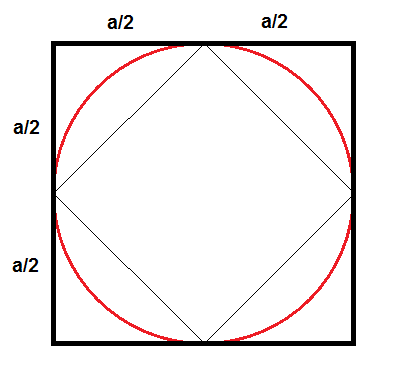
Could you please explain how you derived the area of a small square ?

Forgive my ignorance but after spending 10 mins i am still lost :(

Thanks in Advance
User avatar
shasadou
Joined: 12 Aug 2015
Last visit: 24 Nov 2022
Posts: 219
Own Kudos:
3,175
 [1]
Given Kudos: 1,475
Concentration: General Management, Operations
GMAT 1: 640 Q40 V37
GMAT 2: 650 Q43 V36
GMAT 3: 600 Q47 V27
GPA: 3.3
WE:Management Consulting (Consulting)
GMAT 3: 600 Q47 V27
Posts: 219
Kudos: 3,175
 [1]
1
Kudos
Add Kudos
Bookmarks
Bookmark this Post
Let the side of the smaller square be root 2, hence the diagonal of circle = 2. The diag of circle a the same time equals the side of the larger square. Here is the fraction.

(2*4) / (4*root2)
avatar
michaeltorre
Joined: 27 Jun 2016
Last visit: 11 Nov 2018
Posts: 1
Posts: 1
Kudos: 0
Kudos
Add Kudos
Bookmarks
Bookmark this Post
Isn't it also possible to use a smart number here?

Say the larger square's side equals 4 then two sides of the triangle would equal 2. The hypotenuse (and one side of the smaller square) would equal 2root2. The larger square would have a perimeter of 16 and smaller square would have a perimeter of 8root2. At that point I feel like this approach should work but I think I missed something because I can't get to root2 as an answer.
avatar
bailz314
avatar
Current Student
Joined: 05 Sep 2016
Last visit: 17 Jul 2020
Posts: 5
Given Kudos: 28
Location: Argentina
GMAT 1: 650 Q43 V36
GPA: 3.4
GMAT 1: 650 Q43 V36
Posts: 5
Kudos: 0
Kudos
Add Kudos
Bookmarks
Bookmark this Post
Really didn´t know how to solve it... just thought that the ratio of the larger to the smaller should be larger than 1 (thus eliminating A and B), and shouldn´t be twice as large, so the only answer possible was C..
User avatar
spetznaz
Joined: 08 Jun 2015
Last visit: 14 Jul 2024
Posts: 254
Own Kudos:
Given Kudos: 147
Location: India
GMAT 1: 640 Q48 V29
GMAT 2: 700 Q48 V38
GPA: 3.33
Products:
Kudos
Add Kudos
Bookmarks
Bookmark this Post
The answer is option C.

The conventional method

Assume the radius of the circle to be r. The length of the smaller square is r*sqrt(2).
The length of the larger square is 2*r.

Now the ratio is (2*r)/(r*sqrt(2))

This is sqrt(2). Hence option C.
avatar
LeveragedTiger
Joined: 08 Mar 2017
Last visit: 26 Jan 2018
Posts: 12
Own Kudos:
Given Kudos: 14
Concentration: Finance, Strategy
GMAT 1: 730 Q49 V40
WE:Asset Management (Finance: Venture Capital)
GMAT 1: 730 Q49 V40
Posts: 12
Kudos: 11
Kudos
Add Kudos
Bookmarks
Bookmark this Post
For the smaller square inscribed in the circle, assume that the side of each square is X. Using the properties of squares, we know that the diagonal is x(rt 2). The perimeter of the smaller is square is 4*x = 4x.

Since the diagonal of the square is also the diameter of the circle, therefore the diameter also equals x(rt 2).

For the circle to be inscribed on the larger square, its diameter must equal the length of one of the sides of the square. So the length of the sides of the larger square are x(rt 2).

Therefore the perimeter of the large square is 4 * x(rt 2) = 4x(rt 2).

The question asks for the ratio of the perimeter of the larger square to the smaller square so we arrange:

4x(rt 2) / 4x.

The 4x's cancel out so we get rt 2 as the answer.
User avatar
jwang516
Joined: 31 Mar 2017
Last visit: 16 Apr 2019
Posts: 31
Own Kudos:
Given Kudos: 16
GMAT 1: 710 Q45 V42
GMAT 2: 730 Q50 V39
GMAT 3: 740 Q50 V40
GPA: 3.73
GMAT 3: 740 Q50 V40
Posts: 31
Kudos: 86
Kudos
Add Kudos
Bookmarks
Bookmark this Post
Where did I go wrong? I used smart numbers

Assuming each side of the large square is 2. Then the perimeter of the large sqaure is 8

The radius of the circle is half the Perimeter of the large sqaure which is 1
The radius of the circle is also half the diagonal of the small square inside the circle. The full diagonal of the small square is therefore 2.

We can make the small square inside the circle into two 45-45-90 triangles where the hypotnuse equals the diagonal which is 2

Therefore one side of the small sqaure is 2/SQRT(2) = 2* SQRT(2) / 2 = SQRT(2)
The perimeter of 4 sides of the small sqaure is 4 * SQRT(2)

Comparing this to the large sqaure would be 8 : 4SQRT(2) which simplifies to 1 : 1/2 SQRT(2)

However, the answer is just SQRT(2), not 1/2 SQRT(2)
User avatar
Bunuel
User avatar
Math Expert
Joined: 02 Sep 2009
Last visit: 22 Apr 2026
Posts: 109,740
Own Kudos:
Given Kudos: 105,816
Products:
Expert
Expert reply
Active GMAT Club Expert! Tag them with @ followed by their username for a faster response.
Posts: 109,740
Kudos: 810,521
Kudos
Add Kudos
Bookmarks
Bookmark this Post
jwang516
Where did I go wrong? I used smart numbers

Assuming each side of the large square is 2. Then the perimeter of the large sqaure is 8

The radius of the circle is half the Perimeter of the large sqaure which is 1
The radius of the circle is also half the diagonal of the small square inside the circle. The full diagonal of the small square is therefore 2.

We can make the small square inside the circle into two 45-45-90 triangles where the hypotnuse equals the diagonal which is 2

Therefore one side of the small sqaure is 2/SQRT(2) = 2* SQRT(2) / 2 = SQRT(2)
The perimeter of 4 sides of the small sqaure is 4 * SQRT(2)

Comparing this to the large sqaure would be 8 : 4SQRT(2) which simplifies to 1 : 1/2 SQRT(2)

However, the answer is just SQRT(2), not 1/2 SQRT(2)

Check below:

\(\frac{8}{4\sqrt{2}}=\frac{2}{\sqrt{2}}=\frac{\sqrt{2}*\sqrt{2}}{\sqrt{2}}=\sqrt{2}\).

Hope it helps.
User avatar
jwang516
Joined: 31 Mar 2017
Last visit: 16 Apr 2019
Posts: 31
Own Kudos:
Given Kudos: 16
GMAT 1: 710 Q45 V42
GMAT 2: 730 Q50 V39
GMAT 3: 740 Q50 V40
GPA: 3.73
GMAT 3: 740 Q50 V40
Posts: 31
Kudos: 86
Kudos
Add Kudos
Bookmarks
Bookmark this Post
Bunuel
jwang516
Where did I go wrong? I used smart numbers

Assuming each side of the large square is 2. Then the perimeter of the large sqaure is 8

The radius of the circle is half the Perimeter of the large sqaure which is 1
The radius of the circle is also half the diagonal of the small square inside the circle. The full diagonal of the small square is therefore 2.

We can make the small square inside the circle into two 45-45-90 triangles where the hypotnuse equals the diagonal which is 2

Therefore one side of the small sqaure is 2/SQRT(2) = 2* SQRT(2) / 2 = SQRT(2)
The perimeter of 4 sides of the small sqaure is 4 * SQRT(2)

Comparing this to the large sqaure would be 8 : 4SQRT(2) which simplifies to 1 : 1/2 SQRT(2)

However, the answer is just SQRT(2), not 1/2 SQRT(2)

Check below:

\(\frac{8}{4\sqrt{2}}=\frac{2}{\sqrt{2}}=\frac{\sqrt{2}*\sqrt{2}}{\sqrt{2}}=\sqrt{2}\).

Hope it helps.

Oh my goodness, the question asked for ratio of big square to small. Silly mistake on my part. Thanks for the help!
avatar
sealberg
Joined: 23 Aug 2016
Last visit: 29 May 2018
Posts: 44
Own Kudos:
Given Kudos: 1
Posts: 44
Kudos: 14
Kudos
Add Kudos
Bookmarks
Bookmark this Post
Side of smaller square = s
Perimeter of smaller square = 4s
Diagonal of smaller square, and hence the diameter of the circle = s*root2
The diameter of the circle = length of the side of the larger square
Perimeter of larger square = 4s*root2
Ratio of perimeter of larger square to perimeter of smaller square = 4s*root2/4s = root2 Answer C
avatar
krsrinath
Joined: 09 Aug 2014
Last visit: 27 Oct 2017
Posts: 4
Own Kudos:
Given Kudos: 217
Posts: 4
Kudos: 2
Kudos
Add Kudos
Bookmarks
Bookmark this Post
We could do it this way:

If ratio of sides of 2 Parallelograms (squares are parallelograms) = A/B , then ratio of areas will be \(\frac{A^2}{B^2}\)

Area of Square inscribed in a circle (Smaller square)= \(πa^2/4\) ----------Equation 1
Area of Square with a circle inscribed in it (Bigger square)= \(πa^2/2\)-----Equation 2

Now we have ratio of Areas as: \(\frac{Equation 2}{Equation 1}\) i.e. 2

Hence ratios of perimeters or sides = Square root of 2. \(C\)
User avatar
ayakik
Joined: 15 Sep 2022
Last visit: 31 Jan 2023
Posts: 9
Given Kudos: 9
GMAT 1: 610 Q36 V37
GMAT 2: 650 Q39 V41
GMAT 2: 650 Q39 V41
Posts: 9
Kudos: 0
Kudos
Add Kudos
Bookmarks
Bookmark this Post
Hello, how do we know that that is how the diagram will look? I knew that the diagonal of the smaller square would need to be the same as the circumference of the circle, but I got stuck after that. Any help would be appreciated. Thank you.

Bunuel KarishmaB avigutman
Moderators:
Math Expert
109740 posts
Founder
43149 posts