Events & Promotions
|
|

GMAT Club Daily Prep
Thank you for using the timer - this advanced tool can estimate your performance and suggest more practice questions. We have subscribed you to Daily Prep Questions via email.
Customized
for You
Track
Your Progress
Practice
Pays
Not interested in getting valuable practice questions and articles delivered to your email? No problem, unsubscribe here.
 Sep 21
07:00 PM EDT
-10:00 PM EDT
Boost your GMAT score in less than one month in a live online class + 6 months access to TTP OnDemand video courses included!


 14 Apr 2026, 22:13
Kudos
Bookmarks
| Data Sufficiency Butler: April 2025 | ||
| April 15 | DS 1 | DS 2 |
_______________________
DS 1
Before the start of the fall service cycle, the city transit authority revised Route G by increasing service frequency and adding a stop near a busy office district. Based on those changes, the authority expected the average (arithmetic mean) number of riders on Route G each weekday to increase by 20 percent. Did the average (arithmetic mean) number of riders on Route G each weekday actually increase by more than 25 percent?
(1) The actual average (arithmetic mean) number of riders on Route G each weekday was 500 higher than expected.
(2) The actual average (arithmetic mean) number of riders on Route G each weekday was less than 12,600.
_______________________
DS 2
During two 7-day promotional weeks, Week 1 and Week 2, a bike-share service tracked the total number of bicycles rented. If in Week 1, 20 percent of the bicycles rented were rented on Sunday, while in Week 2, 15 percent of the bicycles rented were rented on Sunday, were more bicycles rented in Week 2 than in Week 1?
(1) On each day from Monday through Saturday in Week 2, the number of bicycles rented was at least 7 percent higher than the number rented on the corresponding day in Week 1.
(2) The number of bicycles rented on Sunday in Week 2 was greater than 76 percent of the number rented on Sunday in Week 1.
14 Apr 2026, 22:13
Kudos
Bookmarks
We continue posting New questions from GMAT Club Tests. Give these a try, post your solution, and earn kudos for a correct answer.
Fresh question:
1. https://gmatclub.com/forum/before-the-s ... 56467.html
2. https://gmatclub.com/forum/during-two-7 ... 56466.html
All NEW Data Sufficiency Questions (batch 4):
1. https://gmatclub.com/forum/a-local-arts ... 56327.html
2. https://gmatclub.com/forum/elena-marco- ... 56387.html
3. https://gmatclub.com/forum/cedar-court- ... 56386.html
4. https://gmatclub.com/forum/during-a-two ... 56434.html
5. https://gmatclub.com/forum/for-a-trade- ... 56433.html
6. https://gmatclub.com/forum/before-the-s ... 56467.html
7. https://gmatclub.com/forum/during-two-7 ... 56466.html
Fresh question:
1. https://gmatclub.com/forum/before-the-s ... 56467.html
2. https://gmatclub.com/forum/during-two-7 ... 56466.html
All NEW Data Sufficiency Questions (batch 4):
1. https://gmatclub.com/forum/a-local-arts ... 56327.html
2. https://gmatclub.com/forum/elena-marco- ... 56387.html
3. https://gmatclub.com/forum/cedar-court- ... 56386.html
4. https://gmatclub.com/forum/during-a-two ... 56434.html
5. https://gmatclub.com/forum/for-a-trade- ... 56433.html
6. https://gmatclub.com/forum/before-the-s ... 56467.html
7. https://gmatclub.com/forum/during-two-7 ... 56466.html

 15 Apr 2026, 08:00
Kudos
Bookmarks
April 15th Quant Question of the Day
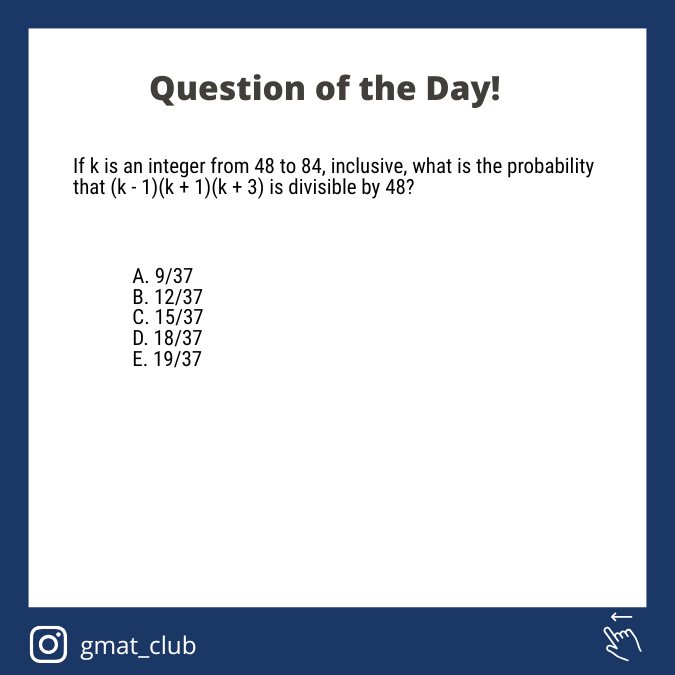
Answer and Explanation | Subscribe via E-mail, Forum, Instagram, or YouTube
Answer and Explanation | Subscribe via E-mail, Forum, Instagram, or YouTube