Last visit was: 26 Apr 2026, 06:55 It is currently 26 Apr 2026, 06:55
Close
GMAT Club Daily Prep
Thank you for using the timer - this advanced tool can estimate your performance and suggest more practice questions. We have subscribed you to Daily Prep Questions via email.

Customized
for You

we will pick new questions that match your level based on your Timer History

Track
Your Progress

every week, we’ll send you an estimated GMAT score based on your performance

Practice
Pays

we will pick new questions that match your level based on your Timer History
Not interested in getting valuable practice questions and articles delivered to your email? No problem, unsubscribe here.
Close
Request Expert Reply
Confirm Cancel
User avatar
Bunuel
User avatar
Math Expert
Joined: 02 Sep 2009
Last visit: 26 Apr 2026
Posts: 109,837
Own Kudos:
811,372
 [8]
Given Kudos: 105,895
Products:
Expert
Expert reply
Active GMAT Club Expert! Tag them with @ followed by their username for a faster response.
Posts: 109,837
Kudos: 811,372
 [8]
1
Kudos
Add Kudos
7
Bookmarks
Bookmark this Post
User avatar
Bunuel
User avatar
Math Expert
Joined: 02 Sep 2009
Last visit: 26 Apr 2026
Posts: 109,837
Own Kudos:
Given Kudos: 105,895
Products:
Expert
Expert reply
Active GMAT Club Expert! Tag them with @ followed by their username for a faster response.
Posts: 109,837
Kudos: 811,372
Kudos
Add Kudos
Bookmarks
Bookmark this Post
avatar
filipTGIM
Joined: 21 May 2013
Last visit: 11 Nov 2018
Posts: 5
Own Kudos:
Given Kudos: 5
Posts: 5
Kudos: 22
Kudos
Add Kudos
Bookmarks
Bookmark this Post
avatar
Anonamy
Joined: 01 Aug 2014
Last visit: 21 Jun 2016
Posts: 40
Own Kudos:
Given Kudos: 34
GMAT 1: 710 Q44 V42
GMAT 1: 710 Q44 V42
Posts: 40
Kudos: 117
Kudos
Add Kudos
Bookmarks
Bookmark this Post
I took the wrong approach with this question, would someone kindly clarify?

I had done a quick sketch of 0,6 on a graph and assumed that since the distance between the first point and where x meets the number line (x, 0) then the hypotenuse would be 16, and the radius would therefore be 16.

Where am I going wrong? I recognize that a 6-8-10 triangle can be formed from the side with a value of 6 however how does length 16 factor into this? Thanks
User avatar
Bunuel
User avatar
Math Expert
Joined: 02 Sep 2009
Last visit: 26 Apr 2026
Posts: 109,837
Own Kudos:
811,372
 [4]
Given Kudos: 105,895
Products:
Expert
Expert reply
Active GMAT Club Expert! Tag them with @ followed by their username for a faster response.
Posts: 109,837
Kudos: 811,372
 [4]
4
Kudos
Add Kudos
Bookmarks
Bookmark this Post
Anonamy
I took the wrong approach with this question, would someone kindly clarify?

I had done a quick sketch of 0,6 on a graph and assumed that since the distance between the first point and where x meets the number line (x, 0) then the hypotenuse would be 16, and the radius would therefore be 16.

Where am I going wrong? I recognize that a 6-8-10 triangle can be formed from the side with a value of 6 however how does length 16 factor into this? Thanks


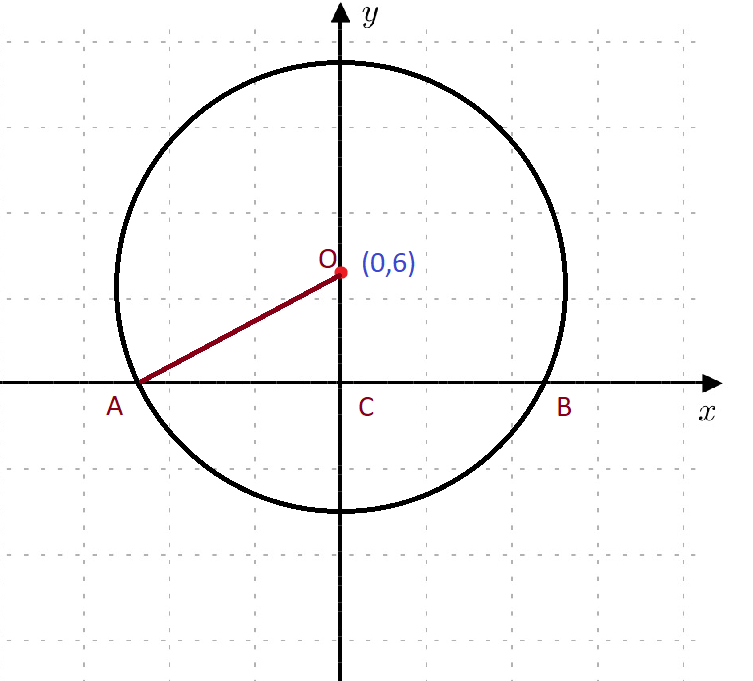
The center of the circle is on y-axis, so it's symmetric around it. We know that the the distance between the two points where the circle intersects the x-axis is 16, hence half of it (8 units) must be to the left of 0 and the remaining half (another 8 units) to the right of 0.

As you can see the radius of the circle is a hypotenuse of a right triangle with the sides equal to 6 and 16/2=8 (6-8-10 right triangle), so radius=hypotenuse=10. The area is \(\pi{r^2}=100\pi\).

Attachment:
Circle.png
Circle.png [ 11.15 KiB | Viewed 17403 times ]
User avatar
Senthil7
Joined: 31 Mar 2016
Last visit: 05 Mar 2017
Posts: 322
Own Kudos:
Given Kudos: 197
Location: India
Concentration: Operations, Finance
GMAT 1: 670 Q48 V34
GPA: 3.8
WE:Operations (Commercial Banking)
GMAT 1: 670 Q48 V34
Posts: 322
Kudos: 218
Kudos
Add Kudos
Bookmarks
Bookmark this Post
I think this is a high-quality question and I agree with explanation. Wow. This is a 700 level question certainly not 600 as classified by you Bunuel. Anyway terrific question in my view! Great work!
User avatar
spetznaz
Joined: 08 Jun 2015
Last visit: 14 Jul 2024
Posts: 254
Own Kudos:
Given Kudos: 147
Location: India
GMAT 1: 640 Q48 V29
GMAT 2: 700 Q48 V38
GPA: 3.33
Products:
Kudos
Add Kudos
Bookmarks
Bookmark this Post
+1 for option E. Draw the graph , the answer will stand out almost immediately !
avatar
zishu912
Joined: 31 Jan 2018
Last visit: 02 Nov 2019
Posts: 52
Own Kudos:
Given Kudos: 39
GMAT 1: 700 Q46 V40
GMAT 1: 700 Q46 V40
Posts: 52
Kudos: 35
Kudos
Add Kudos
Bookmarks
Bookmark this Post
100pi
User avatar
EgmatQuantExpert
User avatar
e-GMAT Representative
Joined: 04 Jan 2015
Last visit: 02 Apr 2024
Posts: 3,657
Own Kudos:
20,890
 [1]
Given Kudos: 165
Expert
Expert reply
Posts: 3,657
Kudos: 20,890
 [1]
1
Kudos
Add Kudos
Bookmarks
Bookmark this Post

Solution:


Given:

    • Centre of the circle is at (6,0)

    • The distance between points where the circle intersects the x-axis = 16 units

Working out:

We need to find out the area of the circle.

To solve this problem, let us first draw a proper diagram.


The distance AB is 16 units (given in the question)

Since the diagram is symmetrical, AC=CB= AC/2 = 8 units.

OC = 6 units

Thus, AO (Radius of the circle) = \(\sqrt{( 6^2 + 8^2)}\) = \(\sqrt{100}\) = 10 units

Hence the area of the square = \(pie * 10^2 = 100 pie\)

Answer: Option E
User avatar
RenanBragion
User avatar
Current Student
Joined: 01 Jun 2020
Last visit: 14 Oct 2025
Posts: 130
Own Kudos:
Given Kudos: 12
Location: Brazil
GMAT 1: 760 Q48 V46
Products:
GMAT 1: 760 Q48 V46
Posts: 130
Kudos: 14
Kudos
Add Kudos
Bookmarks
Bookmark this Post
I think this is a high-quality question and I agree with explanation.
User avatar
Kali123
Joined: 24 Jun 2017
Last visit: 29 Sep 2022
Posts: 24
Own Kudos:
Given Kudos: 70
Posts: 24
Kudos: 9
Kudos
Add Kudos
Bookmarks
Bookmark this Post
Bunuel
Official Solution:

The center of the circle is at point \((0, 6)\). If the distance between the two points where the circle intersects the x-axis is 16, what is the area of the circle?

A. \(36\pi\)
B. \(45\pi\)
C. \(64\pi\)
D. \(81\pi\)
E. \(100\pi\)

The radius of the circle \(= \sqrt{6^2 + 8^2} = 10\). The area \(= \pi10^2 = 100\pi\).

Answer: E

Hi Bunuel,

Why should the diagram be symmtrical?
User avatar
chetan2u
User avatar
GMAT Expert
Joined: 02 Aug 2009
Last visit: 26 Apr 2026
Posts: 11,229
Own Kudos:
Given Kudos: 335
Status:Math and DI Expert
Location: India
Concentration: Human Resources, General Management
GMAT Focus 1: 735 Q90 V89 DI81
Products:
Expert
Expert reply
GMAT Focus 1: 735 Q90 V89 DI81
Posts: 11,229
Kudos: 45,021
Kudos
Add Kudos
Bookmarks
Bookmark this Post
srikarkali
Bunuel
Official Solution:

The center of the circle is at point \((0, 6)\). If the distance between the two points where the circle intersects the x-axis is 16, what is the area of the circle?

A. \(36\pi\)
B. \(45\pi\)
C. \(64\pi\)
D. \(81\pi\)
E. \(100\pi\)

The radius of the circle \(= \sqrt{6^2 + 8^2} = 10\). The area \(= \pi10^2 = 100\pi\).

Answer: E

Hi Bunuel,

Why should the diagram be symmtrical?

Because the center lies on y axis, that is y-axis acts as a diameter. The circle will be symmetrical about y-axis, as y-axis divide this circle in two parts
User avatar
bumpbot
User avatar
Non-Human User
Joined: 09 Sep 2013
Last visit: 04 Jan 2021
Posts: 38,988
Own Kudos:
Posts: 38,988
Kudos: 1,118
Kudos
Add Kudos
Bookmarks
Bookmark this Post
Automated notice from GMAT Club BumpBot:

A member just gave Kudos to this thread, showing it’s still useful. I’ve bumped it to the top so more people can benefit. Feel free to add your own questions or solutions.

This post was generated automatically.
Moderators:
Math Expert
109837 posts
Founder
43161 posts