Last visit was: 22 Apr 2026, 05:02 It is currently 22 Apr 2026, 05:02
Close
GMAT Club Daily Prep
Thank you for using the timer - this advanced tool can estimate your performance and suggest more practice questions. We have subscribed you to Daily Prep Questions via email.

Customized
for You

we will pick new questions that match your level based on your Timer History

Track
Your Progress

every week, we’ll send you an estimated GMAT score based on your performance

Practice
Pays

we will pick new questions that match your level based on your Timer History
Not interested in getting valuable practice questions and articles delivered to your email? No problem, unsubscribe here.
Close
Request Expert Reply
Confirm Cancel
User avatar
Toma13
Joined: 08 Nov 2023
Last visit: 02 Jan 2024
Posts: 6
Own Kudos:
474
 [190]
Given Kudos: 2
GMAT Focus 1: 645 Q82 V81 DI82
Posts: 6
Kudos: 474
 [190]
11
Kudos
Add Kudos
179
Bookmarks
Bookmark this Post
Most Helpful Reply
User avatar
Jahnavi_M
Joined: 15 Jul 2023
Last visit: 19 Jan 2024
Posts: 7
Own Kudos:
70
 [68]
Given Kudos: 39
Posts: 7
Kudos: 70
 [68]
47
Kudos
Add Kudos
21
Bookmarks
Bookmark this Post
User avatar
KarishmaB
Joined: 16 Oct 2010
Last visit: 21 Apr 2026
Posts: 16,439
Own Kudos:
79,383
 [25]
Given Kudos: 484
Location: Pune, India
Expert
Expert reply
Active GMAT Club Expert! Tag them with @ followed by their username for a faster response.
Posts: 16,439
Kudos: 79,383
 [25]
23
Kudos
Add Kudos
2
Bookmarks
Bookmark this Post
General Discussion
User avatar
ankitmba95
Joined: 31 Oct 2023
Last visit: 17 Dec 2023
Posts: 30
Own Kudos:
26
 [9]
Given Kudos: 11
Location: India
Concentration: Finance, Technology
GMAT 1: 710 Q50 V35
GMAT 2: 750 Q50 V41
GPA: 3.15
WE:Sales (Other)
Products:
GMAT 2: 750 Q50 V41
Posts: 30
Kudos: 26
 [9]
9
Kudos
Add Kudos
Bookmarks
Bookmark this Post
By trying to form sum:

7 -> 1 cannot be any of the 3 numbers. Next (2,3,2) is again >1. so not possible
9 -> (3,3,3) fits well. possible
11 -> trying (2,3,6); It fits well as 1/2+1/3 = 5/6. possible

Thus answer is E.
User avatar
Toma13
Joined: 08 Nov 2023
Last visit: 02 Jan 2024
Posts: 6
Own Kudos:
474
 [9]
Given Kudos: 2
GMAT Focus 1: 645 Q82 V81 DI82
Posts: 6
Kudos: 474
 [9]
9
Kudos
Add Kudos
Bookmarks
Bookmark this Post
ankitmba95
By trying to form sum:

7 -> 1 cannot be any of the 3 numbers. Next (2,3,2) is again >1. so not possible
9 -> (3,3,3) fits well. possible
11 -> trying (2,3,6); It fits well as 1/2+1/3 = 5/6. possible

Thus answer is E.


I was thinking about just putting random values to check, but I was really hoping to find out a pattern. When I had this ex in my mock test, I found 9 to fit and had a strong feeling about 11 as well, but I tried like 4 4 3 and one more and it didn't work, so I concluded that only the second one works. Is there any way to find it easier or just trial and error?
User avatar
HarshaBujji
Joined: 29 Jun 2020
Last visit: 05 Apr 2026
Posts: 723
Own Kudos:
906
 [1]
Given Kudos: 247
Location: India
Products:
Posts: 723
Kudos: 906
 [1]
1
Kudos
Add Kudos
Bookmarks
Bookmark this Post
Number guessing is the easiest way in these type of questions. We can eliminate most of the sets directly.

1/5 + .... cannot make a combination.

1/2 + 1/4 + 1/4
1/3+1/3+1/3
1/6 + 1/2 + 1/3

Only possible sets.
User avatar
chetan2u
User avatar
GMAT Expert
Joined: 02 Aug 2009
Last visit: 22 Apr 2026
Posts: 11,229
Own Kudos:
44,988
 [3]
Given Kudos: 335
Status:Math and DI Expert
Location: India
Concentration: Human Resources, General Management
GMAT Focus 1: 735 Q90 V89 DI81
Products:
Expert
Expert reply
GMAT Focus 1: 735 Q90 V89 DI81
Posts: 11,229
Kudos: 44,988
 [3]
3
Kudos
Add Kudos
Bookmarks
Bookmark this Post
 
Toma13
If x, y and z are positive integers, such that 1/x + 1/y + 1/z = 1, which of the following could be the value of x + y + z?

I. 7
II. 9
III. 11

(A) I only
(B) II only
(C) III only
(D) I and II only
(E) II and III only
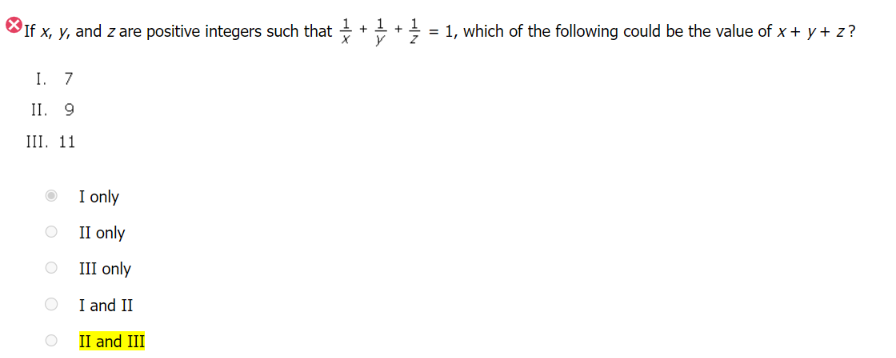
Attachment:
2024-01-29_19-36-12.png
­samarpan.g28, the moment I read your question, my instinct told me to simplify the equation, add number properties to it and look for a solution. Normally, using options would be the best way forward.
(I)
\(\frac{1}{x} + \frac{1}{y }+\frac{ 1}{z} = 1 \)
Observation: The greatest term (1/a) of the three cannot be less than the average 1/3, so one of the three integers has to be 2 or 3.
So if one is 3: \(\frac{1}{3} + \frac{1}{y }+\frac{ 1}{z} = 1 \)......\( \frac{1}{y }+\frac{ 1}{z} = \frac{2}{3} =\frac{1}{3} +\frac{1}{3}\)....3+3+3=9
If one is 2: \(\frac{1}{2} + \frac{1}{y }+\frac{ 1}{z} = 1 \)......\( \frac{1}{y }+\frac{ 1}{z} = \frac{1}{2} =\frac{1}{4} +\frac{1}{4}=\frac{1}{3} +\frac{1}{6}\)
....2+4+4=10 and 2+3+4 = 11
Clearly taking the two largest as 1/2 and 1/3 will require 1/6. Thus none can be less than 6.

(II)
x, y and z are positive integers, so let us take three cases

1. All three are equal: x=y=z, so \(\frac{1}{x} + \frac{1}{y }+\frac{ 1}{z} = 1 \)
\(\frac{1}{x} + \frac{1}{x }+\frac{ 1}{x} = 1.......\frac{3}{x}=1....x=3 \)
\(\frac{1}{3} + \frac{1}{3 }+\frac{ 1}{3} = 1 \)
So, solution, 3,3,3 and x+y+z=9
2. Exactly two are equal: y=z, so \(\frac{1}{x} + \frac{1}{y }+\frac{ 1}{z} = 1 \)
\(\frac{1}{x} + \frac{1}{y }+\frac{ 1}{y} = 1.......\frac{1}{x}+\frac{2}{y}=1......\frac{1}{x}+/frac{1}{\frac{y}{2}} =1\)
Only possibility = \(\frac{1}{2}+\frac{1}{2}=1........x=2, y=z=4\) 
\(\frac{1}{2} + \frac{1}{4}+\frac{ 1}{4} = 1 \)
So, solution, 2, 4, 4 and x+y+z=10
3. All three are different:  \(\frac{1}{x} + \frac{1}{y }+\frac{ 1}{z} = 1 \)
\(\frac{xy+yz+xz}{xyz}=1........... xy+yz+xz=xyz.........xyz-xy=xz+yz.......xy(z-1)=z(x+y)\)
As z and z-1 are co-prime, we can take z=xy and z-1 = x+y. Thus, xy = x+y+1
Only possibility = > x=2 and y=3.
\(\frac{1}{2} + \frac{1}{3}+\frac{ 1}{6} = 1 \)
So, solution, 2, 3, 6 and x+y+z=11
 ­­
User avatar
sayan640
Joined: 29 Oct 2015
Last visit: 22 Apr 2026
Posts: 1,120
Own Kudos:
861
 [2]
Given Kudos: 789
GMAT 1: 570 Q42 V28
Products:
GMAT 1: 570 Q42 V28
Posts: 1,120
Kudos: 861
 [2]
2
Kudos
Add Kudos
Bookmarks
Bookmark this Post
KarishmaB gmatophobia, Can I face any problem if I follow this approach ? This looks much easier to follow and quick also.
Jahnavi_M
Here, we have to use Arithmetic mean >= Harmonic Mean,

(X+Y+Z)/3 >= 3/(1/X + 1/Y + 1/Z)

(X+Y+Z) >= 3 * 3/1

(X+Y+Z) >= 9

Posted from my mobile device
­
User avatar
Oppenheimer1945
Joined: 16 Jul 2019
Last visit: 21 Apr 2026
Posts: 786
Own Kudos:
663
 [2]
Given Kudos: 236
Location: India
GMAT Focus 1: 645 Q90 V76 DI80
GPA: 7.81
2
Kudos
Add Kudos
Bookmarks
Bookmark this Post
sayan640
KarishmaB gmatophobia, Can I face any problem if I follow this approach ? This looks much easier to follow and quick also.
Jahnavi_M
Here, we have to use Arithmetic mean >= Harmonic Mean,

(X+Y+Z)/3 >= 3/(1/X + 1/Y + 1/Z)

(X+Y+Z) >= 3 * 3/1

(X+Y+Z) >= 9

Posted from my mobile device
­

Yes. This is actually the mathematical way to solve this problem.

AM>=HM
.
For equal values of x,y,z; the value of expression will have min of 9. Now only make sure integers work here
User avatar
DanTheGMATMan
Joined: 02 Oct 2015
Last visit: 18 Apr 2026
Posts: 380
Own Kudos:
267
 [1]
Given Kudos: 9
Expert
Expert reply
Posts: 380
Kudos: 267
 [1]
1
Kudos
Add Kudos
Bookmarks
Bookmark this Post
­I think choosing numbers and noticing the constraints on the numbers is ultimately the best way to go. That harmonic mean thing doesn't help you much and its more work. Karishmab explains it nicely.

Here's me working through it:

­
User avatar
KarishmaB
Joined: 16 Oct 2010
Last visit: 21 Apr 2026
Posts: 16,439
Own Kudos:
79,383
 [1]
Given Kudos: 484
Location: Pune, India
Expert
Expert reply
Active GMAT Club Expert! Tag them with @ followed by their username for a faster response.
Posts: 16,439
Kudos: 79,383
 [1]
Kudos
Add Kudos
1
Bookmarks
Bookmark this Post
sayan640
KarishmaB gmatophobia, Can I face any problem if I follow this approach ? This looks much easier to follow and quick also.
Jahnavi_M
Here, we have to use Arithmetic mean >= Harmonic Mean,

(X+Y+Z)/3 >= 3/(1/X + 1/Y + 1/Z)

(X+Y+Z) >= 3 * 3/1

(X+Y+Z) >= 9

Posted from my mobile device
­
­
If you know it and it comes to mind during the test, you can of course. GMAT doesn't care what method you use to arrive at the answer. Though it doesn't question you on GP and HP directly. There would always be other methods (or logic or estimation) by which you can get the answer. Otherwise there will be no end to math concepts you must know for GMAT. After all, it is a test of logic.
User avatar
egmat
User avatar
e-GMAT Representative
Joined: 02 Nov 2011
Last visit: 21 Apr 2026
Posts: 5,632
Own Kudos:
33,430
 [6]
Given Kudos: 707
GMAT Date: 08-19-2020
Expert
Expert reply
Active GMAT Club Expert! Tag them with @ followed by their username for a faster response.
Posts: 5,632
Kudos: 33,430
 [6]
5
Kudos
Add Kudos
1
Bookmarks
Bookmark this Post
­Dive into this challenging question that tests your ability to think outside the box. While there's no predefined method to solve, this video demonstrates how to approach such problems by:
  1. Carefully analyzing the given information
  2. Drawing key inferences from the data
  3. Developing a step-by-step solving process

Watch as we break down the question, highlighting crucial insights that lead to the solution. This video emphasizes the importance of:
  1. Patience in tackling complex problems
  2. The value of spending time on challenging questions
  3. How strong inference skills can unlock seemingly difficult scenarios


While this question may take longer than others, mastering such problems can significantly boost your problem-solving abilities and exam performance.
Can you spot the critical inferences before they're pointed out in the solution?

 ­
User avatar
Dbrunik
Joined: 13 Apr 2024
Last visit: 20 Apr 2026
Posts: 259
Own Kudos:
136
 [2]
Given Kudos: 267
Location: United States (MN)
Concentration: Finance, Technology
GMAT Focus 1: 625 Q84 V82 DI77
Posts: 259
Kudos: 136
 [2]
1
Kudos
Add Kudos
1
Bookmarks
Bookmark this Post
try this case to make sure you understand the concept tested here.


it also helps to break them out the answer choices into its factors.

for example, 18 has 18,1,2,9,3,6 as factors.

this tells you the fractions have to include the numbers above, and we can prove this, since 1/3+1/3+1/6+1/6 = 18
avatar
rachanarc
Joined: 13 Oct 2020
Last visit: 22 Oct 2025
Posts: 6
Own Kudos:
2
 [1]
Given Kudos: 154
Location: India
Concentration: General Management, International Business
Products:
Posts: 6
Kudos: 2
 [1]
1
Kudos
Add Kudos
Bookmarks
Bookmark this Post
Dbrunik Answer is (A) is correct? works only for 18.. But this approach took me sometime to solve :?

Can you please elaborate the approach with the concept that you are suggesting here.

Thanks in advance! This brings a new perspective to these kindof questions:)
Dbrunik
try this case to make sure you understand the concept tested here.


it also helps to break them out the answer choices into its factors.

for example, 18 has 18,1,2,9,3,6 as factors.

this tells you the fractions have to include the numbers above, and we can prove this, since 1/3+1/3+1/6+1/6 = 18
User avatar
Dbrunik
Joined: 13 Apr 2024
Last visit: 20 Apr 2026
Posts: 259
Own Kudos:
Given Kudos: 267
Location: United States (MN)
Concentration: Finance, Technology
GMAT Focus 1: 625 Q84 V82 DI77
Posts: 259
Kudos: 136
Kudos
Add Kudos
Bookmarks
Bookmark this Post
No a is not correct, but you could also see that there are other numbers not listed that could work. The obvious one being 16.

Even if you try 24 you’ll find the factors to be 24 and one 12 and 2, and three and 8, and six and four. If you play around with these numbers. You’ll find that you cannot make one with any organization of their reciprocal.

Beyond 16, there are numbers beyond (18, 20, 24) that can serve as the sum of four positive integers whose reciprocals add up to 1. There’s no inherent uniqueness to 18; it just happens to be a convenient example that works out nicely among the given options.

One is equal to 1/2+1/3+1/7+1/42

If this isn’t Immediately obvious to you, notice how 2×3×7 = 42. Try this tactic with other numbers or with other sets of fractions.

54 works.


rachanarc
Dbrunik Answer is (A) is correct? works only for 18.. But this approach took me sometime to solve :?

Can you please elaborate the approach with the concept that you are suggesting here.

Thanks in advance! This brings a new perspective to these kindof questions:)
Dbrunik
try this case to make sure you understand the concept tested here.


it also helps to break them out the answer choices into its factors.

for example, 18 has 18,1,2,9,3,6 as factors.

this tells you the fractions have to include the numbers above, and we can prove this, since 1/3+1/3+1/6+1/6 = 18
User avatar
Dbrunik
Joined: 13 Apr 2024
Last visit: 20 Apr 2026
Posts: 259
Own Kudos:
Given Kudos: 267
Location: United States (MN)
Concentration: Finance, Technology
GMAT Focus 1: 625 Q84 V82 DI77
Posts: 259
Kudos: 136
Kudos
Add Kudos
Bookmarks
Bookmark this Post
20 also works here

This becomes clear because 1/6+1/6+1/6+1/2=1


rachanarc
Dbrunik Answer is (A) is correct? works only for 18.. But this approach took me sometime to solve :?

Can you please elaborate the approach with the concept that you are suggesting here.

Thanks in advance! This brings a new perspective to these kindof questions:)
Dbrunik
try this case to make sure you understand the concept tested here.


it also helps to break them out the answer choices into its factors.

for example, 18 has 18,1,2,9,3,6 as factors.

this tells you the fractions have to include the numbers above, and we can prove this, since 1/3+1/3+1/6+1/6 = 18
User avatar
Kinshook
User avatar
Major Poster
Joined: 03 Jun 2019
Last visit: 22 Apr 2026
Posts: 5,986
Own Kudos:
Given Kudos: 163
Location: India
GMAT 1: 690 Q50 V34
WE:Engineering (Transportation)
Products:
GMAT 1: 690 Q50 V34
Posts: 5,986
Kudos: 5,855
Kudos
Add Kudos
Bookmarks
Bookmark this Post
If x, y and z are positive integers, such that 1/x + 1/y + 1/z = 1, which of the following could be the value of x + y + z?

1/z = 1 - 1/x - 1/y = (xy - x - y)/xy

z = xy/(xy-x-y)

x = 1; y = 1; z = 1/(1-1-1) = -1; Not feasible since x, y and z are positive integers
x = 1; y = 2; z = 2/(2-1-2) = -2; Not feasible since x, y and z are positive integers
x= 2; y = 2; z = 4/(4-2-2); Not feasible since x, y and z are positive integers
x = 2; y = 3; z = 6/(6-2-3) = 5; x + y + z = 2 + 3 + 6 = 11
x = 3; y = 3; z = 9/(9-3-3) = 3; x + y + z = 3 + 3 + 3 = 9
x = 3; y = 4; z = 12/(12-3-4) = 12/5; Not feasible since x, y and z are positive integers
x = 4; y = 4; x + y = 8 > 7; x+y+z can not be 7

I. 7
II. 9
III. 11

(A) I only
(B) II only
(C) III only
(D) I and II only
(E) II and III only

IMO E
User avatar
terminatork07
Joined: 29 Jul 2023
Last visit: 21 Apr 2026
Posts: 33
Own Kudos:
Given Kudos: 23
Posts: 33
Kudos: 5
Kudos
Add Kudos
Bookmarks
Bookmark this Post
Solution without involving any knowledge of Harmonic Mean concepts

If x = y = z = k , then k = 3 (then x + y + z = 9 is one solution).

Now let's keep of one the variables (z) = 3; which implies the sum of reciprocals of x and y should be equal to 2/3. (1/x + 1/y = 2/3)

From the above equation we can deduce (x+y)/xy = 2/3

From I and III lets back-solve -

For I to be correct - x + y = 7 - 3 = 4 AND x.y = 6

The solutions to these 2 equations is non-integeral so I is out (it's given in the question prompt that x and y can only be positive integers)

For III to be correct x + y = 8 AND x.y = 12

BINGO - x = 6 and y = 2 fits, so 11 is a possible solution.

RETRO -

Concepts tested in the question -
1. Averages (three number's sum - 1/x,1/y,1/z is 1 then average is 1/3, which means that if you decrease one number others should increase in the same proportion)
2. How fast are how in plugging in values and validating the answers.
3. Back-Solve from given data.
User avatar
XLmafia21
Joined: 23 Aug 2024
Last visit: 19 Apr 2026
Posts: 25
Own Kudos:
Given Kudos: 441
Location: India
GMAT Focus 1: 675 Q88 V85 DI77
Products:
GMAT Focus 1: 675 Q88 V85 DI77
Posts: 25
Kudos: 23
Kudos
Add Kudos
Bookmarks
Bookmark this Post
i interpreted this as %s adding upto 100%
drew a quick table for my reference starting from 2,3,4... till 10
1/2 = 50%
1/3 = 33.33%
1/4 = 25%
1/5 = 20%
1/6 = 16.67%
1/7 = 14.28%
1/8 = 12.5%
1/9 = 11.11%
1/10 = 10%
Now, can i think of combinations which would yield 100% as sum:
1. 33.33 % + 33.33% + 33.33% = 100% => x=y=z = 3 => x+y+z = 9
2. 50% + 25% + 25% = 100% => x=2, y=z= 4 => x+y+z = 10 (ignore)
3. 50% + 33.33% + 16.67% => x=2, y=3, z=6 => x+y+z = 11
Hence, option E
I think the best way is the AM>= HM property suggested by others.
User avatar
GMATGuruNY
Joined: 04 Aug 2010
Last visit: 02 Apr 2026
Posts: 1,347
Own Kudos:
Given Kudos: 9
Schools:Dartmouth College
Expert
Expert reply
Posts: 1,347
Kudos: 3,904
Kudos
Add Kudos
Bookmarks
Bookmark this Post
Toma13
If x, y and z are positive integers, such that 1/x + 1/y + 1/z = 1, which of the following could be the value of x + y + z?

I. 7
II. 9
III. 11

(A) I only
(B) II only
(C) III only
(D) I and II only
(E) II and III only

Attachment:
2024-01-29_19-36-12.png

\(\frac{1}{x} + \frac{1}{y} = 1 - \frac{1}{z}\)
\(\frac{1}{x} + \frac{1}{y} = \frac{z-1}{z}\)
Implication:
1/x + 1/y = 1/2, 2/3, 3/4, 4/5...

Case 1: z=2, implying that 1/x + 1/y = 1/2
If 1/x = 1/3, then 1/y = 1/2 - 1/3 = 1/6
Thus, it's possible that 1/x = 1/3 and 1/y = 1/6, with the result that x=3 and y=6.
In this case:
x+y+z = 3+6+2 = 11
Since III is possible, eliminate A, B and D, none of which includes III.

Case 2: z=3, implying that 1/x + 1/y = 2/3
Since 1/3 + 1/3 = 2/3, it's possible that 1/x = 1/3 and 1/y = 1/3, with the result that x=3 and y=3.
In this case:
x+y+z = 3+3+3 = 9
Since II is possible, eliminate C, which does not include II.

Moderators:
Math Expert
109740 posts
Tuck School Moderator
853 posts