Events & Promotions
|
|

GMAT Club Daily Prep
Thank you for using the timer - this advanced tool can estimate your performance and suggest more practice questions. We have subscribed you to Daily Prep Questions via email.
Customized
for You
Track
Your Progress
Practice
Pays
Not interested in getting valuable practice questions and articles delivered to your email? No problem, unsubscribe here.
 Sep 23
12:30 AM EDT
-01:30 AM EDT
Learn how Keshav, a Chartered Accountant, scored an impressive 705 on GMAT in just 30 days with GMATWhiz's expert guidance. In this video, he shares preparation tips and strategies that worked for him, including the mock, time management, and more Sep 24
01:30 AM EDT
-01:30 AM EDT
Tejas studied hard but kept repeating the same mistakes. After 3 attempts at 645, a focused 4-week strategy helped him identify and fix what was holding him back—leading to a 695 with just 12–15 hours of study per week. Sep 26
06:00 PM PDT
-07:00 PM PDT
Free- full-length test + 15 concept videos + 150+ short videos + study plan!

punit2020
Joined: 20 Mar 2020
Last visit: 02 Jul 2024
Posts: 35
Given Kudos: 64
Location: India
Schools: IESE '26 (D) Oxford Said'25 Judge '25 (D) Emory Goizueta (S) Marshall (II) HEC Jan'24 Intake (D) IE Sep'24 intake Kelley '26 (II) ESADE'26 (D) Imperial'25 Broad'26 (II) NUS '26 (D) Simon '26 (S) Owen '26 IMD (D) Fisher '26
GMAT Focus 1: 665 Q84 V84 DI81 
GMAT 1: 710 Q49 V38
GPA: 4
Schools: IESE '26 (D) Oxford Said'25 Judge '25 (D) Emory Goizueta (S) Marshall (II) HEC Jan'24 Intake (D) IE Sep'24 intake Kelley '26 (II) ESADE'26 (D) Imperial'25 Broad'26 (II) NUS '26 (D) Simon '26 (S) Owen '26 IMD (D) Fisher '26
GMAT Focus 1: 665 Q84 V84 DI81
GMAT 1: 710 Q49 V38
Posts: 35
 28 Dec 2023, 11:36
Kudos
Bookmarks


Dropdown 1: 3
Dropdown 2: 10
Be sure to select an answer first to save it in the Error Log before revealing the correct answer (OA)!
Difficulty:
 25%
(medium)
25%
(medium)
Question Stats:
84% (02:25) correct 16%
(02:57)
wrong
based on 1555
sessions
16%
(02:57)
wrong
based on 1555
sessions
History
Date
Time
Result
Not Attempted Yet
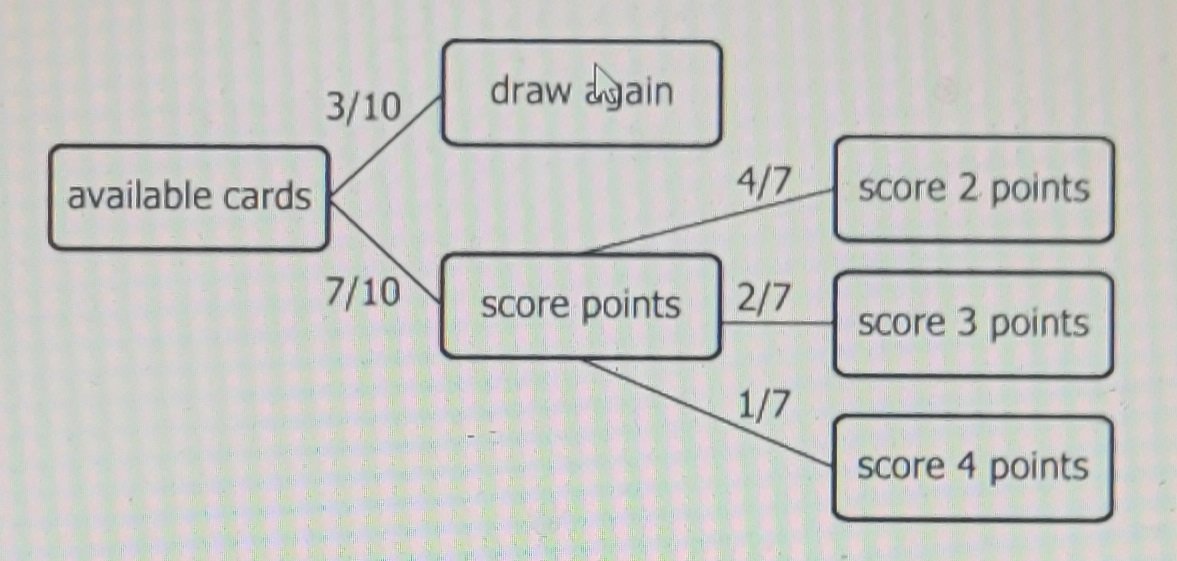
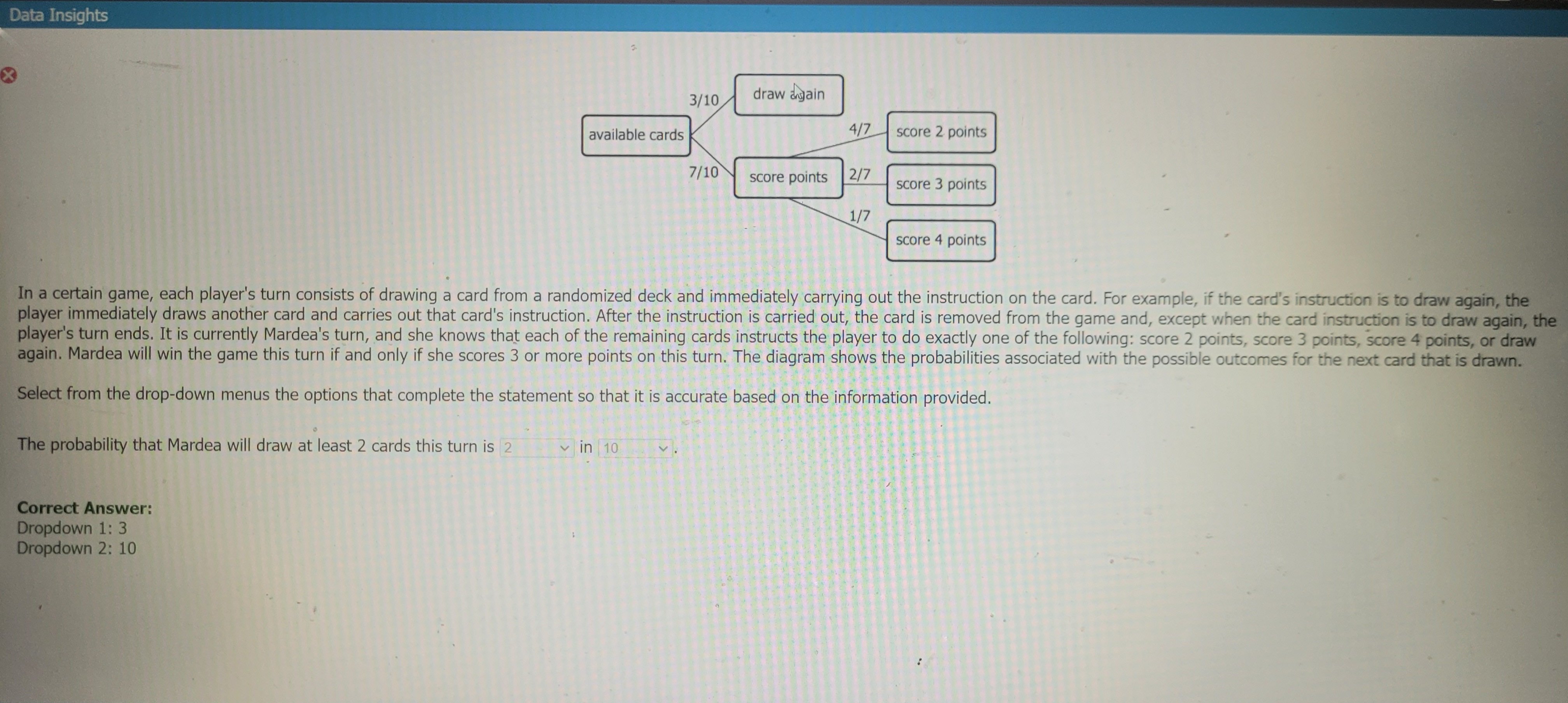
In a certain game, each player's turn consists of drawing a card from a randomized deck and immediately carrying out the instructions on the card. For example, if the card's instruction is to draw again, the player immediately draws another card and carries out that card's instruction. After the instruction is carried out, the card is removed from the game, and, except when the card instruction is to draw again, the player's turn ends. It is currently Mardea's turn, and she knows that each of the remaining cards instructs the player to do exactly one of the following: score 2 points, score 3 points, score 4 points, or draw again. Mardea will win the game this turn if and only if she scores 3 or more points on this turn. The diagram shows the probabilities associated with the possible outcomes for the next card that is drawn.
Select from the drop-down menus the options that complete the statement so that it is accurate based on the information provided.
The probability that Mardea will draw at least 2 cards this turn is in
Show SpoilerMy question
What will be the answer for the above question if it was aksed that " What is the probability that Mardea will win this game?"
I apologize beforehand because i am not following the laid down guidelines for posting any question. I have my exam in a few days, running short on time.
20231229_000125.jpg [ 166.89 KiB | Viewed 24456 times ]
I apologize beforehand because i am not following the laid down guidelines for posting any question. I have my exam in a few days, running short on time.
Attachment:
File comment: Official questiion
20231229_000125.jpg [ 1.49 MiB | Viewed 17633 times ]
20231229_000125.jpg [ 1.49 MiB | Viewed 17633 times ]
Attachment:
20231229_000125.jpg [ 166.89 KiB | Viewed 24456 times ]
ShowHide Answer
Official Answer
Dropdown 1: 3
Dropdown 2: 10
Pro tip:
Combine official questions for familiarity with GMAT Club Tests for analytics and tougher Focus-level practice so the real exam feels manageable.
Explore →

Fish181
Joined: 13 Dec 2023
Last visit: 10 Aug 2026
Posts: 127
Given Kudos: 53
Status:Applying in R1 of 2024 to t15
Affiliations: University of Tennessee
Location: United States (CO)
Concentration: Strategy, Finance
GMAT Focus 1: 605 Q76 V84 DI80
GMAT Focus 2: 615 Q78 V86 DI78
GPA: 3.62
WE:Analyst (Consumer Packaged Goods)
GMAT Focus 2: 615 Q78 V86 DI78
Posts: 127
18 Mar 2024, 09:35
Kudos
Bookmarks
In the spirit of DI questions, it made it really long and convoluted just to throw you off. It's simply asking given the probabilities, what are the odds that Mardea will draw 2 or more cards during her turn?
Well, she has to draw at least one card, so there is a 100% chance of that. We also know the only way to have more than one turn is if she gets the "draw again" card.
Knowing the rule of collectively exhaustive events https://www.statology.org/collectively-exhaustive/ we know that:
Probability of At least 2 = 1 - Probability(Only 1)
This is the mathematical way of saying "the odds of at least 2 turns is the total probability of anything possible (which is a 100% probability) minus the probability of only 1 turn."
The probability of only 1 turn would be if she scored points on the first draw, which the graph says is a 7/10 chance.
So the answer is 1 - 7/10 = 3/10 or 3 and 10.
Well, she has to draw at least one card, so there is a 100% chance of that. We also know the only way to have more than one turn is if she gets the "draw again" card.
Knowing the rule of collectively exhaustive events https://www.statology.org/collectively-exhaustive/ we know that:
Probability of At least 2 = 1 - Probability(Only 1)
This is the mathematical way of saying "the odds of at least 2 turns is the total probability of anything possible (which is a 100% probability) minus the probability of only 1 turn."
The probability of only 1 turn would be if she scored points on the first draw, which the graph says is a 7/10 chance.
So the answer is 1 - 7/10 = 3/10 or 3 and 10.

 28 Dec 2023, 11:44
Kudos
Bookmarks
punit2020
Mardea has to score 3 or more.
Let there be 10 cards, out of which 3 are draw again. So these cards will have no role on winning or losing.
Mardea will have to finally end the game by picking any of 7 cards: FOUR cards of 2 points, TWO cards of 3 points and ONE card of 4 points.
If he picks any of 3s and 4, he will win so has to pick any of three cards out of seven cards => P = 3/7
Original question: There are THREE draw again cards. If any is picked, Mardea will have to pick another card. So probability is 3 in total 10 cards.