Last visit was: 22 Apr 2026, 13:25 It is currently 22 Apr 2026, 13:25
Close
GMAT Club Daily Prep
Thank you for using the timer - this advanced tool can estimate your performance and suggest more practice questions. We have subscribed you to Daily Prep Questions via email.

Customized
for You

we will pick new questions that match your level based on your Timer History

Track
Your Progress

every week, we’ll send you an estimated GMAT score based on your performance

Practice
Pays

we will pick new questions that match your level based on your Timer History
Not interested in getting valuable practice questions and articles delivered to your email? No problem, unsubscribe here.
Close
Request Expert Reply
Confirm Cancel
User avatar
mirhaque
Joined: 02 Feb 2004
Last visit: 06 Aug 2008
Posts: 211
Own Kudos:
260
 [172]
Posts: 211
Kudos: 260
 [172]
17
Kudos
Add Kudos
155
Bookmarks
Bookmark this Post
Most Helpful Reply
User avatar
Bunuel
User avatar
Math Expert
Joined: 02 Sep 2009
Last visit: 22 Apr 2026
Posts: 109,754
Own Kudos:
Given Kudos: 105,823
Products:
Expert
Expert reply
Active GMAT Club Expert! Tag them with @ followed by their username for a faster response.
Posts: 109,754
Kudos: 810,659
 [74]
37
Kudos
Add Kudos
37
Bookmarks
Bookmark this Post
User avatar
Bunuel
User avatar
Math Expert
Joined: 02 Sep 2009
Last visit: 22 Apr 2026
Posts: 109,754
Own Kudos:
810,659
 [9]
Given Kudos: 105,823
Products:
Expert
Expert reply
Active GMAT Club Expert! Tag them with @ followed by their username for a faster response.
Posts: 109,754
Kudos: 810,659
 [9]
Kudos
Add Kudos
8
Bookmarks
Bookmark this Post
General Discussion
User avatar
anuu
Joined: 28 Feb 2011
Last visit: 16 Aug 2012
Posts: 30
Own Kudos:
24
 [1]
Given Kudos: 1
Posts: 30
Kudos: 24
 [1]
Kudos
Add Kudos
1
Bookmarks
Bookmark this Post
Bunuel
mirhaque
Set T consists of all points (x, y) such that x^2+y^2=1. If point (a, b) is selected from set T at random, what is the probability that b>a+1?

(A) \(\frac{1}{4}\)
(B) \(\frac{1}{3}\)
(C) \(\frac{1}{2}\)
(D) \(\frac{3}{5}\)
(E) \(\frac{2}{3}\)


PLS DRAW & ILLUSTRATE:

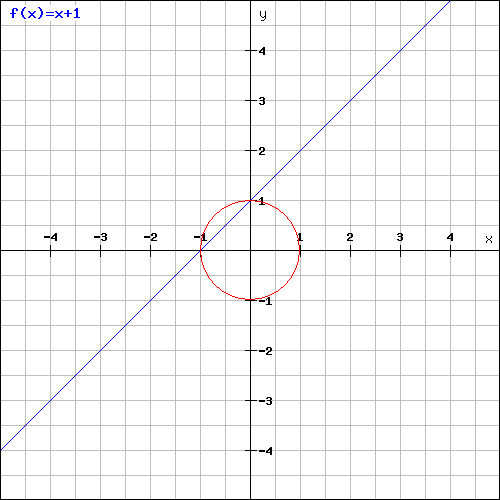
Look at the diagram below.
Attachment:
graph.php.png
The circle represented by the equation \(x^2+y^2 = 1\) is centered at the origin and has the radius of \(r=\sqrt{1}=1\) (for more on this check Coordinate Geometry chapter of math book: math-coordinate-geometry-87652.html ).

So, set T is the circle itself (red curve).

Question is: if point (a,b) is selected from set T at random, what is the probability that b>a+1? All points (a,b) which satisfy this condition (belong to T and have y-coordinate > x-coordinate + 1) lie above the line y=x+1 (blue line). You can see that portion of the circle which is above the line is 1/4 of the whole circumference, hence P=1/4.

Answer: A.

If it were: set T consists of all points (x,y) such that \(x^2+y^2<1\) (so set T consists of all points inside the circle). If point (a,b) is selected from set T at random, what is the probability that b>a+1?

Then as the area of the segment of the circle which is above the line is \(\frac{\pi{r^2}}{4}-\frac{r^2}{2}=\frac{\pi-2}{4}\) so \(P=\frac{area_{segment}}{area_{circle}}=\frac{\frac{\pi-2}{4}}{\pi{r^2}}=\frac{\pi-2}{4\pi}\).

Hope it's clear.

Hi Bunnel,

Can you pls explain how did u calculate area of segment above the line (pi-2/4) for x^2+y^2<1

Anu
User avatar
Bunuel
User avatar
Math Expert
Joined: 02 Sep 2009
Last visit: 22 Apr 2026
Posts: 109,754
Own Kudos:
810,659
 [4]
Given Kudos: 105,823
Products:
Expert
Expert reply
Active GMAT Club Expert! Tag them with @ followed by their username for a faster response.
Posts: 109,754
Kudos: 810,659
 [4]
3
Kudos
Add Kudos
1
Bookmarks
Bookmark this Post
anuu
Hi Bunnel,

Can you pls explain how did u calculate area of segment above the line (pi-2/4) for x^2+y^2<1

Anu

Sure. Look at the diagram. The area above the line equals to 1/4th of the area of the circle (\(\frac{\pi{r^2}}{4}\)) minus the area of the isosceles right triangle made by radii (\(\frac{1}{2}*r*r\)): \(\frac{\pi{r^2}}{4}-\frac{r^2}{2}=\frac{\pi}{4}-\frac{1}{2}=\frac{\pi-2}{4}\) (since given that \(r=1\)).

Hope it's clear.
User avatar
gmatprav
Joined: 25 Oct 2013
Last visit: 19 Nov 2015
Posts: 109
Own Kudos:
Given Kudos: 55
Posts: 109
Kudos: 186
Kudos
Add Kudos
Bookmarks
Bookmark this Post
Bunuel
mirhaque
Set T consists of all points (x, y) such that x^2+y^2=1. If point (a, b) is selected from set T at random, what is the probability that b>a+1?

(A) \(\frac{1}{4}\)
(B) \(\frac{1}{3}\)
(C) \(\frac{1}{2}\)
(D) \(\frac{3}{5}\)
(E) \(\frac{2}{3}\)


PLS DRAW & ILLUSTRATE:

Look at the diagram below.
Attachment:
graph.php.png
The circle represented by the equation \(x^2+y^2 = 1\) is centered at the origin and has the radius of \(r=\sqrt{1}=1\) (for more on this check Coordinate Geometry chapter of math book: math-coordinate-geometry-87652.html ).

So, set T is the circle itself (red curve).

Question is: if point (a,b) is selected from set T at random, what is the probability that b>a+1? All points (a,b) which satisfy this condition (belong to T and have y-coordinate > x-coordinate + 1) lie above the line y=x+1 (blue line). You can see that portion of the circle which is above the line is 1/4 of the whole circumference, hence P=1/4.

Answer: A.

If it were: set T consists of all points (x,y) such that \(x^2+y^2<1\) (so set T consists of all points inside the circle). If point (a,b) is selected from set T at random, what is the probability that b>a+1?

Then as the area of the segment of the circle which is above the line is \(\frac{\pi{r^2}}{4}-\frac{r^2}{2}=\frac{\pi-2}{4}\) so \(P=\frac{area_{segment}}{area_{circle}}=\frac{\frac{\pi-2}{4}}{\pi{r^2}}=\frac{\pi-2}{4\pi}\).

Hope it's clear.

Great explanation! very elegant. thanks Bunuel.
User avatar
jlgdr
Joined: 06 Sep 2013
Last visit: 24 Jul 2015
Posts: 1,302
Own Kudos:
Given Kudos: 355
Concentration: Finance
Posts: 1,302
Kudos: 2,975
Kudos
Add Kudos
Bookmarks
Bookmark this Post
Bunuel
pkonduri
Hi Bunuel,

Can you please take some time and clarify my doubt?

How did you arrive at P = 1/4, The portion of the circle that is above the line is (pi*r^2/4) - 1/* r^2 correct?

Check this: set-t-consists-of-all-points-x-y-such-that-x-2-y-2-1-if-15626.html#p1047717

Hope it helps.

Hi Bunuel,

Still don't get how did you arrive at the conclusion that the area above the line within the circle is 1/4th of the circle for the original question

Would you kindly elaborate on this

Thanks
Cheers!
J :)
User avatar
Bunuel
User avatar
Math Expert
Joined: 02 Sep 2009
Last visit: 22 Apr 2026
Posts: 109,754
Own Kudos:
Given Kudos: 105,823
Products:
Expert
Expert reply
Active GMAT Club Expert! Tag them with @ followed by their username for a faster response.
Posts: 109,754
Kudos: 810,659
Kudos
Add Kudos
Bookmarks
Bookmark this Post
jlgdr
Bunuel
pkonduri
Hi Bunuel,

Can you please take some time and clarify my doubt?

How did you arrive at P = 1/4, The portion of the circle that is above the line is (pi*r^2/4) - 1/* r^2 correct?

Check this: set-t-consists-of-all-points-x-y-such-that-x-2-y-2-1-if-15626.html#p1047717

Hope it helps.

Hi Bunuel,

Still don't get how did you arrive at the conclusion that the area above the line within the circle is 1/4th of the circle for the original question

Would you kindly elaborate on this

Thanks
Cheers!
J :)

Original question does not ask about the area, it asks about the portion of the circumference
User avatar
jlgdr
Joined: 06 Sep 2013
Last visit: 24 Jul 2015
Posts: 1,302
Own Kudos:
Given Kudos: 355
Concentration: Finance
Posts: 1,302
Kudos: 2,975
Kudos
Add Kudos
Bookmarks
Bookmark this Post
OK sorry now i get it. For a second i forgot that pi = 3.14159

Thanks
Cheers
J :)

Posted from my mobile device
User avatar
AliciaSierra
Joined: 17 Mar 2014
Last visit: 14 Jun 2024
Posts: 736
Own Kudos:
Given Kudos: 1,350
Products:
Posts: 736
Kudos: 648
Kudos
Add Kudos
Bookmarks
Bookmark this Post
Bunuel
mirhaque
Set T consists of all points (x, y) such that x^2+y^2=1. If point (a, b) is selected from set T at random, what is the probability that b>a+1?

(A) \(\frac{1}{4}\)
(B) \(\frac{1}{3}\)
(C) \(\frac{1}{2}\)
(D) \(\frac{3}{5}\)
(E) \(\frac{2}{3}\)


PLS DRAW & ILLUSTRATE:

Look at the diagram below.
Attachment:
graph.php.png
The circle represented by the equation \(x^2+y^2 = 1\) is centered at the origin and has the radius of \(r=\sqrt{1}=1\) (for more on this check Coordinate Geometry chapter of math book: math-coordinate-geometry-87652.html ).

So, set T is the circle itself (red curve).

Question is: if point (a,b) is selected from set T at random, what is the probability that b>a+1? All points (a,b) which satisfy this condition (belong to T and have y-coordinate > x-coordinate + 1) lie above the line y=x+1 (blue line). You can see that portion of the circle which is above the line is 1/4 of the whole circumference, hence P=1/4.

Answer: A.

If it were: set T consists of all points (x,y) such that \(x^2+y^2<1\) (so set T consists of all points inside the circle). If point (a,b) is selected from set T at random, what is the probability that b>a+1?

Then as the area of the segment of the circle which is above the line is \(\frac{\pi{r^2}}{4}-\frac{r^2}{2}=\frac{\pi-2}{4}\) so \(P=\frac{area_{segment}}{area_{circle}}=\frac{\frac{\pi-2}{4}}{\pi{r^2}}=\frac{\pi-2}{4\pi}\).

Hope it's clear.

Hi Bunuel,

Do we have more variations of such questions. If yes, could you share it i want to practice.

R/
Ammu
User avatar
sunita123
Joined: 13 Oct 2013
Last visit: 09 Mar 2022
Posts: 116
Own Kudos:
Given Kudos: 530
Concentration: Strategy, Entrepreneurship
Posts: 116
Kudos: 298
Kudos
Add Kudos
Bookmarks
Bookmark this Post
Hi Bunuel,

I understand the approach but can you please let me know how did you draw that blue line for f(x)=x+1?

Thanks


Bunuel
mirhaque
Set T consists of all points (x, y) such that x^2+y^2=1. If point (a, b) is selected from set T at random, what is the probability that b>a+1?

(A) \(\frac{1}{4}\)
(B) \(\frac{1}{3}\)
(C) \(\frac{1}{2}\)
(D) \(\frac{3}{5}\)
(E) \(\frac{2}{3}\)


PLS DRAW & ILLUSTRATE:

Look at the diagram below.
Attachment:
graph.php.png
The circle represented by the equation \(x^2+y^2 = 1\) is centered at the origin and has the radius of \(r=\sqrt{1}=1\) (for more on this check Coordinate Geometry chapter of math book: math-coordinate-geometry-87652.html ).

So, set T is the circle itself (red curve).

Question is: if point (a,b) is selected from set T at random, what is the probability that b>a+1? All points (a,b) which satisfy this condition (belong to T and have y-coordinate > x-coordinate + 1) lie above the line y=x+1 (blue line). You can see that portion of the circle which is above the line is 1/4 of the whole circumference, hence P=1/4.

Answer: A.

If it were: set T consists of all points (x,y) such that \(x^2+y^2<1\) (so set T consists of all points inside the circle). If point (a,b) is selected from set T at random, what is the probability that b>a+1?

Then as the area of the segment of the circle which is above the line is \(\frac{\pi{r^2}}{4}-\frac{r^2}{2}=\frac{\pi-2}{4}\) so \(P=\frac{area_{segment}}{area_{circle}}=\frac{\frac{\pi-2}{4}}{\pi{r^2}}=\frac{\pi-2}{4\pi}\).

Hope it's clear.
User avatar
Bunuel
User avatar
Math Expert
Joined: 02 Sep 2009
Last visit: 22 Apr 2026
Posts: 109,754
Own Kudos:
810,659
 [1]
Given Kudos: 105,823
Products:
Expert
Expert reply
Active GMAT Club Expert! Tag them with @ followed by their username for a faster response.
Posts: 109,754
Kudos: 810,659
 [1]
1
Kudos
Add Kudos
Bookmarks
Bookmark this Post
sunita123
Hi Bunuel,

I understand the approach but can you please let me know how did you draw that blue line for f(x)=x+1?

Thanks


Bunuel
mirhaque
Set T consists of all points (x, y) such that x^2+y^2=1. If point (a, b) is selected from set T at random, what is the probability that b>a+1?

(A) \(\frac{1}{4}\)
(B) \(\frac{1}{3}\)
(C) \(\frac{1}{2}\)
(D) \(\frac{3}{5}\)
(E) \(\frac{2}{3}\)


PLS DRAW & ILLUSTRATE:

Look at the diagram below.
Attachment:
graph.php.png
The circle represented by the equation \(x^2+y^2 = 1\) is centered at the origin and has the radius of \(r=\sqrt{1}=1\) (for more on this check Coordinate Geometry chapter of math book: math-coordinate-geometry-87652.html ).

So, set T is the circle itself (red curve).

Question is: if point (a,b) is selected from set T at random, what is the probability that b>a+1? All points (a,b) which satisfy this condition (belong to T and have y-coordinate > x-coordinate + 1) lie above the line y=x+1 (blue line). You can see that portion of the circle which is above the line is 1/4 of the whole circumference, hence P=1/4.

Answer: A.

If it were: set T consists of all points (x,y) such that \(x^2+y^2<1\) (so set T consists of all points inside the circle). If point (a,b) is selected from set T at random, what is the probability that b>a+1?

Then as the area of the segment of the circle which is above the line is \(\frac{\pi{r^2}}{4}-\frac{r^2}{2}=\frac{\pi-2}{4}\) so \(P=\frac{area_{segment}}{area_{circle}}=\frac{\frac{\pi-2}{4}}{\pi{r^2}}=\frac{\pi-2}{4\pi}\).

Hope it's clear.

The blue line is y = x + 1. The area above it is y > x + 1. So, all the points for which y-coordinate is greater than x-coordinate + 1.
User avatar
EMPOWERgmatRichC
User avatar
Major Poster
Joined: 19 Dec 2014
Last visit: 31 Dec 2023
Posts: 21,777
Own Kudos:
13,045
 [1]
Given Kudos: 450
Status:GMAT Assassin/Co-Founder
Affiliations: EMPOWERgmat
Location: United States (CA)
GMAT 1: 800 Q51 V49
GRE 1: Q170 V170
Expert
Expert reply
GMAT 1: 800 Q51 V49
GRE 1: Q170 V170
Posts: 21,777
Kudos: 13,045
 [1]
1
Kudos
Add Kudos
Bookmarks
Bookmark this Post
Hi All,

This question is fairly 'high-concept', but you can solve it with a drawing and a bit of logic.

When you graph the equation X^2 + Y^2 = 1, you will have a circle with a radius of 1 that is centered around the Origin. There are only four points on that circle that are integer values: (0,1), (1, 0), (0, -1) and (-1, 0). All of the other points are positive/negative fractional values. Knowing that, the ONLY way for the inequality Y > X + 1 to occur is when X is NEGATIVE and Y is POSITIVE. That outcome only occurs in the 2nd quadrant of the graph (which is 1/4 of the circle). While you might be unsure about whether every point in that quadrant would 'fit' the inequality or not, the answer choices ARE numbers - and the smallest of them is 1/4. Since there's no smaller possibility, 1/4 must be the answer.

Final Answer:
GMAT assassins aren't born, they're made,
Rich
User avatar
rahul16singh28
Joined: 31 Jul 2017
Last visit: 09 Jun 2020
Posts: 428
Own Kudos:
Given Kudos: 752
Location: Malaysia
GPA: 3.95
WE:Consulting (Energy)
Posts: 428
Kudos: 503
Kudos
Add Kudos
Bookmarks
Bookmark this Post
mirhaque
Set T consists of all points (x, y) such that x^2+y^2=1. If point (a, b) is selected from set T at random, what is the probability that b>a+1?

(A) \(\frac{1}{4}\)
(B) \(\frac{1}{3}\)
(C) \(\frac{1}{2}\)
(D) \(\frac{3}{5}\)
(E) \(\frac{2}{3}\)


PLS DRAW & ILLUSTRATE:

Its very simple if we proceed in this way... we are given that for any point (a,b) selected from set T \(a^2 + b^2 = 1\). Also, as \(b - a > 1...... i.e. b^2 + a^2 - 2ab > 1\)
or \(ab < 0\). Now, lets consider this sample space Set T = \({(1/\sqrt{2},-1/\sqrt{2}) (1/\sqrt{2},1/\sqrt{2}) (-1/\sqrt{2},1/\sqrt{2}) (-1/\sqrt{2},-1/\sqrt{2})}\).. Now as \(ab < 0\), we can select only 2 points from this sample space of \(8.. i.e. 2/8 = 1/4\)... You can try with \(3/\sqrt{5},4/\sqrt{5}\) and write all the possible conditions for this number as above.
User avatar
CEdward
Joined: 11 Aug 2020
Last visit: 14 Apr 2022
Posts: 1,162
Own Kudos:
Given Kudos: 332
Posts: 1,162
Kudos: 289
Kudos
Add Kudos
Bookmarks
Bookmark this Post
Bunuel Thanks for responding to my post about a similar question.

For this one here, πr^2/4−r^2/2=π−2/4

Is my math off? Shouldn't it be πr^2/4−r^2/2=π−2/4 --> πr^2/4−2r^2/4=r^2 (π-2) / 4

What happened to the r^2?

Edit: I see now. r = 1. Totally brilliant.
User avatar
Bambi2021
Joined: 13 Mar 2021
Last visit: 23 Dec 2021
Posts: 306
Own Kudos:
Given Kudos: 226
Posts: 306
Kudos: 142
Kudos
Add Kudos
Bookmarks
Bookmark this Post
Great question. I had to think a lot. Now my question is how to find the probability if the inequality is:

b > 0,5 - a

It looks close to 1/3 of the circle but I cant solve it exactly. Bunuel? Anyone?

Posted from my mobile device
User avatar
Crytiocanalyst
Joined: 16 Jun 2021
Last visit: 27 May 2023
Posts: 943
Own Kudos:
Given Kudos: 309
Posts: 943
Kudos: 214
Kudos
Add Kudos
Bookmarks
Bookmark this Post
The circle represented by the equation x^2+y^2=1 is centered at the origin and has the radius of r=1
We have to plot for the line which represents b>a+1 or simply put y> x+1
When visualised it lays in the 3rd quadrant and it's approximately one fourth of the area
Alternatively : π*r^2/4−r^2/2=π/4−1/2=π−2/4
Hence IMO A
avatar
FjliketheCruiser
Joined: 30 Dec 2021
Last visit: 18 Apr 2022
Posts: 1
Location: Lebanon
Posts: 1
Kudos: 0
Kudos
Add Kudos
Bookmarks
Bookmark this Post
please correct my way of thinking if it is flawed.

first we have a^2 + b^2 = 1.
this means that the maximum and minimum of a and b are -1 and 1.
and b>a+1. so a and b cant be zero also. now can they be 1 and -1.
therefore b has to be positive and a has to be negative.
P(B>0) * p(A<0) = 1/2 * 1/2 = 1/4
User avatar
nivivacious
Joined: 10 Mar 2015
Last visit: 18 Aug 2024
Posts: 238
Own Kudos:
Given Kudos: 175
Location: India
Concentration: Strategy, Marketing
GPA: 3.5
WE:Advertising (Advertising and PR)
Posts: 238
Kudos: 313
Kudos
Add Kudos
Bookmarks
Bookmark this Post
mirhaque
Set T consists of all points (x, y) such that x^2 + y^2 = 1. If point (a, b) is selected from set T at random, what is the probability that b > a + 1 ?


(A) \(\frac{1}{4}\)

(B) \(\frac{1}{3}\)

(C) \(\frac{1}{2}\)

(D) \(\frac{3}{5}\)

(E) \(\frac{2}{3}\)


Attachment:
0012.jpg

Experience GMAT Club Test Questions
Yes, you've landed on a GMAT Club Tests question
Craving more? Unlock our full suite of GMAT Club Tests here
Want to experience more? Get a taste of our tests with our free trial today
Rise to the challenge with GMAT Club Tests. Happy practicing!
­Brunuel's expln is the best but roughly another way to think about this is: if you see the equation of x^2+y^2=1, it means the circle on the graph is centered at the origin. 
Which means the area/size of the circle for all 4 quadrants will be equal.
if you need a P(b>a+1) it cannot be C, D, E since theyre >= 1/2
Between A and B, I would pick A since it has lesser area (remember, all 4 quadrants are equal and you need greater than a+1
 
User avatar
bumpbot
User avatar
Non-Human User
Joined: 09 Sep 2013
Last visit: 04 Jan 2021
Posts: 38,968
Own Kudos:
Posts: 38,968
Kudos: 1,117
Kudos
Add Kudos
Bookmarks
Bookmark this Post
Automated notice from GMAT Club BumpBot:

A member just gave Kudos to this thread, showing it’s still useful. I’ve bumped it to the top so more people can benefit. Feel free to add your own questions or solutions.

This post was generated automatically.
Moderators:
Math Expert
109754 posts
Tuck School Moderator
853 posts