Events & Promotions
|
|

GMAT Club Daily Prep
Thank you for using the timer - this advanced tool can estimate your performance and suggest more practice questions. We have subscribed you to Daily Prep Questions via email.
Customized
for You
Track
Your Progress
Practice
Pays
Not interested in getting valuable practice questions and articles delivered to your email? No problem, unsubscribe here.
 Apr 26
10:00 AM EDT
-11:00 AM EDT
The Target Test Prep course represents a quantum leap forward in GMAT preparation, a radical reinterpretation of the way that students should study. Try before you buy with a 5-day, full-access trial of the course for FREE! Apr 27
11:00 AM EDT
-12:00 PM EDT
Prefer video-based learning? The Target Test Prep OnDemand course is a one-of-a-kind video masterclass featuring 400 hours of lecture-style teaching by Scott Woodbury-Stewart, founder of Target Test Prep and one of the most accomplished GMAT instructors Apr 28
08:00 AM PDT
-11:00 AM PDT
Whether you are just beginning your MBA journey or fine-tuning your path to a 700+ score, GMAT Day is designed to give you a competitive edge.


C
Be sure to select an answer first to save it in the Error Log before revealing the correct answer (OA)!
Difficulty:
 35%
(medium)
35%
(medium)
Question Stats:
67% (01:30) correct 33%
(01:44)
wrong
based on 4788
sessions
33%
(01:44)
wrong
based on 4788
sessions
History
Date
Time
Result
Not Attempted Yet

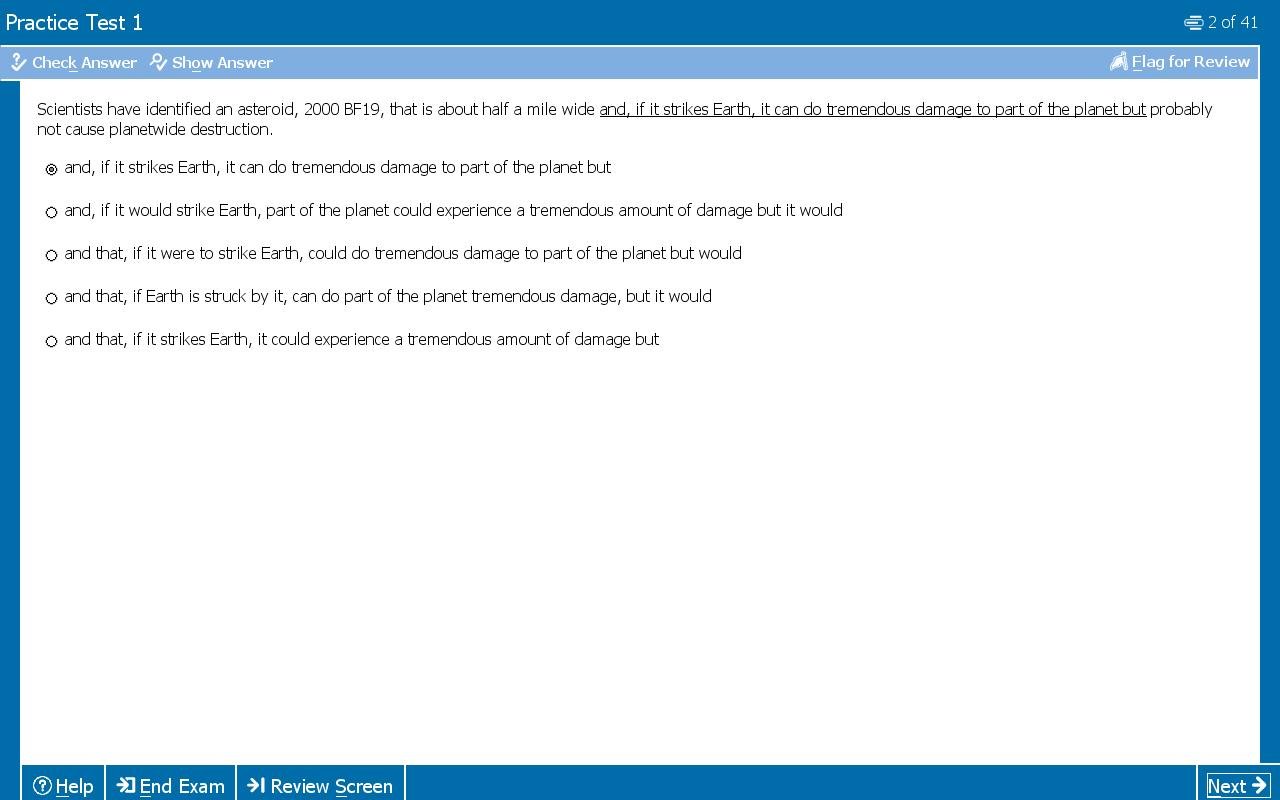
Scientists have identified an asteroid, 2000 BF19, that is about half a mile wide and, if it strikes Earth, it can do tremendous damage to part of the planet but probably not cause planetwide destruction.
A. and, if it strikes Earth, it can do tremendous damage to part of the planet but
B. and, if it would strike Earth, part of the planet could experience a tremendous amount of damage but it would
C. and that, if it were to strike Earth, could do tremendous damage to part of the planet but would
D. and that, if Earth is struck by it, can do part of the planet tremendous damage, but it would
E. and that, if it strikes Earth, it could experience a tremendous amount of damage but
asteroid.JPG [ 75.64 KiB | Viewed 38873 times ]
A. and, if it strikes Earth, it can do tremendous damage to part of the planet but
B. and, if it would strike Earth, part of the planet could experience a tremendous amount of damage but it would
C. and that, if it were to strike Earth, could do tremendous damage to part of the planet but would
D. and that, if Earth is struck by it, can do part of the planet tremendous damage, but it would
E. and that, if it strikes Earth, it could experience a tremendous amount of damage but
Attachment:
asteroid.JPG [ 75.64 KiB | Viewed 38873 times ]
Every tricky question should trigger a follow up quiz.
Build that habit with
GMAT Club Forum Quiz →.

akhil911

Joined: 11 Aug 2011
Last visit: 29 Jan 2018
Posts: 129
Given Kudos: 886
Location: United States
Concentration: Economics, Finance
Schools: CBS '17 Haas '17 Anderson '17 HKUST '16 Booth '17 Sloan '17 Stern '17 Yale '17 Kenan-Flagler '17 (S) Ross '17 (S) Kelley '17 (S) NUS '17 HEC Dec '17 Jones '16
GMAT Date: 10-16-2013
GPA: 3
WE:Analyst (Computer Software)
Products:
 10 Oct 2013, 08:30
Kudos
Bookmarks
Scientists have identified an asteroid, 2000 BF19, that is about half a mile wide and, if it strikes Earth, it can do tremendous damage to part of the planet but probably not cause planet-wide destruction.
So the scientists found two facts about the asteroid. These two facts are connected by “and”. The first fact begins with “that”. However, the second fact does not begin with “that”. This leads to parallelism error in the sentence.
A. and, if it strikes Earth, it can do tremendous damage to part of the planet but: Incorrect for the reason stated above.
B. and, if it would strike Earth, part of the planet could experience a tremendous amount of damage but it would: Incorrect. Repeats the same parallelism error of Choice A.
C. and that, if it were to strike Earth, could do tremendous damage to part of the planet but would: Correct.
D. and that, if Earth is struck by it, can do part of the planet tremendous damage, but it would: Incorrect. This choice has ungrammatical structure. The “if” clause is unnecessarily in passive voice. The “then” clause is still in active voice. This makes it seem that Erath could only partly damage the planet. This meaning is illogical.
E. and that, if it strikes Earth, it could experience a tremendous amount of damage but: Incorrect. The pronoun “it” in the “then” clause refers to “asteroid”, meaning that the asteroid could experience damage. This is certainly not the intended meaning of the sentence.
I read this explanation on the e-gmat forum and am posting it here for the benefit of the fellow students.
Hope this helps everyone.
So the scientists found two facts about the asteroid. These two facts are connected by “and”. The first fact begins with “that”. However, the second fact does not begin with “that”. This leads to parallelism error in the sentence.
A. and, if it strikes Earth, it can do tremendous damage to part of the planet but: Incorrect for the reason stated above.
B. and, if it would strike Earth, part of the planet could experience a tremendous amount of damage but it would: Incorrect. Repeats the same parallelism error of Choice A.
C. and that, if it were to strike Earth, could do tremendous damage to part of the planet but would: Correct.
D. and that, if Earth is struck by it, can do part of the planet tremendous damage, but it would: Incorrect. This choice has ungrammatical structure. The “if” clause is unnecessarily in passive voice. The “then” clause is still in active voice. This makes it seem that Erath could only partly damage the planet. This meaning is illogical.
E. and that, if it strikes Earth, it could experience a tremendous amount of damage but: Incorrect. The pronoun “it” in the “then” clause refers to “asteroid”, meaning that the asteroid could experience damage. This is certainly not the intended meaning of the sentence.
I read this explanation on the e-gmat forum and am posting it here for the benefit of the fellow students.
Hope this helps everyone.

 30 Jan 2017, 02:21
Kudos
Bookmarks
OreoShake
First recollect the IF... THEN .. structure for the following cases:
1. IF simple present THEN simple future.
2. IF hypothetical subjunctive THEN conditional (would / could etc.).
Now consider a sentence in the first structure:
If it strikes Earth, it will probably not cause planet-wide destruction.
How would you convert this sentence to a future event not likely to happen (i.e., the second structure):
If it struck Earth (OR if it were to strike Earth), it would probably not cause planet-wide destruction.
Note that "would" in the THEN clause is a grammatical requirement to match the IF clause. Therefore in this case "would probably" is not considered redundant.
In the previous example, there is no IF.. THEN.. structure to justify the use of "would". In such standard cases, "will probably" is correct.