
Bunuel
Fresh GMAT Club Tests' Challenge Question:

Does regular polygon X have more than 6 sides?
(1) The ratio of the length of the longest line that can be drawn between two vertices of polygon X to the length of any one side of polygon X is greater than 2.
(2) The degree measure of an interior angle of polygon X is NOT an integer.
The question asks "Does regular polygon X have
more than 6 sides?"
(1)
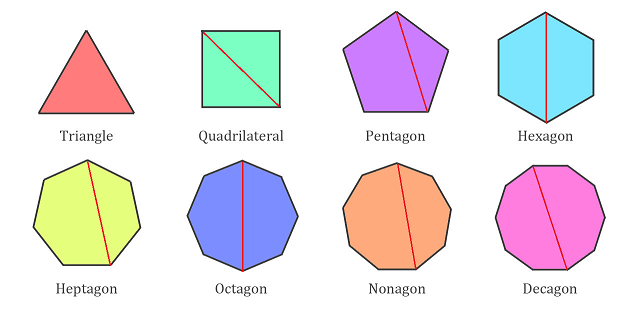
Let's take a square. The length of the longest line is the diameter of the square. So the ratio of diameter to the side increases because the length of the diameter is constant, and the length of the side (chord) decreases.
As the question is concerned with a 6-sided polygon, let's take a regular hexagon - 6 sided regular polygon.
The sum of its angles is (n-2)x180=720. So, each angle is 720/6=120 degrees.
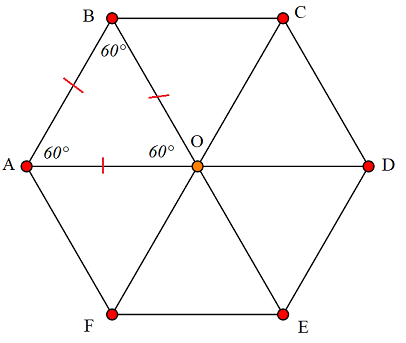
The length of the longest line is the diameter of the circumscribed circle, i.e. AD.
Angle OAF = angle OFA= 60 degrees => triangle AOF is equilateral. So, AF is equal to the length of the radius => 1/2 of the diameter.
Per st.1, the ratio of diagonal is more than 2, so the polygon must have more than 6 angles.
Sufficient.
(2)
Angle of a triangle = 180/3 = 60
Angle of a square = 360/4 = 90
Pentagon: Sum of angles = (n-2) x 180 = 540. Angle of pentagon = 540/5 = 108
Angle of hexagon, as mentioned above, is 120 degrees.
Sufficient, we can stop here and move on.
The asnwer is D
Just to prove, the sum of angles of the 7 sided polygon (heptagon) = (7-3)x180=900. 900/7=128 4/7
Hence D
Attachments

hexagon-long-diagonals.png [ 8.04 KiB | Viewed 7392 times ]