Events & Promotions
|
|

GMAT Club Daily Prep
Thank you for using the timer - this advanced tool can estimate your performance and suggest more practice questions. We have subscribed you to Daily Prep Questions via email.
Customized
for You
Track
Your Progress
Practice
Pays
Not interested in getting valuable practice questions and articles delivered to your email? No problem, unsubscribe here.
 Sep 02
01:00 PM EDT
-11:59 PM EDT
Take 30% off all study plans with code COURSEWORK - Expires on Monday 9/7 Sep 04
10:00 AM PDT
-11:00 AM PDT
What does test anxiety really look like on the GMAT? For many test takers, it does not look like a panic attack. Instead, it shows up as brain fog, rereading, negative comparisons, mental noise.... Sep 04
10:00 AM EDT
-11:59 PM EDT
We’ve worked incredibly hard to build TTP into the best test prep experience possible, and it would mean a lot to us to win Newsweek’s 2026 Readers’ Choice Award for Best Test Prep. If TTP has helped you, we’d be incredibly grateful for your vote. Sep 06
09:30 AM EDT
-12:30 PM EST
Top scores are possible when you enroll in a powerful EA course, taught live online + 6 months access to TTP OnDemand video courses included! Perfect class schedule and easy course access for working professionals. Class starts Sundays Sept. 6, 2026.- Sep 07
12:01 AM PDT
-11:59 PM PDT
On the 7th, GMAT Club Tests will be Free! Including all the Quizzes, Questions, and Tests. 12 AM - 11:59 PM PDT - Sep 07
10:00 AM PDT
-11:00 AM PDT
A complete walkthrough of GMAT Club’s free 12-week GMAT study plan: what you study each week, how progress and goals are tracked, how the error log works, and how your practice unlocks paid tools at no cost. - Sep 09
07:00 AM PDT
-10:00 AM PDT
Meet AdComs and explore top Master’s programs - MiM, MiF, MSc, MSBA and more. - Application Fee Waivers - Free 1-Week of GMAT Club Tests: - Master's Application Toolkit - Grand Prize Giveaway - Sep 09
10:00 AM PDT
-11:00 AM PDT
Three MBA applications. Three rejections. No interview invites. A year later, Aman was admitted to Cambridge Judge, SMU, and IMD. In this episode of MBA Admit Stories, Aman shares how he rebuilt his MBA application...  Sep 15
07:00 PM EDT
-09:00 PM EST
Elite scores are possible when you enroll in a powerful GMAT course, taught live online + 6 months access to TTP OnDemand video courses included! Class starts Tues/Thurs Sept. 15, 2026 - Nov. 15, 2027, 7:00pm-9:00pm EST Sep 21
08:00 PM EDT
-10:00 PM EDT
Boost your GMAT score in less than one month in a live online class + 6 months access to TTP OnDemand video courses included! Class starts Mon, Tues, Wed, Thur, Fri Sept. 21, 2026 - Oct. 9, 2027, 7:00pm-10:00pm EST


 02 Jun 2026, 08:00
Kudos
Bookmarks
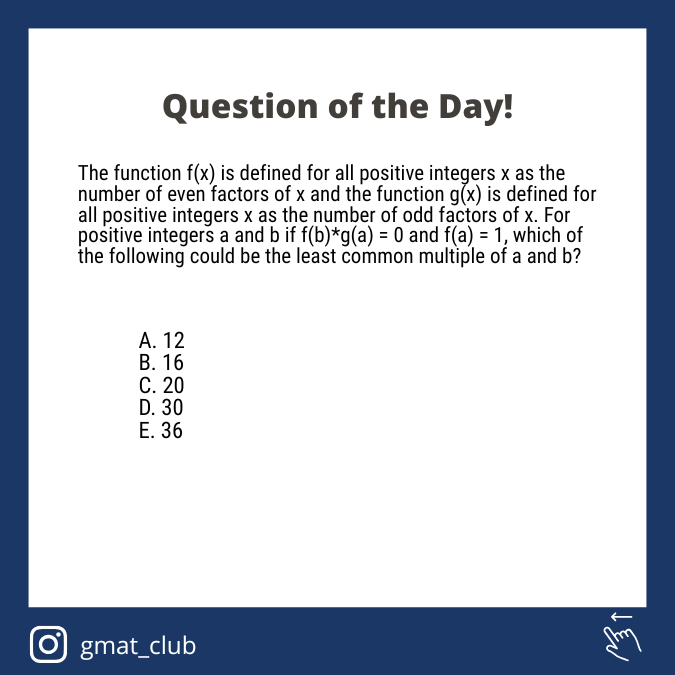
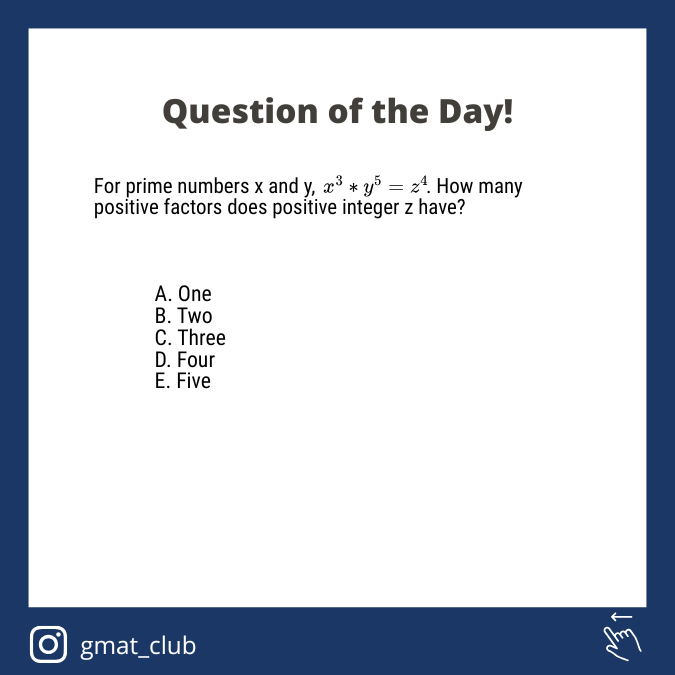
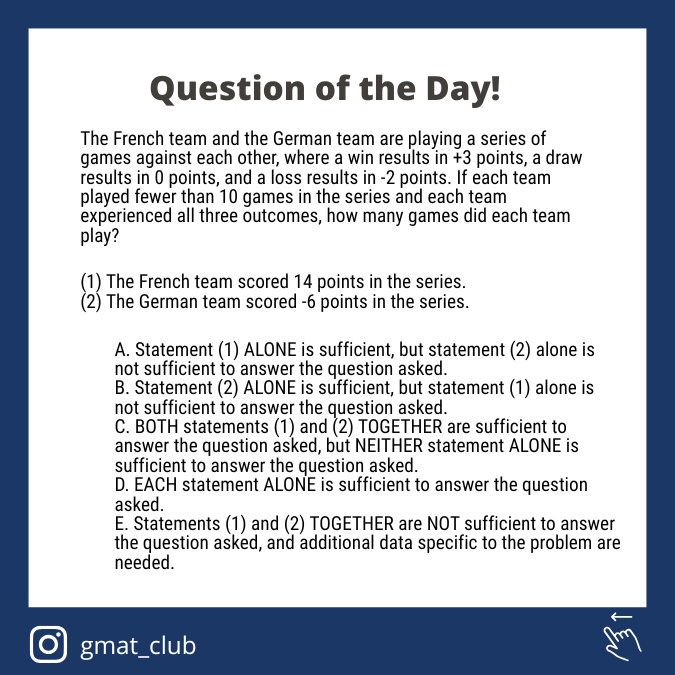
June 2nd Quant Question of the Day
Answer and Explanation | Subscribe via E-mail, Forum, Instagram, or YouTube
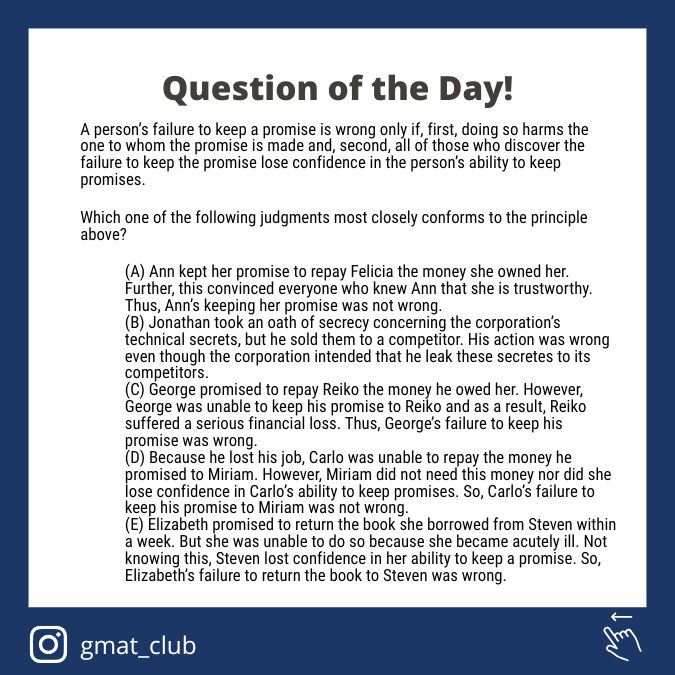
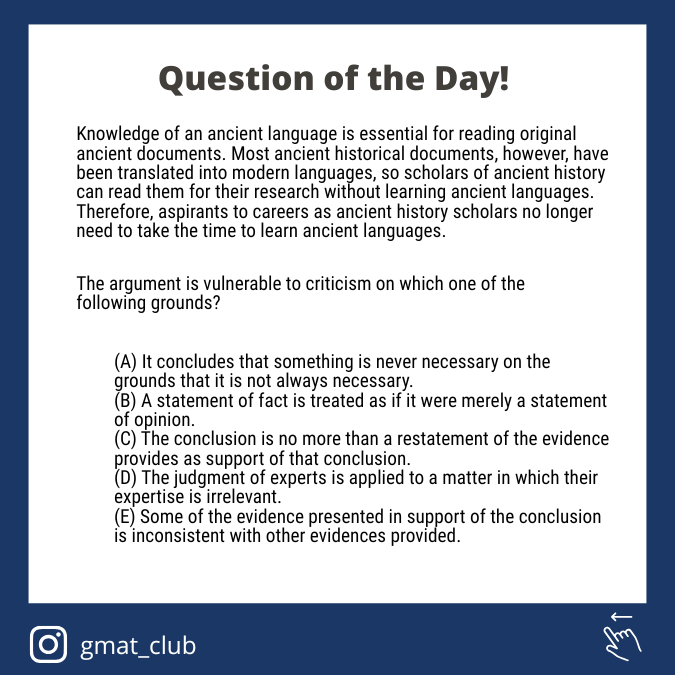
June 2nd Verbal Question of the Day

Answer and Explanation | Subscribe via E-mail, Forum, Instagram, or YouTube
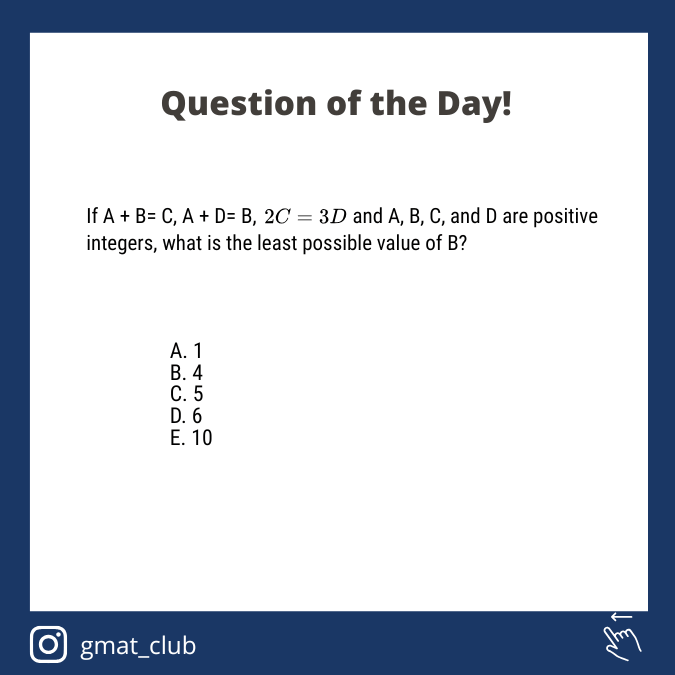
Answer and Explanation | Subscribe via E-mail, Forum, Instagram, or YouTube
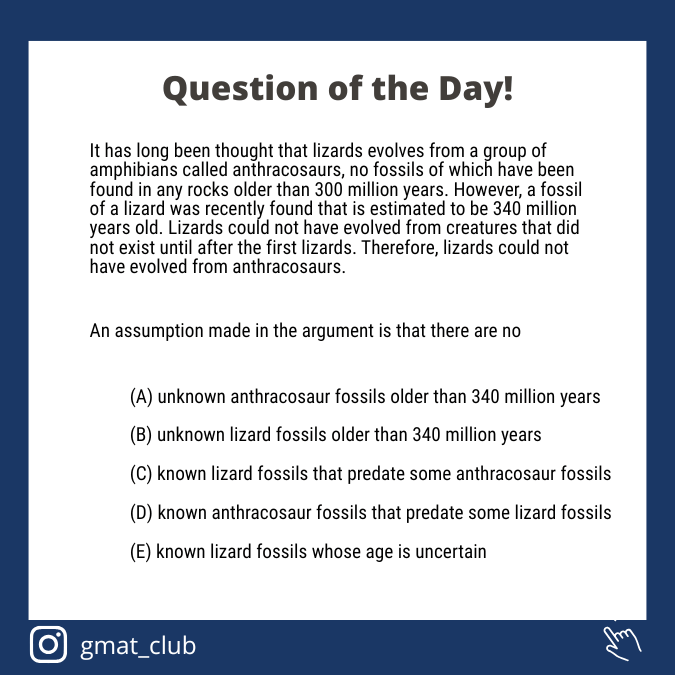
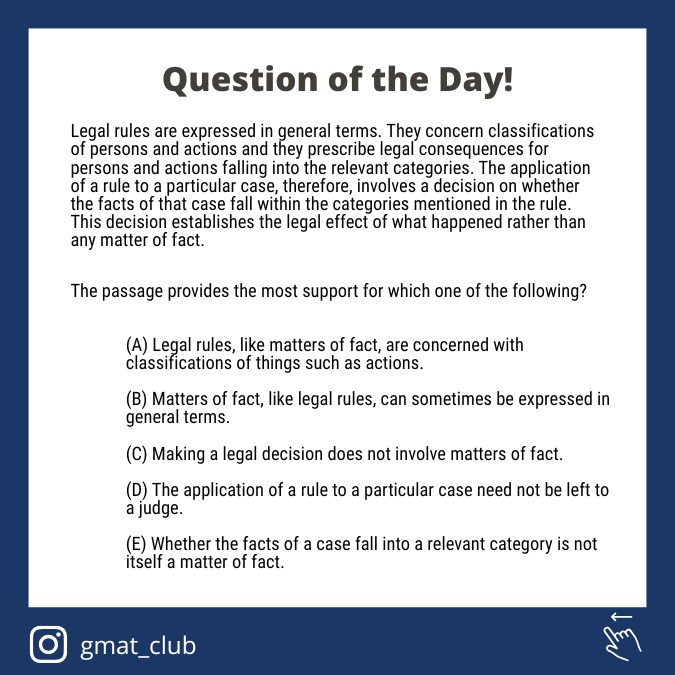
June 2nd Verbal Question of the Day
Answer and Explanation | Subscribe via E-mail, Forum, Instagram, or YouTube

 02 Jun 2026, 16:49
Kudos
Bookmarks
| Problem Solving Butler: June 2026 | ||
| June 3 | PS 1 | PS 2 |
_____________________
PS 1
How many different words, with or without meaning, can be formed by shuffling the alphabets of “MIRANDA” such that M always comes before R and R always comes before D in the words formed?
A. 10
B. 60
C. 420
D. 840
E. 1680
_____________________
PS 2
In a group of 11 members, 5 have 4 siblings each and 6 have one sibling each. If three members are selected randomly, what is the probability that two of the selected three are siblings?
A. 2/55
B. 8/33
C. 26/55
D. 29/55
E. 25/33
02 Jun 2026, 16:50
Kudos
Bookmarks
| Critical Reasoning Butler: June 2026 | ||
| June 3 | CR 1 | CR 2 |
______________________
CR 1
Parkinson’s Law, an observation advanced by the British civil servant C. Northcote Parkinson, for whom it is named, posits that bureaucracies expand to fill the space available for their expansion. One of Parkinson’s principal pieces of evidence for his Law was the remarkable growth of the British Colonial Office, whose staff continued to swell as the British colonies weakened, and which actually attained its greatest size and influence at the precise moment the British colonial empire collapsed.
Which of the following does NOT illustrate a phenomenon similar to those covered by Parkinson’s Law?
A. The demand for military research tends to correlate positively with the amount of money governments allot to the military each year.
B. The bigger the pie that my aunt bakes, the more of my relatives show up to eat it.
C. Many prominent Hollywood sitcom writers attest that the time it takes to script an episode is dictated by the time a studio provides them to script that episode.
D. Parkinson’s coefficient of inefficiency further predicts that the efficiency of an administrative body decreases in proportion to the number of members added to it.
E. Most professional athletes remark that the amount of money required to sustain their families, image, and lifestyle grows as their income over the course of their careers.
______________________
CR 2
Environmental groups are aggressively protesting the proposed use of a new technique for mining oil from the fringes of underground aquifers. These groups complain that such mining will lead to instances of contaminated groundwater and to sinkholes and other disasters in areas near the proposed mining. But, as the mining companies are quick to retort, the countries already using this technique have not reported any groundwater contamination or environmental issues. Therefore, it is safe to proceed with the new technique.
Which of the following, if true, most undermines the conclusion above?
(A) Some of the countries currently using the new technique have only been doing so for two years or less.
(B) Other widely-used techniques used to procure oil have led to even worse contamination issues than what environmentalists predict could happen with the new technique
(C) The countries currently using the technique are so dependent on oil revenue that they are unlikely to report any problems that might require them to stop.
(D) In the years that the new technique had been in use, several safeguards have been added to prevent the contamination of nearby water.
(E) All of the aquifers near which the proposed technique would be employed are used or will soon be used to provide drinking water for their surrounding communities.