Events & Promotions
|
|

GMAT Club Daily Prep
Thank you for using the timer - this advanced tool can estimate your performance and suggest more practice questions. We have subscribed you to Daily Prep Questions via email.
Customized
for You
Track
Your Progress
Practice
Pays
Not interested in getting valuable practice questions and articles delivered to your email? No problem, unsubscribe here.
 Sep 24
08:00 AM EDT
-08:30 AM EDT
Meet Tuck at an informal student or staff-hosted coffee chat in a city near you! Sep 26
01:00 PM EDT
-04:00 PM EDT
Top scores are possible when you enroll in a powerful GMAT course, taught live online + 6 months access to TTP OnDemand video courses included. Class starts Saturdays Sept. 26, 2026 - Dec. 19, 2026, 1:00pm-4:00pm ES Sep 29
11:00 AM EDT
-01:00 PM EDT
" Description: Top scores are possible when you enroll in a powerful GMAT course, taught live online + 6 months access to TTP OnDemand video courses included! Class starts Tues/Thur Sept. 29, 2026 - Dec. 3, 2026, 11:00am-1:00pm EST Oct 01
07:00 AM BST
-08:00 AM GMT
Welcome to the GMAT Club's Free Interview Prep Event for Top MBA Programs! Buy tickets - Virtual series that’s all set to equip you to -excel in your MBA interviews.

 Updated on: 03 Mar 2024, 23:12
Originally posted by marcodonzelli on 12 Mar 2008, 13:16.
Last edited by gmatophobia on 03 Mar 2024, 23:12, edited 1 time in total.
Last edited by gmatophobia on 03 Mar 2024, 23:12, edited 1 time in total.
Updated the tags, added screenshot
Kudos
Bookmarks


E
Be sure to select an answer first to save it in the Error Log before revealing the correct answer (OA)!
Difficulty:
 25%
(medium)
25%
(medium)
Question Stats:
82% (02:09) correct 18%
(02:38)
wrong
based on 1520
sessions
18%
(02:38)
wrong
based on 1520
sessions
History
Date
Time
Result
Not Attempted Yet
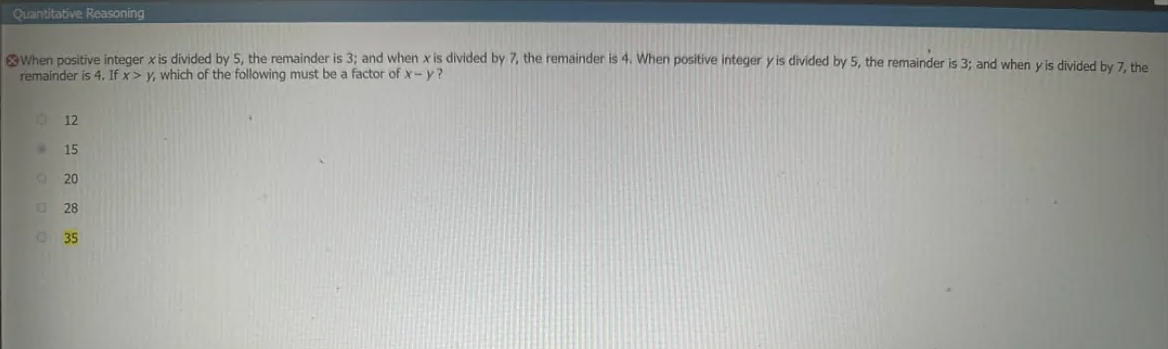
When positive integer x is divided by 5, the remainder is 3; and when x is divided by 7, the remainder is 4. When positive integer y is divided by 5, the remainder is 3; and when y is divided by 7, the remainder is 4. If x > y, which of the following must be a factor of x - y?
(A) 12
(B) 15
(C) 20
(D) 28
(E) 35
Screenshot 2024-03-04 114120.png [ 378.31 KiB | Viewed 8884 times ]
(A) 12
(B) 15
(C) 20
(D) 28
(E) 35
Attachment:
Screenshot 2024-03-04 114120.png [ 378.31 KiB | Viewed 8884 times ]
Trying to understand why the right answer is right?
GMAT Club Tests explanations walk through concepts, shortcuts, and common traps on many questions.
See how →

 13 Jan 2012, 10:31
Kudos
Bookmarks
Baten80
The way to derive general formula is described in the solution below:
When positive integer x is divided by 5, the remainder is 3; and when x is divided by 7, the remainder is 4. When positive integer y is divided by 5, the remainder is 3; and when y is divided by 7, the remainder is 4. If x > y, which of the following must be a factor of x - y?
(A) 12
(B) 15
(C) 20
(D) 28
(E) 35
When a positive integer x is divided by 5 and 7, the remainders are 3 and 4, respectively: \(x = 5q + 3\) (where x could be 3, 8, 13, 18, 23, ...) and \(x = 7p + 4\) (where x could be 4, 11, 18, 25, ...).
A general formula can be derived from the above two statements:
The divisor will be the least common multiple of the two divisors 5 and 7, hence 35.
The remainder will be the first common integer in the two patterns, hence 18. Therefore, to satisfy both conditions, x must be of the form x = 35m + 18 (where x could be 18, 53, 88, ...).
The same applies to y (as the same information is given about y): \(y = 35n + 18\).
Henxe, \(x-y=(35m+18)-(35n+18)=35(m-n)\). Therefore, x - y must be a multiple of 35.
Answer: E.
More about this concept:
https://gmatclub.com/forum/manhattan-re ... ve#p721341
https://gmatclub.com/forum/good-problem ... ve#p722552
Hope it helps.
 11 May 2008, 10:19
Kudos
Bookmarks
Hi , I tried two ways of reaching the answer and I get E 35. Not sure if this is right though  !
!
For x we have two equations:
x=3+5m
x=4+7n
Similarly for y:
y=3+5l
4= 4 +7j
x-y =3+5m - (3+5l)
=5(m-l)
x-y = 4+7n -(4+7j)
= 7(n-j)
7 and 5 are factors of x-y, therefore 7*5 =35 must be a factor of x-y.
Another way I tried to solve this is by using numbers, If x=3+5m, then c must be a number with units digit 8 or 3
since x=7 +5n , the values of x that satisfy these two equations are 18 and 53,
since y has similar rules and x>y; x=53 and y =18,
x-y= 53-18 =35, therefore 35 must be a factor of x-y.
!For x we have two equations:
x=3+5m
x=4+7n
Similarly for y:
y=3+5l
4= 4 +7j
x-y =3+5m - (3+5l)
=5(m-l)
x-y = 4+7n -(4+7j)
= 7(n-j)
7 and 5 are factors of x-y, therefore 7*5 =35 must be a factor of x-y.
Another way I tried to solve this is by using numbers, If x=3+5m, then c must be a number with units digit 8 or 3
since x=7 +5n , the values of x that satisfy these two equations are 18 and 53,
since y has similar rules and x>y; x=53 and y =18,
x-y= 53-18 =35, therefore 35 must be a factor of x-y.