Events & Promotions
|
|

GMAT Club Daily Prep
Thank you for using the timer - this advanced tool can estimate your performance and suggest more practice questions. We have subscribed you to Daily Prep Questions via email.
Customized
for You
Track
Your Progress
Practice
Pays
Not interested in getting valuable practice questions and articles delivered to your email? No problem, unsubscribe here.
 Sep 26
01:00 PM EDT
-04:00 PM EDT
Top scores are possible when you enroll in a powerful GMAT course, taught live online + 6 months access to TTP OnDemand video courses included. Class starts Saturdays Sept. 26, 2026 - Dec. 19, 2026, 1:00pm-4:00pm ES Sep 29
11:00 AM EDT
-01:00 PM EDT
" Description: Top scores are possible when you enroll in a powerful GMAT course, taught live online + 6 months access to TTP OnDemand video courses included! Class starts Tues/Thur Sept. 29, 2026 - Dec. 3, 2026, 11:00am-1:00pm EST Oct 01
07:00 AM BST
-08:00 AM GMT
Welcome to the GMAT Club's Free Interview Prep Event for Top MBA Programs! Buy tickets - Virtual series that’s all set to equip you to -excel in your MBA interviews.


C
Be sure to select an answer first to save it in the Error Log before revealing the correct answer (OA)!
Difficulty:
 25%
(medium)
25%
(medium)
Question Stats:
68% (00:59) correct 32%
(01:17)
wrong
based on 8306
sessions
32%
(01:17)
wrong
based on 8306
sessions
History
Date
Time
Result
Not Attempted Yet
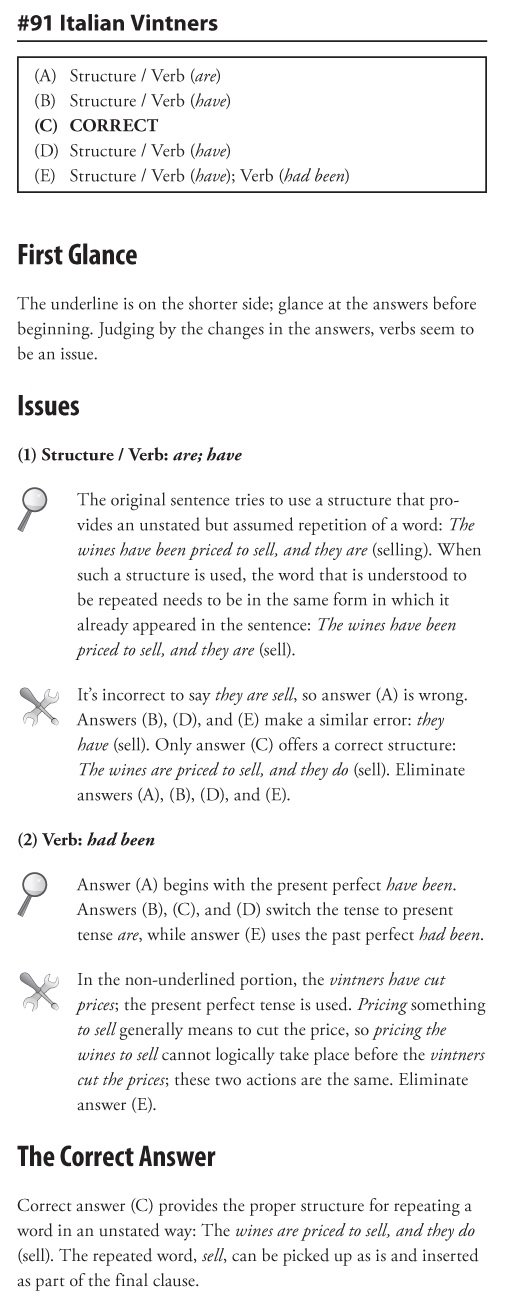
In an effort to reduce their inventories, Italian vintners have cut prices; their wines have been priced to sell, and they are.
(A) have been priced to sell, and they are
(B) are priced to sell, and they have
(C) are priced to sell, and they do
(D) are being priced to sell, and have
(E) had been priced to sell, and they have
01.jpg [ 184.94 KiB | Viewed 80331 times ]
(A) have been priced to sell, and they are
(B) are priced to sell, and they have
(C) are priced to sell, and they do
(D) are being priced to sell, and have
(E) had been priced to sell, and they have
Attachment:
01.jpg [ 184.94 KiB | Viewed 80331 times ]
Solving this question helps.
Taking a timed set of similar questions in
GMAT Club Forum Quiz →
is even better.

 08 Jan 2013, 16:43
Kudos
Bookmarks
KevinBrink
Hi KevinBrink,
In an effort to reduce their inventories, Italian vintners have cut prices; their wines have been priced to sell, and they are.
This is an official question – OG13#91 – created by the creators of the GMAT. The quality of their questions is unparalleled. I guess, you are not able to understand the meaning of this problem, and that is why it is giving you a tough time. So let’s get started with meaning analysis.
Meaning Analysis:
Italian wine sellers have cut prices of their wines because they want to reduce their stock. They have priced their wine such so that they sell, and the wines actually sell because of this reduced price.
Error Analysis:
Now let’s look at the errors in the original sentence:
The first past of the underlined portion says the wines have been priced to sell. The second part says “they are”. So here we have ellipsis in play. Now, we can only make those words understood that have already appeared in the sentence in the same for. However, after “are” the verbs that can be used are “sold” or “selling”. However, none of these verb forms appear in the sentence anywhere. Hence, “are” is the incorrect helping verb.
Now, there can be a confusion regarding the usage of “sell”. “sell” means to “sell” something. When someone does the action of selling. There is another meaning of “sell” - to have a specific price; be offered for sale at the price indicated. For example: Leather boots sell for just $30.
This is how “sell” has been used in the second part of the underlined portion.
PoE:
(A) have been priced to sell, and they are: Incorrect for the reason stated above.
(B) are priced to sell, and they have: Incorrect. “have” should be followed by “sold” but this word is not present anywhere in the sentence.
(C) are priced to sell, and they do: Correct. Helping verb “do” stands for “sell”, the word that already exists in the sentence.
(D) are being priced to sell, and have: Incorrect. Same error as choice B.
(E) had been priced to sell, and they have: Incorrect.
i. Use of past perfect tense “had been priced” is incorrect because there is no other event in past tense.
ii. Same error as in choice B.
Hope this helps.

Thanks.
Shraddha


 11 Oct 2017, 12:22
Kudos
Bookmarks
Heh. I kind of hate this question, and that’s exactly why we chose it for a QOTD. Yeah, it’s a verb tense question, but as with most GMAT SC verb tense questions, it’s mostly a question of thinking somewhat deeply about meaning. If you’re using different verb tenses, then the actions must logically happen at different times. (And we’ll have a lot more to say about GMAT verb tenses in an upcoming YouTube webinar.)
OK, so let’s start by figuring out WTF this sentence is trying to say. Before the semicolon, we have an action in present perfect tense (“vintners have cut prices”). The use of this tense suggests that the action began in the past, and continues into the present – or at least that the consequences continue in the present.
So whatever happens in the underlined portion, it has to be consistent – somehow – with the timeline that vintners started cutting prices sometime in the past, and then reaped the benefits later.
The bigger issue: “they are” is the end of the sentence. “They are”… WHAT, exactly? “They are”… delicious? “They are”… cheap? “They are”… getting me drunk after I drink two bottles for breakfast?
(Oops, did I say that last part out loud? I don’t drink wine for breakfast… anymore. But there were some interesting times in Argentina…)
Anyway, you have to make a big, fat, weird leap to assume that the word “selling” is implied at the end of the sentence. There’s no grammatical reason why we would be able to make that assumption. And so we don’t actually know what the sentence is trying to say if the sentence just ends with “they are.”
So (A) is out, even if you’re able to give the verb tenses the benefit of the doubt.
We can’t just assume that the word “sold” would magically appear after the “have.” Again, there’s no grammatical reason why we can just carry another form of the verb “to sell” to the end of the sentence.
(B) is gone, too.
So in (C), the meaning actually makes sense: if “do” refers back to the verb “to sell”, we’re OK. “... the wines are priced to sell, and they [sell].” No problem.
The verb tenses also work pretty well here: vintners “have cut prices” (starting in the past, continuing into the present), and THEN we see the consequences in the present (“the wines are priced to sell, and they [sell]”).
We probably can’t do much better than (C).
In other words, even if we assume that the word “have” magically implies the entire phrase “have sold”, the timeline would still be illogical. So (D) is out.
(E) can be eliminated, and we’re left with (C). Tough question, no?
OK, so let’s start by figuring out WTF this sentence is trying to say. Before the semicolon, we have an action in present perfect tense (“vintners have cut prices”). The use of this tense suggests that the action began in the past, and continues into the present – or at least that the consequences continue in the present.
So whatever happens in the underlined portion, it has to be consistent – somehow – with the timeline that vintners started cutting prices sometime in the past, and then reaped the benefits later.
Quote:
I’m not sure that the verb tenses are 100% wrong here, but they aren’t great. “Vintners have cut prices” (in the past, continuing into the present), the wines “have been priced to sell” (also in the past, continuing into the present), but then we have “they are.” Why is it that the “they are” is suddenly in the present, but the pricing stuff started in the past? I’m not sure that it’s wrong, but I don’t think it’s ideal.
The bigger issue: “they are” is the end of the sentence. “They are”… WHAT, exactly? “They are”… delicious? “They are”… cheap? “They are”… getting me drunk after I drink two bottles for breakfast?
(Oops, did I say that last part out loud? I don’t drink wine for breakfast… anymore. But there were some interesting times in Argentina…)
Anyway, you have to make a big, fat, weird leap to assume that the word “selling” is implied at the end of the sentence. There’s no grammatical reason why we would be able to make that assumption. And so we don’t actually know what the sentence is trying to say if the sentence just ends with “they are.”
So (A) is out, even if you’re able to give the verb tenses the benefit of the doubt.
Quote:
We have a very similar problem in (B) as in (A): “they have”… what, exactly? “They have”… been fermented from leftover potato pancakes instead of grapes? “They have”… caused Johnny Depp to destroy another hotel room in a drunken haze? “They have”… made Mike tipsy and happy after a long day of surfing?
We can’t just assume that the word “sold” would magically appear after the “have.” Again, there’s no grammatical reason why we can just carry another form of the verb “to sell” to the end of the sentence.
(B) is gone, too.
Quote:
OK, this is a weird aspect of the English language: various forms of the verb “to do” functions sort of like a pronoun, except that it can refer back to a verb instead of a noun. Consider the following examples:
- Mike always wanted to surf in Chile, and last year, he did. → “did” refers back to the verb “to surf”
- Charlie wanted to eat nine pretzels in one day, and on his last trip to Munich, he did. → “did” refers back to the verb phrase “to eat nine pretzels in one day”, and that sounds awesome
So in (C), the meaning actually makes sense: if “do” refers back to the verb “to sell”, we’re OK. “... the wines are priced to sell, and they [sell].” No problem.
The verb tenses also work pretty well here: vintners “have cut prices” (starting in the past, continuing into the present), and THEN we see the consequences in the present (“the wines are priced to sell, and they [sell]”).
We probably can’t do much better than (C).
Quote:
(D) has the same general issue as in (A) and (B): “they have”… what, exactly? Plus, the verb tenses aren’t great here. Why would we use the present progressive “are being priced” – which emphasizes that an action is happening right now – only to switch back to “have”… which is presumably present perfect tense, if it were followed by a participle (i.e., “have sold”).
In other words, even if we assume that the word “have” magically implies the entire phrase “have sold”, the timeline would still be illogical. So (D) is out.
Quote:
(E) has the same “they have… what?” issue as (D), but now the verb tenses are even worse. “Had been priced to sell” suggests that they had been priced to sell in the distant past, before some other past action. So, um, the wines “had been priced to sell” before “vintners have cut prices”, I guess? I’m not sure that you could use the past perfect “had been” before the present perfect “have cut” – but either way, the timeline is completely illogical.
(E) can be eliminated, and we’re left with (C). Tough question, no?