Events & Promotions
| Last visit was: 27 Sep 2026, 04:07 |
It is currently 27 Sep 2026, 04:07 |
|
|

GMAT Club Daily Prep
Thank you for using the timer - this advanced tool can estimate your performance and suggest more practice questions. We have subscribed you to Daily Prep Questions via email.
Customized
for You
Track
Your Progress
Practice
Pays
Not interested in getting valuable practice questions and articles delivered to your email? No problem, unsubscribe here.
 Sep 28
07:00 PM EDT
-10:00 PM EDT
Boost your GMAT score in less than one month in a live online class + 6 months access to TTP OnDemand video courses included! Class starts Mon, Tues, Wed, Thur, Fri Sept. 28, 2026 - Oct. 16, 2027, 7:00pm-10:00pm EST Sep 29
11:00 AM EDT
-01:00 PM EDT
" Description: Top scores are possible when you enroll in a powerful GMAT course, taught live online + 6 months access to TTP OnDemand video courses included! Class starts Tues/Thur Sept. 29, 2026 - Dec. 3, 2026, 11:00am-1:00pm EST Oct 01
07:00 AM BST
-08:00 AM GMT
Welcome to the GMAT Club's Free Interview Prep Event for Top MBA Programs! Buy tickets - Virtual series that’s all set to equip you to -excel in your MBA interviews. Oct 03
01:00 PM EDT
-04:00 PM EDT
Top scores are possible when you enroll in a powerful GMAT course, taught live online + 6 months access to TTP OnDemand video courses included! Class starts Saturdays Oct. 3, 2026 - Dec. 26, 2026, 1:00pm-4:00pm EST


 17 Sep 2025, 08:00
Kudos
Bookmarks
September 17th Quant Question of the Day
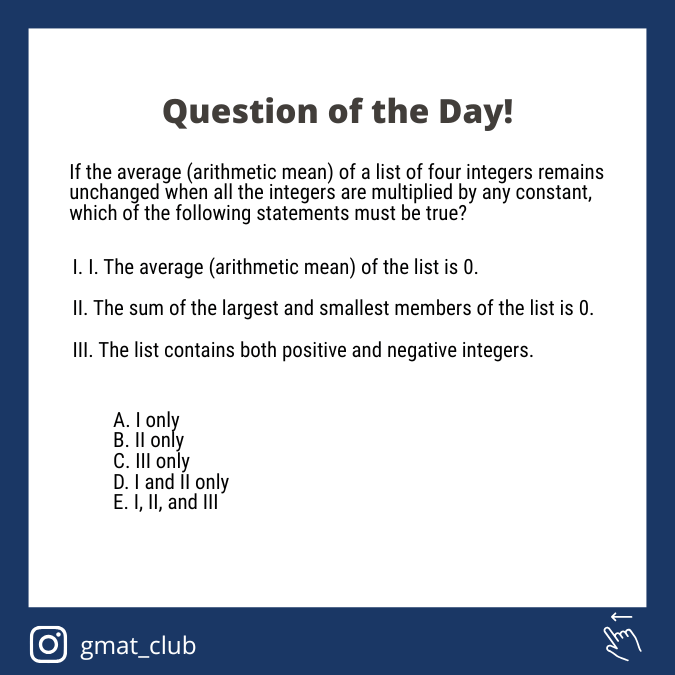
Answer and Explanation | Subscribe via E-mail, Forum, Instagram, or YouTube
Answer and Explanation | Subscribe via E-mail, Forum, Instagram, or YouTube
17 Sep 2025, 08:00
Kudos
Bookmarks
September 17th Verbal Question of the Day
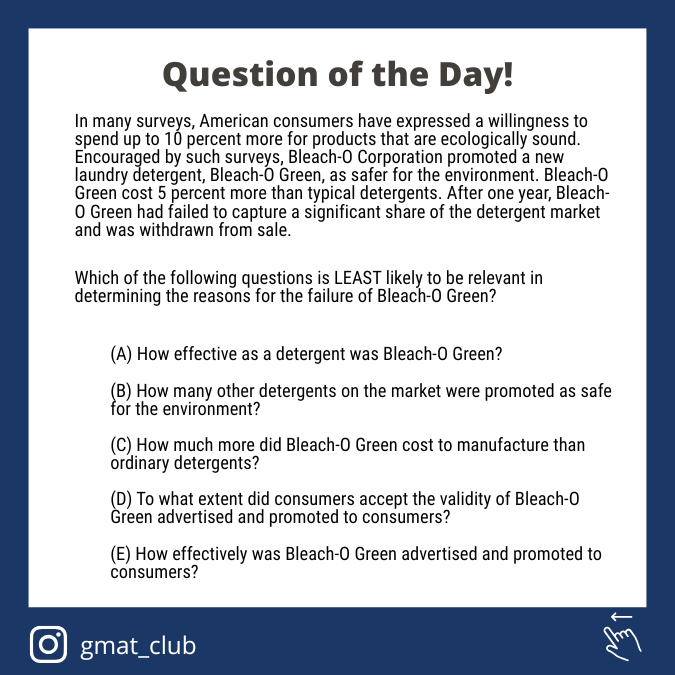
Answer and Explanation | Subscribe via E-mail, Forum, Instagram, or YouTube
Answer and Explanation | Subscribe via E-mail, Forum, Instagram, or YouTube
 18 Sep 2025, 00:03
Kudos
Bookmarks
| Data Sufficiency Butler: September 2025 | ||
| September 18 | DS 1 | DS 2 |
__________________________________
DS 1
If Dave’s average (arithmetic mean) score on three tests was 74, what was his lowest score?
(1) Dave’s highest score was 82.
(2) The sum of Dave’s two highest scores was 162.
__________________________________
DS 2
If a computer dealer sold a few desktop computers and a few laptop computers, what was the average (arithmetic mean) sale price for all the computers that were sold by the dealer last month?
(1) The average sale price for the desktop computers that were sold by the dealer last month was $800.
(2) The average sale price for the laptop computers that were sold by the dealer last month was $1,100.
 18 Sep 2025, 00:11
Kudos
Bookmarks
This post came through our private GMAT Club WhatsApp Group.
Join the WhatsApp Community or Log in to view the full message.
Join the WhatsApp Community or Log in to view the full message.