Events & Promotions
|
|

GMAT Club Daily Prep
Thank you for using the timer - this advanced tool can estimate your performance and suggest more practice questions. We have subscribed you to Daily Prep Questions via email.
Customized
for You
Track
Your Progress
Practice
Pays
Not interested in getting valuable practice questions and articles delivered to your email? No problem, unsubscribe here.
 Sep 28
07:00 PM EDT
-10:00 PM EDT
Boost your GMAT score in less than one month in a live online class + 6 months access to TTP OnDemand video courses included! Class starts Mon, Tues, Wed, Thur, Fri Sept. 28, 2026 - Oct. 16, 2027, 7:00pm-10:00pm EST Sep 29
11:00 AM EDT
-01:00 PM EDT
" Description: Top scores are possible when you enroll in a powerful GMAT course, taught live online + 6 months access to TTP OnDemand video courses included! Class starts Tues/Thur Sept. 29, 2026 - Dec. 3, 2026, 11:00am-1:00pm EST Oct 01
07:00 AM BST
-08:00 AM GMT
Welcome to the GMAT Club's Free Interview Prep Event for Top MBA Programs! Buy tickets - Virtual series that’s all set to equip you to -excel in your MBA interviews. Oct 03
01:00 PM EDT
-04:00 PM EDT
Top scores are possible when you enroll in a powerful GMAT course, taught live online + 6 months access to TTP OnDemand video courses included! Class starts Saturdays Oct. 3, 2026 - Dec. 26, 2026, 1:00pm-4:00pm EST


 08 Oct 2025, 00:40
Kudos
Bookmarks
| Critical Reasoning Butler: September 2025 | ||
| October 8 | CR 1 | CR 2 |
___________________________________
CR 1
All the companies in Balco City have decided to freeze salary increments this year owing to the tough economic situation. Kevin works for a company in Balco city. So, Kevin will face a salary cut this year.
Which of the following arguments exhibits flawed reasoning most similar to the one exhibited in the above argument?
(A) Jerry has not been keeping well of late because of which he hasn’t been able to study at all. Therefore, Jerry will perform poorly in the upcoming college examination.
(B) Because of excessive traffic on the roads, Tom will not be able to arrive for a business meeting ahead of the scheduled time. So, Tom might arrive late for the meeting.
(C) The temperature in the city may fall. Due to heavy rainfall, the temperature is not expected to rise.
(D) Tom likes to travel to his office by bus. Today, there is a bus strike in the city, so Tom will not go to his office.
(E) Mobile phones will cost more in the next few months because the prices of mobile phones are not expected to be cut in the near future.
___________________________________
CR 2
A study has found that new ventures that are funded through bank loans are more likely to succeed than those funded by an entrepreneur’s friends and relatives. The reason for this is not difficult to fathom. The obligation to pay a fixed instalment to the bank every month prevents the entrepreneur from getting complacent and increases his motivation to succeed.
Which of the following raises the strongest doubt on the finding of the above study?
(A) Banks only fund those business ventures that have a very high probability of succeeding.
(B) The study also showed that some ventures that had been funded by an entrepreneur’s friends and relatives were extremely successful.
(C) Most entrepreneurs agree that the pressure of repaying the bank loans acts as a positive stimulus for them.
(D) It is an accepted fact that only those entrepreneurs opt for bank funding who are unable to generate funds from personal sources.
(E) According to a different study, there is a strong correlation between an entrepreneur’s educational background and the nature of his business venture.
08 Oct 2025, 00:46
Kudos
Bookmarks
| Problem Solving Butler: October 2025 | ||
| October 8 | PS 1 | PS 2 |
_______________________________
PS 1
Working together, Jeff and Ashley painted their apartment in 6 hours. If Jeff had been working alone, he could have painted the whole apartment in 10 hours. How many hours would it have taken Ashley to paint the apartment alone?
A. 4
B. 12
C. 15
D. 16
E. 20
_______________________________
PS 2
The denominator of a certain fraction is twice as great as the numerator. If 4 were added to both the numerator and denominator, the new fraction would be 5/8. What is the denominator of the fraction?
(A) 3
(B) 6
(C) 9
(D) 12
(E) 13

 08 Oct 2025, 08:00
Kudos
Bookmarks
October 8th DI Question of the Day
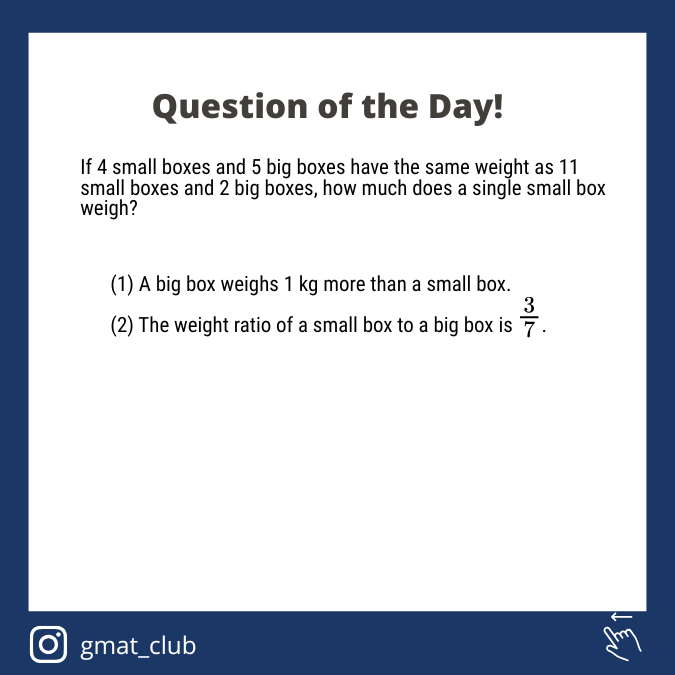
Answer and Explanation | Subscribe via E-mail, Forum, Instagram, or YouTube
Answer and Explanation | Subscribe via E-mail, Forum, Instagram, or YouTube