Events & Promotions
|
|

GMAT Club Daily Prep
Thank you for using the timer - this advanced tool can estimate your performance and suggest more practice questions. We have subscribed you to Daily Prep Questions via email.
Customized
for You
Track
Your Progress
Practice
Pays
Not interested in getting valuable practice questions and articles delivered to your email? No problem, unsubscribe here.
 Sep 26
01:00 PM EDT
-04:00 PM EDT
Top scores are possible when you enroll in a powerful GMAT course, taught live online + 6 months access to TTP OnDemand video courses included. Class starts Saturdays Sept. 26, 2026 - Dec. 19, 2026, 1:00pm-4:00pm ES Sep 29
11:00 AM EDT
-01:00 PM EDT
" Description: Top scores are possible when you enroll in a powerful GMAT course, taught live online + 6 months access to TTP OnDemand video courses included! Class starts Tues/Thur Sept. 29, 2026 - Dec. 3, 2026, 11:00am-1:00pm EST Oct 01
07:00 AM BST
-08:00 AM GMT
Welcome to the GMAT Club's Free Interview Prep Event for Top MBA Programs! Buy tickets - Virtual series that’s all set to equip you to -excel in your MBA interviews.



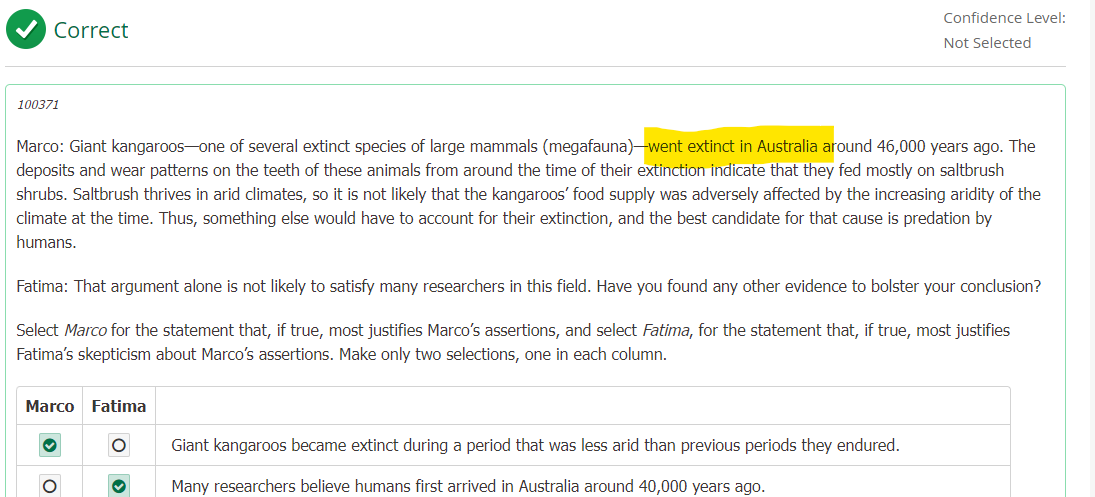
Marco: Giant kangaroos became extinct during a period that was less arid than previous periods they endured.
Fatima: Many researchers believe humans first arrived in Australia around 40,000 years ago.
Be sure to select an answer first to save it in the Error Log before revealing the correct answer (OA)!
Difficulty:
 95%
(hard)
95%
(hard)
Question Stats:
58% (02:38) correct 42%
(02:58)
wrong
based on 1739
sessions
42%
(02:58)
wrong
based on 1739
sessions
History
Date
Time
Result
Not Attempted Yet
Marco: Giant kangaroos—one of several extinct species of large mammals (megafauna)—went extinct in Australia around 46,000 years ago. The deposits and wear patterns on the teeth of these animals from around the time of their extinction indicate that they fed mostly on saltbrush shrubs. Saltbrush thrives in arid climates, so it is not likely that the kangaroos’ food supply was adversely affected by the increasing aridity of the climate at the time. Thus, something else would have to account for their extinction, and the best candidate for that cause is predation by humans.
Fatima: That argument alone is not likely to satisfy many researchers in this field. Have you found any other evidence to bolster your conclusion?
Select Marco for the statement that, if true, most justifies Marco’s assertions, and select Fatima for the statement that, if true, most justifies Fatima’s skepticism about Marco’s assertions. Make only two selections, one in each column.
Fatima: That argument alone is not likely to satisfy many researchers in this field. Have you found any other evidence to bolster your conclusion?
Select Marco for the statement that, if true, most justifies Marco’s assertions, and select Fatima for the statement that, if true, most justifies Fatima’s skepticism about Marco’s assertions. Make only two selections, one in each column.
| Marco | Fatima | |
| Giant kangaroos became extinct during a period that was less arid than previous periods they endured. | ||
| Many researchers believe humans first arrived in Australia around 40,000 years ago. | ||
| Approximately 60 different species in Australia died out in the wave of extinctions around 46,000 years ago. | ||
| Fossils of giant kangaroos also show evidence that those animals' diets routinely included plants other than saltbrush. | ||
| Several types of megafauna larger than the giant kangaroo went extinct around 46,000 years ago. |
ShowHide Answer
Official Answer
Marco: Giant kangaroos became extinct during a period that was less arid than previous periods they endured.
Fatima: Many researchers believe humans first arrived in Australia around 40,000 years ago.
ID: 100371

ChiranjeevSingh
Expert
Tutor

Expert reply
 13 Feb 2024, 22:10
Kudos
Bookmarks
Understanding the Passage
Marco: Giant kangaroos - one of several extinct species of large mammals (megafauna) - went extinct around 46,000 years ago.- Giant Kangaroos - let’s call them GK - is an extinct species.
- GK is a species of large mammals
- Large mammals are called megafauna (mega means big or large; fauna means animals)
- Several species of large mammals are extinct
- GK went extinct around 46K years ago.
The deposits and wear patterns on the teeth of these animals from around the time of their extinction indicate that they fed mostly on saltbrush shrubs.
- Analysis indicates that GK fed mostly on saltbrush shrubs
Saltbrush thrives in arid climates, so it is not likely that the kangaroos' food supply was adversely affected by the increasing aridity of the climate at that time.
- Given that GK fed mostly on saltbrush shrubs and that these shrubs thrive in arid climates, we can expect that GK’s food supply was not affected by the increasing aridity (dryness) of the climate at the time.
- Rather, we can expect the food supply to be abundant for GK at the time they went extinct since saltbrush thrive in arid climates.
Thus, something else would have to account for their extinction, and the best candidate for that cause is predation by humans.
- “Thus” indicates the conclusion.
- Marco concludes that something else would be the cause of GK’s extinction (Marco just eliminated the lack of food supply as a possible cause of GK’s extinction)
- Marco further adds that predation by humans is the best candidate for being the cause of GK’s extinction
- (As I read this conclusion, I see that the second part of the conclusion is a stretch. Marco has provided reasoning for eliminating one cause, but many causes can be possible. How can we conclude predation by humans as the best candidate for the cause of extinction?)
Fatima: That argument alone is not likely to satisfy many researchers in this field. Have you found any other evidence to bolster your conclusion?
- Fatima doesn’t provide any counterpoint.
- She says that Marco’s argument is unlikely to satisfy many researchers in this field. (She says ‘many’ researchers, not ‘all’ researchers)
- Then, she asks Marco whether he has more evidence to support his conclusion.
Understanding the Question Stem
Select Marco for the statement that, if true, most justifies Marco's assertions, and select Fatima, for the statement that, if true, most justifies Fatima's skepticism about Marco's assertions.We’re looking for two options:
- One that supports Marco’s argument
- One that supports Fatima’s doubt about Marco’s argument. This option should doubt Marco’s argument by supporting Fatima’s specific doubt. An option that weakens Marco’s argument in a way not aligned with Fatima’s doubt will not be correct.
Evaluating the Options
A. Giant kangaroos became extinct during a period that was less arid than previous periods they endured.
- This option says that the period in which GK became extinct was LESS ARID than previous periods they endured (survived).
- So, GK had survived periods with more arid climates than the one in which they went extinct.
- This option seems to contradict or go against the information in the passage, which states that GK became extinct in a climate of increasing aridity.
- However, since we don’t challenge the facts of the argument and we have to treat the options as true in strengthen or weaken questions, I’ll try to see whether this option can be true without contradicting the passage.
- And I see that this option and the passage can be true simultaneously.
- GK became extinct in a climate of ‘increasing’ aridity. So, the aridity was increasing at that time. Had the aridity become the most extreme ever? That’s not given. So, it is entirely possible that aridity was increasing at that time but was still lower than aridity of some of the previous periods.
- So, the option is not contradicting the passage.
- Given this understanding, what is the impact of this option on Marco’s argument?
- We know that GK became extinct during a period of increasing aridity. We also know that GK’s food supply was likely not negatively affected.
- However, the increasing aridity could affect GK negatively in some other way. GK’s health might have been affected.
- So, while GK’s food supply was not negatively affected, other aspects linked to the increasing aridity of the climate could have led to GK’s extinction.
- This option ELIMINATES OTHER CAUSES linked to climate aridity by saying that GK had endured more arid climates. GK’s enduring more arid climates indicates that no aspects linked to arid climates caused GK’s extinction.
- Thus, this option increases the belief that predation by humans (an aspect not liked to arid climate) is likely the cause of GK’s extinction.
- This option, thus, supports Marco’s argument.
B. Many researchers believe humans first arrived in Australia around 40,000 years ago.
- This option provides info about what many researchers believe.
- Many believe that humans first arrived in Australia around 40K years ago.
- Given that GK went extinct around 46K years ago, this option seems to weaken the argument.
- If humans arrived 40K years ago, they could not be the cause of extinction of GK that happened 46K years ago.
- Fatima mentioned that Marco’s argument will not satisfy ‘many’ researchers. And this option presents the belief of ‘many’ researchers.
- Thus, this option supports Fatima’s doubt about Marco’s argument.
C. Approximately 60 different species in Australia died out in the wave of extinctions around 46,000 years ago.
- This option says that MANY different species went extinct at the same time.
- The important question for us is: what was the cause of this wave of extinctions?
- Was human predation the cause? Or was something else the cause?
- Since the option doesn’t indicate one way or other about the cause of these extinctions, the option has no impact on Marco’s argument.
D. Fossils of giant kangaroos also show evidence that those animals' diets routinely included plants other than saltbrush.
- This option says that GK’s diets frequently included plants other than saltbrush.
- The passage that GK’s diets mostly included saltbrush.
- There’s no conflict between the passage and this option. GK’s diet was mostly saltbrush and regularly included other plants.
- Now, the argument said that since saltbrush thrive in arid climates, GK’s food supply was NOT adversely affected.
- However, if GK’s diet included other plants regularly, GK’s diet could have been adversely affected.
- So, this option is a weakener.
- However, this option is a VERY MILD one because we don’t know whether these other plants were adversely affected by arid climate and because these plants were, in any case, not a major part of GK’s diet
- Thus, between B and D, B wins.
E. Several types of megafauna larger than the giant kangaroo went extinct around 46,000 years ago.
- This option is similar to option C.
- The reason this option has no impact is also the same as the reason why option C has no impact.
General Discussion
 30 Aug 2019, 13:20
Kudos
Bookmarks
Hi aakash214. Thanks for posting this here.
I came across this question on GMAT Prep took and took a long time struggling with it before figuring it out. It is definitely one of the harder ones I have come across!
Firstly let's list down what each of them is saying:
So Marco lists down a bunch of facts about GKs, their habitats and the climate of the time they lived and concludes that increasing aridity of the time means that external factors such as humans were responsible for GK's extinction. Fatima is largely skeptical of the tall claims and asks for more evidence.
Questions asks: Select Marco for the statement that, if true, most justifies Marco’s assertions, and select Fatima, for the statement that, if true, most justifies Fatima’s skepticism about Marco’s assertions. Make only two selections, one in each column.
So we are looking for facts that SUPPORT Marco's and Fatima's assertions (one option each), choices are:
You will see that once you rule out the improbable and unrelated choices only A and B match with Marco's and Fatima's assertions respectively.
Hope this helps. I can't say for sure but this seems like one of the harder IR Qs. I got it wrong too when I was taking the practice test myself.
I came across this question on GMAT Prep took and took a long time struggling with it before figuring it out. It is definitely one of the harder ones I have come across!
Firstly let's list down what each of them is saying:
Quote:
- GKs are one of many species of large mammals
- Went extinct 46,000 years ago
- Evidence from from teeth show they fed mostly on saltbrush
- Saltbrush thrives in arid climates
- We know climate was becoming more arid at the time
- The aridity will help heir main food thrive
- The aridity should in fact help the species thrive, because their main food source will thrive NOT make them extinct
- Hence if it wasn't the climate it HAD to be something else and humans are the most likely.
Quote:
- This argument alone is not enough to convince researchers of your conclusion
- Is there any other evidence you have to support your claim?
So Marco lists down a bunch of facts about GKs, their habitats and the climate of the time they lived and concludes that increasing aridity of the time means that external factors such as humans were responsible for GK's extinction. Fatima is largely skeptical of the tall claims and asks for more evidence.
Questions asks: Select Marco for the statement that, if true, most justifies Marco’s assertions, and select Fatima, for the statement that, if true, most justifies Fatima’s skepticism about Marco’s assertions. Make only two selections, one in each column.
So we are looking for facts that SUPPORT Marco's and Fatima's assertions (one option each), choices are:
Quote:
Yes! Marco does note that the climate, at the time the GKs went extinct, was becoming increasingly arid and dry. It was not the main crux of the arguement but was part of the evidence used to support the conclusion for sure. Lets hold on to this for now as a candidate supporting Marco's assertion.
Quote:
This is a perfect candidate for a fact that supports Fatima's skepticism, if humans arrived only 40 thousand years ago they could not possibly have been the cause of GK extinction 46 thousand years ago! Seems like a good match for Fatima!
Quote:
Does not help support either of the people's arguments.
Quote:
This is actually irrelevant to what Marco has to say, simply because Marco says that their main diet saltbrush was in ample supply and only becoming more widely available due to the increasing aridity of the climate. If GKs did indeed eat something else as well, it really does not support Marco because he has already concluded based on available evidence that their main food source was in ample supply.
Quote:
Extinction of other larger megafauna are not relevant to either of their discussions.
You will see that once you rule out the improbable and unrelated choices only A and B match with Marco's and Fatima's assertions respectively.
Hope this helps. I can't say for sure but this seems like one of the harder IR Qs. I got it wrong too when I was taking the practice test myself.


 :
: