Events & Promotions
|
|

GMAT Club Daily Prep
Thank you for using the timer - this advanced tool can estimate your performance and suggest more practice questions. We have subscribed you to Daily Prep Questions via email.
Customized
for You
Track
Your Progress
Practice
Pays
Not interested in getting valuable practice questions and articles delivered to your email? No problem, unsubscribe here.
 Sep 24
08:00 AM EDT
-08:30 AM EDT
Meet Tuck at an informal student or staff-hosted coffee chat in a city near you! Sep 26
01:00 PM EDT
-04:00 PM EDT
Top scores are possible when you enroll in a powerful GMAT course, taught live online + 6 months access to TTP OnDemand video courses included. Class starts Saturdays Sept. 26, 2026 - Dec. 19, 2026, 1:00pm-4:00pm ES Sep 29
11:00 AM EDT
-01:00 PM EDT
" Description: Top scores are possible when you enroll in a powerful GMAT course, taught live online + 6 months access to TTP OnDemand video courses included! Class starts Tues/Thur Sept. 29, 2026 - Dec. 3, 2026, 11:00am-1:00pm EST Oct 01
07:00 AM BST
-08:00 AM GMT
Welcome to the GMAT Club's Free Interview Prep Event for Top MBA Programs! Buy tickets - Virtual series that’s all set to equip you to -excel in your MBA interviews.

 Updated on: 25 May 2023, 14:42
Originally posted by vjsharma25 on 08 Apr 2011, 05:36.
Last edited by Bunuel on 25 May 2023, 14:42, edited 3 times in total.
Last edited by Bunuel on 25 May 2023, 14:42, edited 3 times in total.
Kudos
Bookmarks


E
Be sure to select an answer first to save it in the Error Log before revealing the correct answer (OA)!
Difficulty:
 65%
(hard)
65%
(hard)
Question Stats:
57% (01:39) correct 43%
(01:43)
wrong
based on 934
sessions
43%
(01:43)
wrong
based on 934
sessions
History
Date
Time
Result
Not Attempted Yet
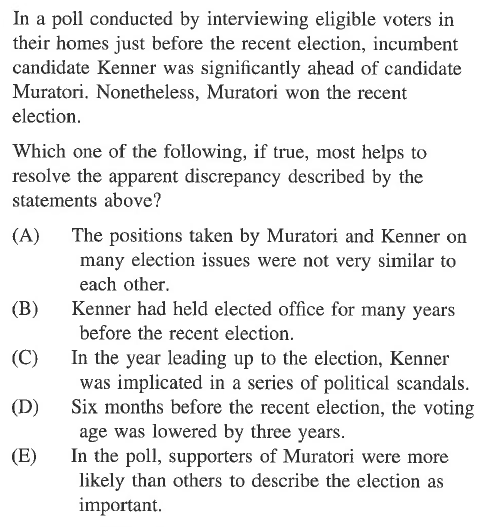
In a poll conducted by interviewing eligible voters in their homes just before the recent election, incumbent candidate Kenner was significantly ahead of candidate Muratori. Nonetheless, Muratori won the recent election.
Which one of the following, if true, most helps to resolve the apparent discrepancy described by the statements above?
(A) The positions taken by Muratori and Kenner on many election issues were not very similar to each other
(B) Kenner had held elected office for many years before the recent election
(C) In the year leading up to the election, Kenner was implicated in a series of political scandals
(D) Six months before the recent election, the voting age was lowered by three years
(E) In the poll, supporters of Muratori were more likely than others to describe the election as important
poll.png [ 45.85 KiB | Viewed 8771 times ]
Which one of the following, if true, most helps to resolve the apparent discrepancy described by the statements above?
(A) The positions taken by Muratori and Kenner on many election issues were not very similar to each other
(B) Kenner had held elected office for many years before the recent election
(C) In the year leading up to the election, Kenner was implicated in a series of political scandals
(D) Six months before the recent election, the voting age was lowered by three years
(E) In the poll, supporters of Muratori were more likely than others to describe the election as important
Attachment:
poll.png [ 45.85 KiB | Viewed 8771 times ]
 11 Apr 2011, 11:39
Kudos
Bookmarks
vjsharma25
With these paradox/discrepancy questions, the most important thing to do is to identify the paradox before you move to the answer choices. Often times you can then start to anticipate what kind of answer you'll need. Here, the discrepancy is:
1) The polls strongly favored Kenner...just hours before the election
2) But Muratori won
How could those two things be true together? Here, I'd start to anticipate some things that could have made that difference. Maybe Kenner had to withdraw from the election the night before? Or some kind of stunning news came out that ruined Kenner's candidacy? Or maybe those voters who preferred Kenner just didn't actually go out and vote, whereas those that preferred Muratori made sure to go vote.
Choice E hits on that last point - it shows why, even though most people preferred Kenner, those people didn't care enough about the election to take the time to go vote their preference, while those who preferred Muratori came out in greater force. Choice E explains the discrepancy - "prefers" doesn't necessarily mean "voted for".
If you look at D, D doesn't directly tie into the candidates (we don't know that younger voters would have preferred Muratori, so we can't say that lowering the voting age would have played a role), but more importantly the time-stamp on it proves that it's irrelevant. The polls were taken YESTERDAY so they should have been inclusive of the voting population at that time. D deals with six months ago, so it shouldn't have any bearing on the discrepancy that took place from yesterday to today.
General Discussion

redskull1

Joined: 11 Feb 2018
Last visit: 25 Sep 2022
Posts: 287
Given Kudos: 115
Location: India
Concentration: General Management, Finance
Schools: Stern '22 (WA) Booth '22 (D) Tuck '22 (D) Tepper '22 (A) Kenan-Flagler '22 (A$) Jones '22 (A$) INSEAD Jan'21 Intake Duke '22 (M$)
GMAT 1: 690 Q47 V37
GMAT 2: 710 Q50 V36
GMAT 3: 750 Q50 V42
Products:
Schools: Stern '22 (WA) Booth '22 (D) Tuck '22 (D) Tepper '22 (A) Kenan-Flagler '22 (A$) Jones '22 (A$) INSEAD Jan'21 Intake Duke '22 (M$)
GMAT 3: 750 Q50 V42
Posts: 287
07 Sep 2018, 05:55
Kudos
Bookmarks
Keypoint = “JUST BEFORE ELECTIONS K > M”.But M still won.
A-Not similar views.Does not prove m wins
B-K was in the elected office.No effect on M winning.If anything shows why K should win as he is the incumbent
C-In the year leading up to the election = not correct.we are worried with just before the elections
D-Six months before.Irrelevant.What happened just before is the relevant part
E-CORRECT.considering important implies they are more likely to vote than supports of K
Posted from my mobile device
A-Not similar views.Does not prove m wins
B-K was in the elected office.No effect on M winning.If anything shows why K should win as he is the incumbent
C-In the year leading up to the election = not correct.we are worried with just before the elections
D-Six months before.Irrelevant.What happened just before is the relevant part
E-CORRECT.considering important implies they are more likely to vote than supports of K
Posted from my mobile device