Events & Promotions
|
|

GMAT Club Daily Prep
Thank you for using the timer - this advanced tool can estimate your performance and suggest more practice questions. We have subscribed you to Daily Prep Questions via email.
Customized
for You
Track
Your Progress
Practice
Pays
Not interested in getting valuable practice questions and articles delivered to your email? No problem, unsubscribe here.
 Sep 26
06:00 PM PDT
-07:00 PM PDT
Free- full-length test + 15 concept videos + 150+ short videos + study plan! Sep 27
01:30 AM EDT
-02:30 AM EDT
At one point, she believed GMAT wasn’t for her. After scoring 595, self-doubt crept in and she questioned her potential. But instead of quitting, she made the right strategic changes. The result? A remarkable comeback to 695. Check out how Saakshi did it. Sep 26
12:30 AM EDT
-01:30 AM EDT
Struggling to find the right strategies to score a 99 %ile on GMAT Focus? Riya (GMAT 715) boosted her score by 100-points in just 15 days! Discover how the right mentorship, tailored strategies, and an unwavering mindset can transform your GMAT prep. Sep 28
07:00 PM EDT
-10:00 PM EDT
Boost your GMAT score in less than one month in a live online class + 6 months access to TTP OnDemand video courses included! Class starts Mon, Tues, Wed, Thur, Fri Sept. 28, 2026 - Oct. 16, 2027, 7:00pm-10:00pm EST Sep 29
11:00 AM EDT
-01:00 PM EDT
" Description: Top scores are possible when you enroll in a powerful GMAT course, taught live online + 6 months access to TTP OnDemand video courses included! Class starts Tues/Thur Sept. 29, 2026 - Dec. 3, 2026, 11:00am-1:00pm EST Oct 01
07:00 AM BST
-08:00 AM GMT
Welcome to the GMAT Club's Free Interview Prep Event for Top MBA Programs! Buy tickets - Virtual series that’s all set to equip you to -excel in your MBA interviews. Oct 03
01:00 PM EDT
-04:00 PM EDT
Top scores are possible when you enroll in a powerful GMAT course, taught live online + 6 months access to TTP OnDemand video courses included! Class starts Saturdays Oct. 3, 2026 - Dec. 26, 2026, 1:00pm-4:00pm EST

 Updated on: 10 Jun 2026, 11:44
Originally posted by guddo on 03 Jun 2024, 07:46.
Last edited by FrozenDragon on 10 Jun 2026, 11:44, edited 2 times in total.
Last edited by FrozenDragon on 10 Jun 2026, 11:44, edited 2 times in total.
Kudos
Bookmarks
Credit in developing countries can be granted through formal or informal channels. Formal channels include institutions such as banks, credit cooperatives, and government agencies. Loans of this type accrue positive interest and are typically court enforced. Informal credit channels include relatives, friends, community members, moneylenders, rotating savings and credit associations, and informal intermediaries. Loans such as these may or may not accrue positive interest. Loans of either type may be used by the borrower for consumption or investment in a business.
In 1930s rural China, informal credit was sometimes court enforced. However, it was more often self-enforcing, especially in remote areas. With a positive–interest rate loan, the borrower would pay principal and interest. With a zero–interest rate loan, the borrower would repay the principal and provide some non-monetary resource in lieu of interest. For example, the borrower might have supplied land, labor, or draft animal services to the lender.
In 1930s rural China, informal credit was sometimes court enforced. However, it was more often self-enforcing, especially in remote areas. With a positive–interest rate loan, the borrower would pay principal and interest. With a zero–interest rate loan, the borrower would repay the principal and provide some non-monetary resource in lieu of interest. For example, the borrower might have supplied land, labor, or draft animal services to the lender.


Giving up a fixed duration of repayment in exchange for security: No
Giving up interest payments in exchange for security: No
Giving up interest payments in exchange for access to other resources: Yes
Be sure to select an answer first to save it in the Error Log before revealing the correct answer (OA)!
Difficulty:
 55%
(hard)
55%
(hard)
Question Stats:
64% (03:09) correct 36%
(03:27)
wrong
based on 3240
sessions
36%
(03:27)
wrong
based on 3240
sessions
History
Date
Time
Result
Not Attempted Yet
ID: 100318
According to the information provided, a lender who offered one of the zero–interest rate loans included in the table would accurately be described as making which of the following trade-offs? Select Yes for each option that applies. Otherwise, select No.
According to the information provided, a lender who offered one of the zero–interest rate loans included in the table would accurately be described as making which of the following trade-offs? Select Yes for each option that applies. Otherwise, select No.
| Yes | No | |
| Giving up a fixed duration of repayment in exchange for security | ||
| Giving up interest payments in exchange for security | ||
| Giving up interest payments in exchange for access to other resources |
ShowHide Answer
Official Answer
Giving up a fixed duration of repayment in exchange for security: No
Giving up interest payments in exchange for security: No
Giving up interest payments in exchange for access to other resources: Yes
The village’s mean annual interest rate in 1935 was greater than 45%.: Yes
The lender anticipated that the borrower would be unable to supply land, labor, or draft animal services in the future.: No
The village’s mean annual interest rate in 1935 was less than 20%.: No
Be sure to select an answer first to save it in the Error Log before revealing the correct answer (OA)!
Difficulty:
 45%
(medium)
45%
(medium)
Question Stats:
71% (01:44) correct
29%
(01:50)
wrong
based on 3287
sessions
History
Date
Time
Result
Not Attempted Yet
ID: 100319
If one of the loans in the survey is considered at random, with no prior knowledge of the village in which it was issued, which of the following factors would, if known, increase the probability that the loan is a zero–interest rate loan? Select Yes for each option that applies on the basis of the given information. Otherwise, select No.
If one of the loans in the survey is considered at random, with no prior knowledge of the village in which it was issued, which of the following factors would, if known, increase the probability that the loan is a zero–interest rate loan? Select Yes for each option that applies on the basis of the given information. Otherwise, select No.
| Yes | No | |
| The village’s mean annual interest rate in 1935 was greater than 45%. | ||
| The lender anticipated that the borrower would be unable to supply land, labor, or draft animal services in the future. | ||
| The village’s mean annual interest rate in 1935 was less than 20%. |
ShowHide Answer
Official Answer
The village’s mean annual interest rate in 1935 was greater than 45%.: Yes
The lender anticipated that the borrower would be unable to supply land, labor, or draft animal services in the future.: No
The village’s mean annual interest rate in 1935 was less than 20%.: No
A greater number of zero–interest rate loans than positive–interest rate loans were negotiated.
Be sure to select an answer first to save it in the Error Log before revealing the correct answer (OA)!
Difficulty:
55%
(hard)
Question Stats:
72% (02:02) correct
28%
(02:15)
wrong
based on 3110
sessions
History
Date
Time
Result
Not Attempted Yet
ID: 100320
The information in the table and graph most strongly indicates that which one of the following is true of the loans in the table?
The information in the table and graph most strongly indicates that which one of the following is true of the loans in the table?
| A greater number of zero–interest rate loans were negotiated in the village with the highest average annual interest rate than in the village with the second-highest rate. | |
| A greater number of zero–interest rate loans than positive–interest rate loans were negotiated. | |
| At least one zero–interest rate loan of fixed duration was used for consumption. | |
| In more than half of the villages with average annual interest rates ranging from 20% to 30%, zero–interest rate loans predominated. | |
| Among loans that were not zero–interest rate loans, the majority were issued at interest rates of less than 40%. |
ShowHide Answer
Official Answer
A greater number of zero–interest rate loans than positive–interest rate loans were negotiated.
used for consumption: Yes
issued without security: Yes
supplied by relatives: No
Be sure to select an answer first to save it in the Error Log before revealing the correct answer (OA)!
Difficulty:
95%
(hard)
Question Stats:
34% (01:23) correct
66%
(01:33)
wrong
based on 945
sessions
History
Date
Time
Result
Not Attempted Yet
A loan considered at random from among the loans reported in the survey was more likely than not to be ________.
Select Yes for each option that results in a statement that can be inferred from the given information. Otherwise, select No.
Select Yes for each option that results in a statement that can be inferred from the given information. Otherwise, select No.
| Yes | No | |
| used for consumption | ||
| issued without security | ||
| supplied by relatives |
ShowHide Answer
Official Answer
used for consumption: Yes
issued without security: Yes
supplied by relatives: No
Zero–interest rate loans were more common than positive–interest rate loans were.
Be sure to select an answer first to save it in the Error Log before revealing the correct answer (OA)!
Difficulty:
 5%
(low)
5%
(low)
Question Stats:
82% (01:19) correct
18%
(01:33)
wrong
based on 642
sessions
History
Date
Time
Result
Not Attempted Yet
The information given most reasonably supports which one of the following conclusions about the loans included in the table and the graph?
| For loans that were positive–interest rate loans, interest rates tended to be lower when loans were secured. | |
| Secured loans were more likely to be zero–interest rate loans than to be positive–interest rate loans. | |
| Positive–interest rate loans were more favorable to lenders than zero–interest rate loans. | |
| Zero–interest rate loans were more common than positive–interest rate loans were. | |
| Informal loans, regardless of loan type, were less likely than formal loans to be used for investment. |
ShowHide Answer
Official Answer
Zero–interest rate loans were more common than positive–interest rate loans were.
Fewer resources devoted to repayment of the loan: No
A more flexible repayment period: No
Fewer consequences associated with default: No
Be sure to select an answer first to save it in the Error Log before revealing the correct answer (OA)!
Difficulty:
95%
(hard)
Question Stats:
22% (01:07) correct
78%
(01:07)
wrong
based on 1128
sessions
History
Date
Time
Result
Not Attempted Yet
Select Yes for each of the following that, on the basis of the given information, can be inferred to represent an advantage for the borrower of a zero–interest rate loan over a positive–interest rate loan of the same amount. Otherwise, select No.
| Yes | No | |
| Fewer resources devoted to repayment of the loan | ||
| A more flexible repayment period | ||
| Fewer consequences associated with default |
ShowHide Answer
Official Answer
Fewer resources devoted to repayment of the loan: No
A more flexible repayment period: No
Fewer consequences associated with default: No
2024-06-03_18-40-38.png [ 71.54 KiB | Viewed 31120 times ]
<br />
GID0675.gif [ 7.79 KiB | Viewed 30806 times ]


Attachment:
2024-06-03_18-40-38.png [ 71.54 KiB | Viewed 31120 times ]
Attachment:
GID0675.gif [ 7.79 KiB | Viewed 30806 times ]


 04 Jul 2024, 05:43
Kudos
Bookmarks
The first Tab talks of type of loans and the next two tabs talk of the loans in 21 villages in 1935 in present northeast China.
Q.1 According to the information provided, a lender who offered one of the zero–interest rate loans included in the table would accurately be described as making which of the following trade-offs?
The first Tab gives us a reason of zer0-interest rate loans, and that is 'With a zero–interest rate loan, the borrower would repay the principal and provide some non-monetary resource in lieu of interest'.
Giving up a fixed duration of repayment in exchange for security..NO
Giving up interest payments in exchange for security..NO
Giving up interest payments in exchange for access to other resources..YES
Hence, No, No, Yes.
Q.2. If one of the loans in the survey is considered at random, with no prior knowledge of the village in which it was issued, which of the following factors would, if known, increase the probability that the loan is a zero–interest rate loan?
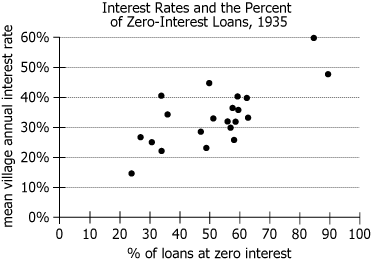
We have to look at the graph for the answer. Where does the probability on X-axis exceed 50%? It is at mean value(Y-axis) above 25%.
The village’s mean annual interest rate in 1935 was greater than 45%.... We can check that there are only two dots above 45% in Y-axis, and both these dots correspond to more than 80% on X-axis, so YES
The lender anticipated that the borrower would be unable to supply land, labor, or draft animal services in the future....Rather it is the opposite. Zero-interest loan meant that there will be no monetary transaction, and the interest that could be accrued would be compensated by resources mentioned in the option. Hence NO
The village’s mean annual interest rate in 1935 was less than 20%....There is only one dot and that gives the probability as 23%, which is below the majority mark
Hence, Yes, No, No.
Q.3. The information in the table and graph most strongly indicates that which one of the following is true of the loans in the table?
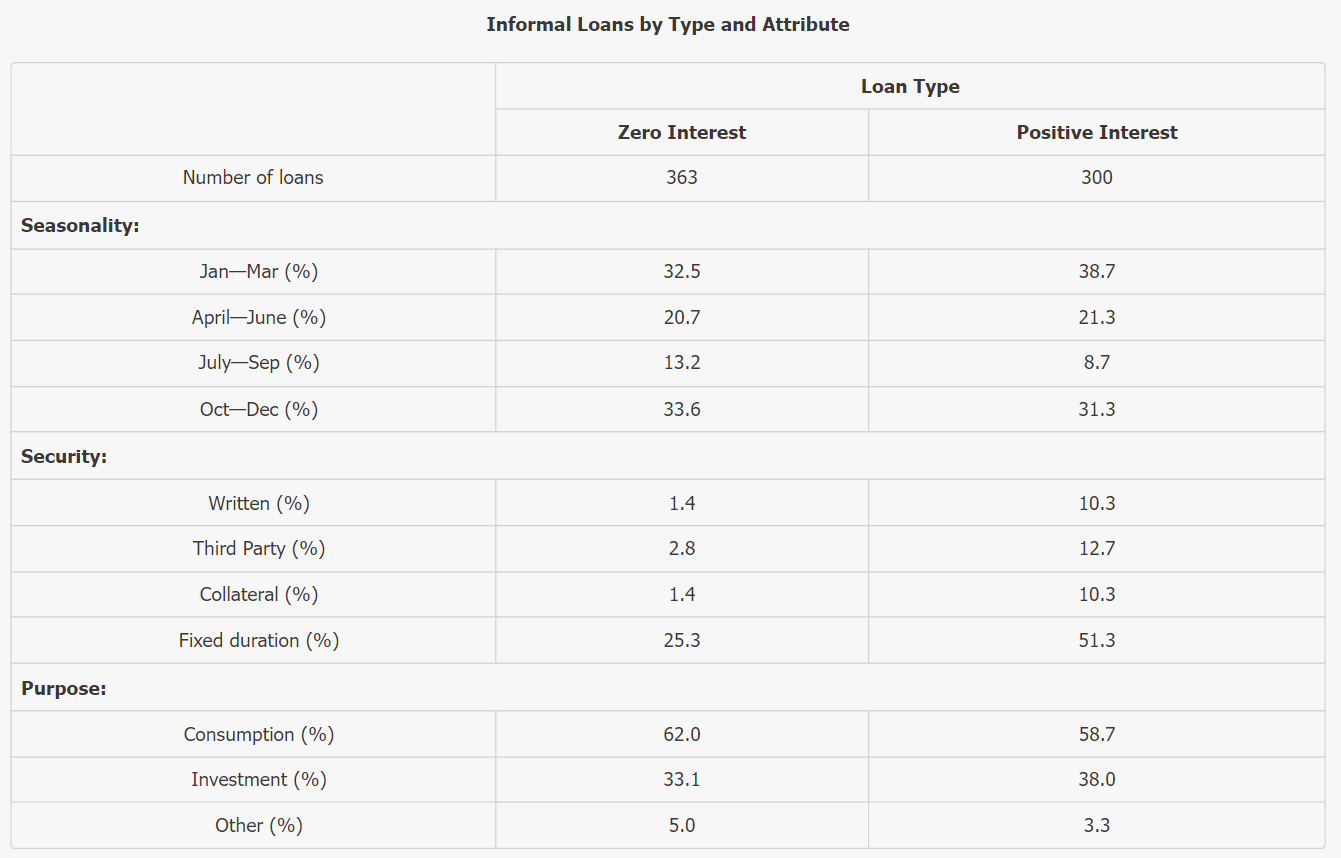
We have to restrict to the table and the table gives us the following to be true.+. 363 zero-interest vs 300 positive interest
A greater number of zero–interest rate loans than positive–interest rate loans were negotiated.
Q.1 According to the information provided, a lender who offered one of the zero–interest rate loans included in the table would accurately be described as making which of the following trade-offs?
The first Tab gives us a reason of zer0-interest rate loans, and that is 'With a zero–interest rate loan, the borrower would repay the principal and provide some non-monetary resource in lieu of interest'.
Giving up a fixed duration of repayment in exchange for security..NO
Giving up interest payments in exchange for security..NO
Giving up interest payments in exchange for access to other resources..YES
Hence, No, No, Yes.
Q.2. If one of the loans in the survey is considered at random, with no prior knowledge of the village in which it was issued, which of the following factors would, if known, increase the probability that the loan is a zero–interest rate loan?
We have to look at the graph for the answer. Where does the probability on X-axis exceed 50%? It is at mean value(Y-axis) above 25%.
The village’s mean annual interest rate in 1935 was greater than 45%.... We can check that there are only two dots above 45% in Y-axis, and both these dots correspond to more than 80% on X-axis, so YES
The lender anticipated that the borrower would be unable to supply land, labor, or draft animal services in the future....Rather it is the opposite. Zero-interest loan meant that there will be no monetary transaction, and the interest that could be accrued would be compensated by resources mentioned in the option. Hence NO
The village’s mean annual interest rate in 1935 was less than 20%....There is only one dot and that gives the probability as 23%, which is below the majority mark
Hence, Yes, No, No.
Q.3. The information in the table and graph most strongly indicates that which one of the following is true of the loans in the table?
We have to restrict to the table and the table gives us the following to be true.+. 363 zero-interest vs 300 positive interest
A greater number of zero–interest rate loans than positive–interest rate loans were negotiated.

BongBideshini
Joined: 25 May 2021
Last visit: 26 Sep 2026
Posts: 395
Given Kudos: 143
Location: India
Concentration: Entrepreneurship, Marketing
Schools: HBS '27 Stanford '27 Wharton '27 Sloan '27
GPA: 3.8
WE:Engineering (Government)
14 Oct 2024, 09:54
Kudos
Bookmarks
Official Answer: Q1
RO1, Giving up a fixed duration or repayment in exchange for security:
Note on the Loan Table tab in the zero-interest column that only 25.3% of zero-interest rate loans had a fixed duration. We can infer that 74.7% of zero-interest loans did not have a fixed duration. But at most 5.6% of zero-interest loans in total had any of the three types of security (and some or all of those loans may have had a fixed duration). Therefore, it would NOT generally be accurate to say that a lender who offered one of the zero-interest loans gave up a fixed duration of repayment in exchange for security.
The correct answer is No.
RO2, Giving up interest payments in exchange for security:
Note on the Loan Table tab in the zero-interest column that at most 5.6% of zero-interest rate loans in total had any of the three types of security (it could be less than 5.6% because some loans might have more than one of the types of security). So, the vast majority of lenders who offered one of the zero-interest rate loans—and therefore gave up interest payments—received no form of security. Therefore, it would NOT be accurate to say that a lender who offered one of the zero-interest loans gave up interest payments in exchange for security.
The correct answer is No.
RO3, Giving up interest payments in exchange for access to other resources:
On the Credit Discussion tab, the second paragraph states that with zero-interest loans, borrowers would repay principal and also provide some non-monetary resource in lieu of interest. Therefore, it would be accurate to say that a lender who offered one of the zero-interest rate loans gave up interest payments in exchange for access to some other resource.
The correct answer is Yes.
Official Answer: Q2
RO1, The village’s mean annual interest rate in 1935 was greater than 45%:
The table on the Loans Table tab indicates that 363 of the loans in the survey were zero-interest rate loans and 300 of the loans in the survey were positive-interest rate loans. Therefore, if a loan in the survey is chosen at random, with no prior knowledge of the village, the probability that the loan is a zero-interest rate loan is approximately 55%. Consider the graph on the Interest Rates tab. There were two villages with mean annual interest rates in 1935 greater than 45%, and in each of them greater than 80% of the loans in the village were zero-interest loans, which is greater than the percentage of all the loans that are zero-interest rate loans. Therefore, if a loan in the survey is considered at random, knowing that the loan was in a village having a mean annual interest rate in 1935 greater than 45% is a factor that increases the probability that the loan is a zero-interest rate loan.
The correct answer is Yes.
RO2, The lender anticipated that the borrower would be unable to supply land, labor, or draft services in the future.
The Credit Discussion tab indicates that in lieu of interest, the lender of a zero-interest rate loan expects to receive from the borrower non-monetary resources such as land, labor, or draft services. Therefore, if a loan in the survey is considered at random, knowing that the borrower would be unable to supply land, labor, or draft services in the future makes it LESS probable that the loan is a zero-interest rate loan.
The correct answer is No.
RO3, The village’s mean annual interest rate in 1935 was less than 20%.
The table on the Loans Table tab indicates that 363 of the loans in the survey were zero-interest rate loans and 300 of the loans in the survey were positive-interest rate loans. Therefore, if a loan in the survey is chosen at random, with no prior knowledge of the village, the probability that the loan is a zero-interest rate loan is approximately 55%. Consider the graph on the Interest Rates tab. There was exactly one village with mean annual interest rates in 1935 less than 20%, and in that village less than 25% of loans were zero-interest rate loans, which is less than the percentage of all the loans that were zero-interest rate loans. Therefore, if a loan in the survey is considered at random, knowing that the loan was in a village having a mean annual interest rate in 1935 that was less than 20% makes it LESS probable that the loan is a zero-interest rate loan.
The correct answer is No.
Official Answer: Q3
The table on the indicates that there were 363 zero-interest rate loans and only 300 positive-interest rate loans.
The correct answer is A greater number of zero-interest rate loans than positive-interest rate loans were negotiated.
RO1, Giving up a fixed duration or repayment in exchange for security:
Note on the Loan Table tab in the zero-interest column that only 25.3% of zero-interest rate loans had a fixed duration. We can infer that 74.7% of zero-interest loans did not have a fixed duration. But at most 5.6% of zero-interest loans in total had any of the three types of security (and some or all of those loans may have had a fixed duration). Therefore, it would NOT generally be accurate to say that a lender who offered one of the zero-interest loans gave up a fixed duration of repayment in exchange for security.
The correct answer is No.
RO2, Giving up interest payments in exchange for security:
Note on the Loan Table tab in the zero-interest column that at most 5.6% of zero-interest rate loans in total had any of the three types of security (it could be less than 5.6% because some loans might have more than one of the types of security). So, the vast majority of lenders who offered one of the zero-interest rate loans—and therefore gave up interest payments—received no form of security. Therefore, it would NOT be accurate to say that a lender who offered one of the zero-interest loans gave up interest payments in exchange for security.
The correct answer is No.
RO3, Giving up interest payments in exchange for access to other resources:
On the Credit Discussion tab, the second paragraph states that with zero-interest loans, borrowers would repay principal and also provide some non-monetary resource in lieu of interest. Therefore, it would be accurate to say that a lender who offered one of the zero-interest rate loans gave up interest payments in exchange for access to some other resource.
The correct answer is Yes.
Official Answer: Q2
RO1, The village’s mean annual interest rate in 1935 was greater than 45%:
The table on the Loans Table tab indicates that 363 of the loans in the survey were zero-interest rate loans and 300 of the loans in the survey were positive-interest rate loans. Therefore, if a loan in the survey is chosen at random, with no prior knowledge of the village, the probability that the loan is a zero-interest rate loan is approximately 55%. Consider the graph on the Interest Rates tab. There were two villages with mean annual interest rates in 1935 greater than 45%, and in each of them greater than 80% of the loans in the village were zero-interest loans, which is greater than the percentage of all the loans that are zero-interest rate loans. Therefore, if a loan in the survey is considered at random, knowing that the loan was in a village having a mean annual interest rate in 1935 greater than 45% is a factor that increases the probability that the loan is a zero-interest rate loan.
The correct answer is Yes.
RO2, The lender anticipated that the borrower would be unable to supply land, labor, or draft services in the future.
The Credit Discussion tab indicates that in lieu of interest, the lender of a zero-interest rate loan expects to receive from the borrower non-monetary resources such as land, labor, or draft services. Therefore, if a loan in the survey is considered at random, knowing that the borrower would be unable to supply land, labor, or draft services in the future makes it LESS probable that the loan is a zero-interest rate loan.
The correct answer is No.
RO3, The village’s mean annual interest rate in 1935 was less than 20%.
The table on the Loans Table tab indicates that 363 of the loans in the survey were zero-interest rate loans and 300 of the loans in the survey were positive-interest rate loans. Therefore, if a loan in the survey is chosen at random, with no prior knowledge of the village, the probability that the loan is a zero-interest rate loan is approximately 55%. Consider the graph on the Interest Rates tab. There was exactly one village with mean annual interest rates in 1935 less than 20%, and in that village less than 25% of loans were zero-interest rate loans, which is less than the percentage of all the loans that were zero-interest rate loans. Therefore, if a loan in the survey is considered at random, knowing that the loan was in a village having a mean annual interest rate in 1935 that was less than 20% makes it LESS probable that the loan is a zero-interest rate loan.
The correct answer is No.
Official Answer: Q3
The table on the indicates that there were 363 zero-interest rate loans and only 300 positive-interest rate loans.
The correct answer is A greater number of zero-interest rate loans than positive-interest rate loans were negotiated.