Events & Promotions
|
|

GMAT Club Daily Prep
Thank you for using the timer - this advanced tool can estimate your performance and suggest more practice questions. We have subscribed you to Daily Prep Questions via email.
Customized
for You
Track
Your Progress
Practice
Pays
Not interested in getting valuable practice questions and articles delivered to your email? No problem, unsubscribe here.
 Sep 21
07:00 PM EDT
-10:00 PM EDT
Boost your GMAT score in less than one month in a live online class + 6 months access to TTP OnDemand video courses included!


D
Be sure to select an answer first to save it in the Error Log before revealing the correct answer (OA)!
Difficulty:
 35%
(medium)
35%
(medium)
Question Stats:
70% (01:50) correct 30%
(01:58)
wrong
based on 5107
sessions
30%
(01:58)
wrong
based on 5107
sessions
History
Date
Time
Result
Not Attempted Yet
Formulas for cash flow and the ratio of debt to equity do not apply to new small businesses in the same way as they do to established big businesses, because they are growing and are seldom in equilibrium.
(A) Formulas for cash flow and the ratio of debt to equity do not apply to new small businesses in the same way as they do to established big businesses, because they are growing and are seldom in equilibrium.
(B) Because they are growing and are seldom in equilibrium, formulas for cash flow and the ratio of debt to equity do not apply to new small businesses in the same way as they do to established big businesses.
(C) Because they are growing and are seldom in equilibrium, new small businesses are not subject to the same applicability of formulas for cash flow and the ratio of debt to equity as established big businesses.
(D) Because new small businesses are growing and are seldom in equilibrium, formulas for cash flow and the ratio of debt to equity do not apply to them in the same way as to established big businesses.
(E) New small businesses are not subject to the applicability of formulas for cash flow and the ratio of debt to equity in the same way as established big businesses, because they are growing and are seldom in equilibrium.
(A) Formulas for cash flow and the ratio of debt to equity do not apply to new small businesses in the same way as they do to established big businesses, because they are growing and are seldom in equilibrium.
(B) Because they are growing and are seldom in equilibrium, formulas for cash flow and the ratio of debt to equity do not apply to new small businesses in the same way as they do to established big businesses.
(C) Because they are growing and are seldom in equilibrium, new small businesses are not subject to the same applicability of formulas for cash flow and the ratio of debt to equity as established big businesses.
(D) Because new small businesses are growing and are seldom in equilibrium, formulas for cash flow and the ratio of debt to equity do not apply to them in the same way as to established big businesses.
(E) New small businesses are not subject to the applicability of formulas for cash flow and the ratio of debt to equity in the same way as established big businesses, because they are growing and are seldom in equilibrium.
I spent 5 minutes on this question and finally got it right. Is there a quicker way to solve this beast?
In A, the they after because is ambiguous; it seems illogically to refer to Formulas because they and Formulas are each the grammatical subject of a clause and because the previous they refers to Formulas. In A and B, do not apply to... in the same way s they do to is wordy and awkward. D, the best choice, says more concisely in the same way as to. Also in B, because they refers to formulas, the introductory clause states confusedly that the formulas are growing. In C and E, subject to the [same] applicability of... is wordy, awkward, and imprecise; furthermore, are is preferable to either before or after established big businesses to complete the comparison. Finally, the referent of they is not immediately clear in E. 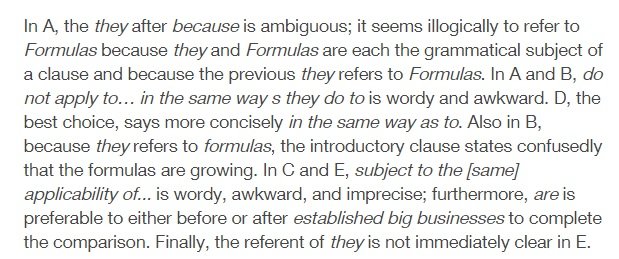
CR 32.jpg [ 86.49 KiB | Viewed 41125 times ]
In A, the they after because is ambiguous; it seems illogically to refer to Formulas because they and Formulas are each the grammatical subject of a clause and because the previous they refers to Formulas. In A and B, do not apply to... in the same way s they do to is wordy and awkward. D, the best choice, says more concisely in the same way as to. Also in B, because they refers to formulas, the introductory clause states confusedly that the formulas are growing. In C and E, subject to the [same] applicability of... is wordy, awkward, and imprecise; furthermore, are is preferable to either before or after established big businesses to complete the comparison. Finally, the referent of they is not immediately clear in E.
Attachment:
CR 32.jpg [ 86.49 KiB | Viewed 41125 times ]

 26 Nov 2015, 13:30
Kudos
Bookmarks
The point about "are" is that C says that small businesses "are not subject to the same XYZ as big businesses." It would be helpful to provide an "are" to complete the comparison: "small businesses are not subject to the same XYZ as are big businesses."
In a simple sentence, we don't need this clarification:
I'm not as strong as you.
But in a sentence with even a slight bit more complexity, that verb can make a big difference. Compare these:
I'm more interested in economics than you.
I'm more interested in economics than you are.
We would probably figure out the intended meaning in the first case (especially if we consider ourselves more interesting than economics), but the second is clearer.
Now look at a sentence with a more involved second half:
The singer is less excited about the concert than the legions of fans seeking her autograph.
This sentence is truly ambiguous. Is she more excited about the fans than about the concert (notice my second "about" to make that clear), or are the fans more excited about the concert than she is? Let's rewrite to indicate the former meaning and then the latter:
The singer is less excited about the concert than about the legions of fans seeking her autograph.
The singer is less excited about the concert than are the legions of fans seeking her autograph.
Here, we put the "are" before that long noun phrase at the end just to make it easier to catch. We could technically put it at the end, but it would be less useful there--by the end, either you've interpreted the meaning correctly or you haven't, and so it's better to make the intended meaning clear sooner.
In a simple sentence, we don't need this clarification:
I'm not as strong as you.
But in a sentence with even a slight bit more complexity, that verb can make a big difference. Compare these:
I'm more interested in economics than you.
I'm more interested in economics than you are.
We would probably figure out the intended meaning in the first case (especially if we consider ourselves more interesting than economics), but the second is clearer.
Now look at a sentence with a more involved second half:
The singer is less excited about the concert than the legions of fans seeking her autograph.
This sentence is truly ambiguous. Is she more excited about the fans than about the concert (notice my second "about" to make that clear), or are the fans more excited about the concert than she is? Let's rewrite to indicate the former meaning and then the latter:
The singer is less excited about the concert than about the legions of fans seeking her autograph.
The singer is less excited about the concert than are the legions of fans seeking her autograph.
Here, we put the "are" before that long noun phrase at the end just to make it easier to catch. We could technically put it at the end, but it would be less useful there--by the end, either you've interpreted the meaning correctly or you haven't, and so it's better to make the intended meaning clear sooner.

vivesomnium
Joined: 09 Feb 2011
Last visit: 18 Mar 2018
Posts: 174
Given Kudos: 13
Concentration: General Management, Social Entrepreneurship
Schools: HBS '14 (A)
GMAT 1: 770 Q50 V47
15 Mar 2011, 21:53
Kudos
Bookmarks
(A) Formulas for cash flow and the ratio of debt to equity do not apply to new small businesses in the same way as they do to established big businesses, because they are growing and are seldom in equilibrium.:Subject of first clause is formulas- formaulas dont apply- so in the clause satrting with because- the subject 'they' stands for formula. Inappropriate, hence wrong.
(B) Because they are growing and are seldom in equilibrium, formulas for cash flow and the ratio of debt to equity do not apply to new small businesses in the same way as they do to established big businesses.Same reason as above - formulas are the subject pointed to by 'they' in the because part of the sentence.Incorrect
(C) Because they are growing and are seldom in equilibrium, new small businesses are not subject to the same applicability of formulas for cash flow and the ratio of debt to equity as established big businesses.Applicability sounds unidiomatic- also sentence seems to imply that formulas dont apply at all-while the implication should be that the formulas dont apply in the same way as to the big businesses
(E) New small businesses are not subject to the applicability of formulas for cash flow and the ratio of debt to equity in the same way as established big businesses, because they are growing and are seldom in equilibrium.awckward and wordy construction, use of applicability- [/quote]
(B) Because they are growing and are seldom in equilibrium, formulas for cash flow and the ratio of debt to equity do not apply to new small businesses in the same way as they do to established big businesses.Same reason as above - formulas are the subject pointed to by 'they' in the because part of the sentence.Incorrect
(C) Because they are growing and are seldom in equilibrium, new small businesses are not subject to the same applicability of formulas for cash flow and the ratio of debt to equity as established big businesses.Applicability sounds unidiomatic- also sentence seems to imply that formulas dont apply at all-while the implication should be that the formulas dont apply in the same way as to the big businesses
(E) New small businesses are not subject to the applicability of formulas for cash flow and the ratio of debt to equity in the same way as established big businesses, because they are growing and are seldom in equilibrium.awckward and wordy construction, use of applicability- [/quote]

 , just kidding )