Events & Promotions
|
|

GMAT Club Daily Prep
Thank you for using the timer - this advanced tool can estimate your performance and suggest more practice questions. We have subscribed you to Daily Prep Questions via email.
Customized
for You
Track
Your Progress
Practice
Pays
Not interested in getting valuable practice questions and articles delivered to your email? No problem, unsubscribe here.
 Sep 21
07:00 PM EDT
-10:00 PM EDT
Boost your GMAT score in less than one month in a live online class + 6 months access to TTP OnDemand video courses included!

 18 Aug 2026, 07:06
Kudos
Bookmarks
This post came through our private GMAT Club WhatsApp Group.
Join the WhatsApp Community or Log in to view the full message.
Join the WhatsApp Community or Log in to view the full message.

bhanu29


GMAT Forum Director
Joined: 02 Oct 2024
Last visit: 20 Sep 2026
Posts: 944
Own Kudos:
Given Kudos: 749
Location: India
Schools: Anderson '27 Booth '27 (S) Foster '27 Haas '27 (S) Ross '27 (S) Tepper '27 Stanford '27 CBS '27 (S) NYU Stern Johnson (Cornell) McCombs '27 Kellogg '27 Sloan '27
GMAT Focus 1: 675 Q87 V85 DI79 
GMAT Focus 2: 715 Q87 V84 DI86
GPA: 9.11
WE:Engineering (Technology)
Products:
Schools: Anderson '27 Booth '27 (S) Foster '27 Haas '27 (S) Ross '27 (S) Tepper '27 Stanford '27 CBS '27 (S) NYU Stern Johnson (Cornell) McCombs '27 Kellogg '27 Sloan '27
GMAT Focus 2: 715 Q87 V84 DI86
Posts: 944
Kudos:
532
18 Aug 2026, 07:06
Kudos
Bookmarks
Yes

 18 Aug 2026, 08:00
Kudos
Bookmarks
August 18th DI Question of the Day
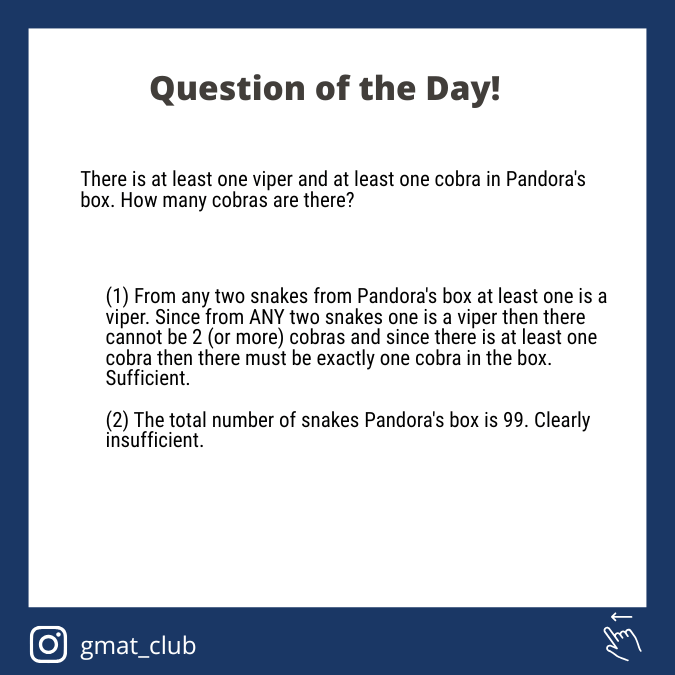
Answer and Explanation | Subscribe via E-mail, Forum, Instagram, or YouTube
Answer and Explanation | Subscribe via E-mail, Forum, Instagram, or YouTube