Events & Promotions
|
|

GMAT Club Daily Prep
Thank you for using the timer - this advanced tool can estimate your performance and suggest more practice questions. We have subscribed you to Daily Prep Questions via email.
Customized
for You
Track
Your Progress
Practice
Pays
Not interested in getting valuable practice questions and articles delivered to your email? No problem, unsubscribe here.
 Sep 02
01:00 PM EDT
-11:59 PM EDT
Take 30% off all study plans with code COURSEWORK - Expires on Monday 9/7 Sep 04
10:00 AM PDT
-11:00 AM PDT
What does test anxiety really look like on the GMAT? For many test takers, it does not look like a panic attack. Instead, it shows up as brain fog, rereading, negative comparisons, mental noise.... Sep 04
10:00 AM EDT
-11:59 PM EDT
We’ve worked incredibly hard to build TTP into the best test prep experience possible, and it would mean a lot to us to win Newsweek’s 2026 Readers’ Choice Award for Best Test Prep. If TTP has helped you, we’d be incredibly grateful for your vote. Sep 06
09:30 AM EDT
-12:30 PM EST
Top scores are possible when you enroll in a powerful EA course, taught live online + 6 months access to TTP OnDemand video courses included! Perfect class schedule and easy course access for working professionals. Class starts Sundays Sept. 6, 2026.- Sep 07
12:01 AM PDT
-11:59 PM PDT
On the 7th, GMAT Club Tests will be Free! Including all the Quizzes, Questions, and Tests. 12 AM - 11:59 PM PDT - Sep 07
10:00 AM PDT
-11:00 AM PDT
A complete walkthrough of GMAT Club’s free 12-week GMAT study plan: what you study each week, how progress and goals are tracked, how the error log works, and how your practice unlocks paid tools at no cost. - Sep 09
07:00 AM PDT
-10:00 AM PDT
Meet AdComs and explore top Master’s programs - MiM, MiF, MSc, MSBA and more. - Application Fee Waivers - Free 1-Week of GMAT Club Tests: - Master's Application Toolkit - Grand Prize Giveaway - Sep 09
10:00 AM PDT
-11:00 AM PDT
Three MBA applications. Three rejections. No interview invites. A year later, Aman was admitted to Cambridge Judge, SMU, and IMD. In this episode of MBA Admit Stories, Aman shares how he rebuilt his MBA application...  Sep 15
07:00 PM EDT
-09:00 PM EST
Elite scores are possible when you enroll in a powerful GMAT course, taught live online + 6 months access to TTP OnDemand video courses included! Class starts Tues/Thurs Sept. 15, 2026 - Nov. 15, 2027, 7:00pm-9:00pm EST Sep 21
08:00 PM EDT
-10:00 PM EDT
Boost your GMAT score in less than one month in a live online class + 6 months access to TTP OnDemand video courses included! Class starts Mon, Tues, Wed, Thur, Fri Sept. 21, 2026 - Oct. 9, 2027, 7:00pm-10:00pm EST


 15 Jul 2026, 08:00
Kudos
Bookmarks


Strengthen: Data from similar cities shows that over 80 percent of urban air pollution originates from regional commuters, and that implementing congestion pricing significantly reduces this pollution and decreases transit times by encouraging commuting during non-peak hours and carpooling.
Weaken: Congestion pricing frequently leads to “traffic displacement,” in which drivers avoid paying the fee to enter high-traffic zones by cutting through residential side streets, increasing both local gridlock and the risk of accidents in neighborhoods.
Be sure to select an answer first to save it in the Error Log before revealing the correct answer (OA)!
Difficulty:
 35%
(medium)
35%
(medium)
Question Stats:
80% (02:31) correct 20%
(02:51)
wrong
based on 423
sessions
20%
(02:51)
wrong
based on 423
sessions
History
Date
Time
Result
Not Attempted Yet
City C is considering two urban planning concepts for traffic management: traffic calming and congestion pricing. Traffic calming involves physical design changes to streets, such as speed bumps, roundabouts, and curb extensions, that are intended to slow vehicles and improve safety for pedestrians and cyclists. In contrast, congestion pricing is a market-based strategy that charges drivers a fee to enter high-traffic zones during peak hours, aiming to reduce the total volume of cars by incentivizing the use of public transit or off-peak travel. Although traffic calming would likely increase safety and livability at a neighborhood level, the mayor asserts that it does little to reduce regional traffic volume, so she favors congestion pricing for its reduction of carbon emissions and efficient management of large-scale urban gridlock.
Select Strengthen for the statement that would, if true, most strengthen the mayor’s position, and select Weaken for the statement that would, if true, most weaken the mayor’s position. Make only two selections, one in each column.
Select Strengthen for the statement that would, if true, most strengthen the mayor’s position, and select Weaken for the statement that would, if true, most weaken the mayor’s position. Make only two selections, one in each column.
| Strengthen | Weaken | |
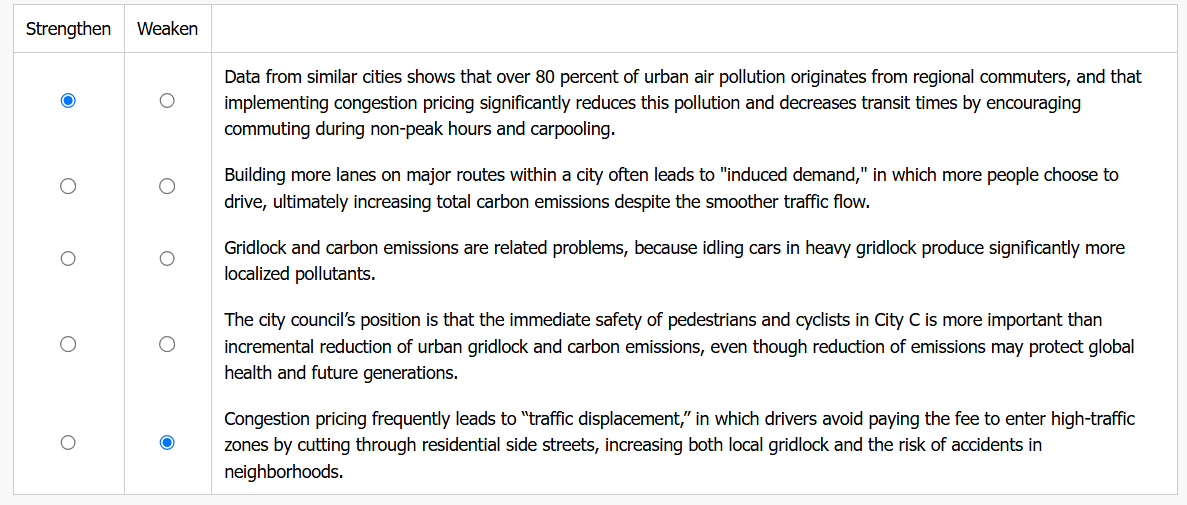
| Data from similar cities shows that over 80 percent of urban air pollution originates from regional commuters, and that implementing congestion pricing significantly reduces this pollution and decreases transit times by encouraging commuting during non-peak hours and carpooling. | ||
| Building more lanes on major routes within a city often leads to "induced demand," in which more people choose to drive, ultimately increasing total carbon emissions despite the smoother traffic flow. | ||
| Gridlock and carbon emissions are related problems, because idling cars in heavy gridlock produce significantly more localized pollutants. | ||
| The city council’s position is that the immediate safety of pedestrians and cyclists in City C is more important than incremental reduction of urban gridlock and carbon emissions, even though reduction of emissions may protect global health and future generations. | ||
| Congestion pricing frequently leads to “traffic displacement,” in which drivers avoid paying the fee to enter high-traffic zones by cutting through residential side streets, increasing both local gridlock and the risk of accidents in neighborhoods. |
ShowHide Answer
Official Answer
Strengthen: Data from similar cities shows that over 80 percent of urban air pollution originates from regional commuters, and that implementing congestion pricing significantly reduces this pollution and decreases transit times by encouraging commuting during non-peak hours and carpooling.
Weaken: Congestion pricing frequently leads to “traffic displacement,” in which drivers avoid paying the fee to enter high-traffic zones by cutting through residential side streets, increasing both local gridlock and the risk of accidents in neighborhoods.
|


⚠️ Important: GMAT Club does not allow AI-generated posts. AI-generated solutions are not eligible for kudos, and users who post them may face moderation action, including a ban.
15 Jul 2026, 09:00
Kudos
Bookmarks
Manhattan Prep Official Explanation
City C is considering two urban planning concepts for traffic management: traffic calming and congestion pricing. Traffic calming involves physical design changes to streets, such as speed bumps, roundabouts, and curb extensions, that are intended to slow vehicles and improve safety for pedestrians and cyclists. In contrast, congestion pricing is a market-based strategy that charges drivers a fee to enter high-traffic zones during peak hours, aiming to reduce the total volume of cars by incentivizing the use of public transit or off-peak travel. Although traffic calming would likely increase safety and livability at a neighborhood level, the mayor asserts that it does little to reduce regional traffic volume, so she favors congestion pricing for its reduction of carbon emissions and efficient management of large-scale urban gridlock.
Select Strengthen for the statement that would, if true, most strengthen the mayor’s position, and select Weaken for the statement that would, if true, most weaken the mayor’s position. Make only two selections, one in each column.
Step 1: Understand the Prompt and Question
Glance at the answer choices. The sentences in the answers typically signal a Verbal question. Further, the wording if true, most strengthen and if true, most weaken in the question stem indicates that this is a Verbal question, specifically a Strengthen/Weaken question.
First, deconstruct the argument / map out the constraints on your scratch paper:
MAP
Two plans for traffic: Traffic calming (TC) or congestion pricing (CP)
TC = physical street design, goal = slow cars down, result = incr local safety
CP = market fees ($$) for peak hours, goal = reduce number of cars, result = decr gridlock/emissions
TC good for neighborhoods, but fails at regional volume. CP reduces traffic volume.
Mayor: City should do CP.
Step 2: Plan your Approach
On Strengthen/Weaken questions, the correct answers should provide evidence to support or undermine an assumption made in the argument. In this case, the mayor assumes that traffic volume is the problem to solve, rather than traffic speed. She also assumes that the suggested solution to traffic volume, congestion pricing, will be successful.
Step 3: Solve the Problem
(A) CORRECT FOR FIRST COLUMN. This choice provides evidence that the mayor’s diagnosis of the problem is accurate (confirming the primary source of pollution) and that her proposed solution is effective at resolving it. By showing that congestion pricing successfully shifts drivers’ behavior, it validates both her logic and her policy choice.
(B) This choice discusses a third concept (building more lanes) that is not part of the mayor's proposed strategy of congestion pricing. The statement does not indicate whether congestion pricing also suffers from induced demand or whether congestion pricing is the solution to it.
(C) This is a neutral factual statement that explains the relationship between gridlock and pollution without favoring one policy over the other.
(D) This statement shows that the city council has a different priority (increasing safety for pedestrians and cyclists) than the mayor does (reducing emissions). However, this choice only identifies an opposing view; it neither strengthens nor weakens the mayor’s logic about the need for or efficacy of congestion pricing.
(E) CORRECT FOR SECOND COLUMN. This statement links the mayor’s preferred solution (congestion pricing) to traffic displacement, which may inadvertently cause some of the very problems the mayor seeks to solve. It indicates that instead of reducing gridlock, the policy might simply move the congestion into residential neighborhoods and increase the risk of local accidents in the process.

GMAT-Club-Forum-goh5y0w4.png [ 82.92 KiB | Viewed 1459 times ]
City C is considering two urban planning concepts for traffic management: traffic calming and congestion pricing. Traffic calming involves physical design changes to streets, such as speed bumps, roundabouts, and curb extensions, that are intended to slow vehicles and improve safety for pedestrians and cyclists. In contrast, congestion pricing is a market-based strategy that charges drivers a fee to enter high-traffic zones during peak hours, aiming to reduce the total volume of cars by incentivizing the use of public transit or off-peak travel. Although traffic calming would likely increase safety and livability at a neighborhood level, the mayor asserts that it does little to reduce regional traffic volume, so she favors congestion pricing for its reduction of carbon emissions and efficient management of large-scale urban gridlock.
Select Strengthen for the statement that would, if true, most strengthen the mayor’s position, and select Weaken for the statement that would, if true, most weaken the mayor’s position. Make only two selections, one in each column.
Step 1: Understand the Prompt and Question
Glance at the answer choices. The sentences in the answers typically signal a Verbal question. Further, the wording if true, most strengthen and if true, most weaken in the question stem indicates that this is a Verbal question, specifically a Strengthen/Weaken question.
First, deconstruct the argument / map out the constraints on your scratch paper:
MAP
Two plans for traffic: Traffic calming (TC) or congestion pricing (CP)
TC = physical street design, goal = slow cars down, result = incr local safety
CP = market fees ($$) for peak hours, goal = reduce number of cars, result = decr gridlock/emissions
TC good for neighborhoods, but fails at regional volume. CP reduces traffic volume.
Mayor: City should do CP.
Step 2: Plan your Approach
On Strengthen/Weaken questions, the correct answers should provide evidence to support or undermine an assumption made in the argument. In this case, the mayor assumes that traffic volume is the problem to solve, rather than traffic speed. She also assumes that the suggested solution to traffic volume, congestion pricing, will be successful.
Step 3: Solve the Problem
(A) CORRECT FOR FIRST COLUMN. This choice provides evidence that the mayor’s diagnosis of the problem is accurate (confirming the primary source of pollution) and that her proposed solution is effective at resolving it. By showing that congestion pricing successfully shifts drivers’ behavior, it validates both her logic and her policy choice.
(B) This choice discusses a third concept (building more lanes) that is not part of the mayor's proposed strategy of congestion pricing. The statement does not indicate whether congestion pricing also suffers from induced demand or whether congestion pricing is the solution to it.
(C) This is a neutral factual statement that explains the relationship between gridlock and pollution without favoring one policy over the other.
(D) This statement shows that the city council has a different priority (increasing safety for pedestrians and cyclists) than the mayor does (reducing emissions). However, this choice only identifies an opposing view; it neither strengthens nor weakens the mayor’s logic about the need for or efficacy of congestion pricing.
(E) CORRECT FOR SECOND COLUMN. This statement links the mayor’s preferred solution (congestion pricing) to traffic displacement, which may inadvertently cause some of the very problems the mayor seeks to solve. It indicates that instead of reducing gridlock, the policy might simply move the congestion into residential neighborhoods and increase the risk of local accidents in the process.
Attachment:
GMAT-Club-Forum-goh5y0w4.png [ 82.92 KiB | Viewed 1459 times ]
General Discussion

 15 Jul 2026, 08:09
Kudos
Bookmarks
weaken - 5th statement - Mayor favors Congestion traffic, only point 5 suggests that Congestion traffic isn't really helping, more over it is causing more trouble weakening her choice
Strengthen - 1st statement - again Mayor favors Congestion traffic as shown conclusion, Point 1 talks about Congestion traffic and is supporting it
Strengthen - 1st statement - again Mayor favors Congestion traffic as shown conclusion, Point 1 talks about Congestion traffic and is supporting it