

 Sign in with Google
 Sign in with Apple

Brian Galvin is the Director of Academic Programs at Veritas Prep, where he oversees all of the company’s GMAT preparation courses.
They say that “elephants never forget”, but, when you think about it, is that really all that impressive? How much do elephants really have to remember? Aspiring graduate students, however, have quite a bit to keep track of: dozens of internet passwords, bank account and phone numbers, mothers’ and significant others’ birthdays, and years’ worth of academia that we’ve accumulated over time. Human ingenuity, however, has created computer memory – we carry gigabytes of storage space in our pockets everywhere we go – so that we don’t need to rely on our more-limited natural capacity for memory. (Note to elephants: Now who’s impressed?)
Given that, why would business schools be overly concerned with your capacity to memorize, when you’ll spend the majority of your professional career with databases and Google at your fingertips? Naturally, there are several items for the GMAT that you’ll “just need to know”, but the authors of the GMAT are more than just clever in their ability to bait you toward incorrect answers; they’re also quite adept at creating a reward system that lines up with what business schools value. Memorization capacity is infinitely less important than is problem solving ability, and so the authors of the GMAT do a laudable job of incorporating mostly skills that you can, if necessary, derive for yourself. Consider the triangle ratios for which you are responsible:
45-45-90 – Isosceles Right Triangle: x, x, x√2
Here, if you simply use the Pythagorean Theorem, a2 + b2 = c2, you can also note that, because the triangle is isosceles, side a will be equal to side b. Accordingly, if a = b, the Pythagorean formula becomes 2 a2 = c2. Then, solving for c to find the ratio, you can follow the steps:
2 a2 = c2
√(2 a2) = √c2
a√2 = c
Therefore, you can prove that the hypotenuse, c, is going to be equal to the square root of 2 multiplied by the length of either shorter side.
The 30-60-90 right triangle ratio, x, x√3, 2x, can be derived in similar fashion. An equilateral triangle has all sides equal, and all angles equal to 60 degrees. If you were to bisect the triangle down the middle, you would create two identical triangles, each with a right angle, one length that is the side of the equilateral triangle, and one side that is half of the equilateral side:
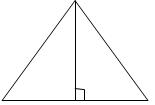
Let’s call the long side, the side of the equilateral triangle, 2x (you’ll see why in a second. Then, the shortest side of the half-triangle will be equal to half of the long side, or x. Then, the height of the equilateral triangle, the new line we drew, we’ll call h, for height. Because the long side is opposite the 90-degree angle, it takes the place of “c” in the Pythagorean Theorem, giving us the formula:
x2 + h2 = (2x)2
Solving for h, we’ll find that:
x2 + h2 = 4x2
h2 = 4x2 – x2
h2 = 3x2
h = x√3
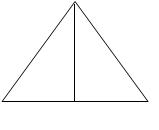
Therefore, we can prove that the triangle ratio for a 30-60-90 triangle is x, x√3, 2x. Naturally, if you can memorize these properties, it will make your calculations go much more quickly, but keep in mind this: most of the “knowledge” that you need for the GMAT you can derive for yourself if you absolutely have to. Because of this, if you blank on a particular formula or property, see if you can quickly prove it back to yourself. The authors of the GMAT can’t simply reward memorization, so they almost always provide you a way to create what you need for yourself. Just knowing this fact, and practicing it if you blank on a formula while you study, can help you develop a supreme confidence heading in to the exam. That’s the thing about the authors of the GMAT – when they seem their “cruelest”, setting trap after trap to keep your score down, they usually also provide you with a path out of the trap if you’re willing to seek it out.
Read more GMAT advice on the Veritas Prep blog. Ready to sign up for a GMAT course? Enroll through GMAT Club and you’ll not only save up to $180 (use discount code GMATC10), but you’ll also get access to all 30 of GMAT Club’s GMAT practice tests! Read more info here.

