Events & Promotions
|
|

GMAT Club Daily Prep
Thank you for using the timer - this advanced tool can estimate your performance and suggest more practice questions. We have subscribed you to Daily Prep Questions via email.
Customized
for You
Track
Your Progress
Practice
Pays
Not interested in getting valuable practice questions and articles delivered to your email? No problem, unsubscribe here.
 Sep 21
07:00 PM EDT
-10:00 PM EDT
Boost your GMAT score in less than one month in a live online class + 6 months access to TTP OnDemand video courses included!


 22 Jan 2015, 07:58
Kudos
Bookmarks


C
Be sure to select an answer first to save it in the Error Log before revealing the correct answer (OA)!
Difficulty:
 45%
(medium)
45%
(medium)
Question Stats:
70% (02:50) correct 30%
(02:38)
wrong
based on 491
sessions
30%
(02:38)
wrong
based on 491
sessions
History
Date
Time
Result
Not Attempted Yet
If ABCD is a rectangle, what is the area of the shaded region?
A. 64
B. 82
C. 96
D. 120
E. 150
Attachment:
Untitled.png [ 4.33 KiB | Viewed 136655 times ]
 28 Jan 2015, 00:41
Kudos
Bookmarks
Answer = C. 96
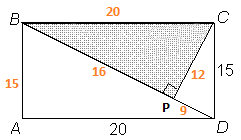
Untitled.png [ 5.42 KiB | Viewed 106166 times ]
Diagonal of rectangle \(= \sqrt{20^2 + 15^2} = \sqrt{625} = 25\)
Half the area of rectangle \(= 150 = \frac{1}{2} * 25 * h\)
Height = 12 = CP
Length BP \(= \sqrt{20^2 - 12^2} = \sqrt{256} = 16\)
Area of shaded region \(\triangle BPC = \frac{1}{2} * 16 * 12 = 96\)
Attachment:
Untitled.png [ 5.42 KiB | Viewed 106166 times ]
Diagonal of rectangle \(= \sqrt{20^2 + 15^2} = \sqrt{625} = 25\)
Half the area of rectangle \(= 150 = \frac{1}{2} * 25 * h\)
Height = 12 = CP
Length BP \(= \sqrt{20^2 - 12^2} = \sqrt{256} = 16\)
Area of shaded region \(\triangle BPC = \frac{1}{2} * 16 * 12 = 96\)

 28 Jan 2015, 13:29
Kudos
Bookmarks
Hi All,
When the GMAT puts a right triangle in front of you, it is probably NOT a random right triangle. While there are some exceptions, in most cases, you're looking at a 3/4/5, 5/12/13, 30/60/90 or 45/45/90 right triangle. If you see ANY clues that point to a specific right triangle, then you should think about how you can prove that the triangle IS what you think it is.
Here, we have 3 right triangles and they all appear to be multiples of a 3/4/5 (notice how each has a diagonal that is a MULTIPLE of 5).
Assuming they're all 3/4/5s, the sides SHOULD be....
Big triangle: 15/20/25
Middle triangle: 12/16/20
Small triangle: 9/12/15
From the picture, there are a couple of other things that need to "line up" to prove that we're correct:
1) One side of the "small" and "middle" triangles MUST be the same.
2) The "other" sides of each of those triangles MUST add up to 25 (the diagonal of the big triangle)
The common "shared" side would be 12, which means the "other" sides (16 and 9) add up to 25. So we have the EXACT situation that we thought we did. With knowledge of ALL of the side lengths, we can now answer any question that's asked.
GMAT assassins aren't born, they're made,
Rich
When the GMAT puts a right triangle in front of you, it is probably NOT a random right triangle. While there are some exceptions, in most cases, you're looking at a 3/4/5, 5/12/13, 30/60/90 or 45/45/90 right triangle. If you see ANY clues that point to a specific right triangle, then you should think about how you can prove that the triangle IS what you think it is.
Here, we have 3 right triangles and they all appear to be multiples of a 3/4/5 (notice how each has a diagonal that is a MULTIPLE of 5).
Assuming they're all 3/4/5s, the sides SHOULD be....
Big triangle: 15/20/25
Middle triangle: 12/16/20
Small triangle: 9/12/15
From the picture, there are a couple of other things that need to "line up" to prove that we're correct:
1) One side of the "small" and "middle" triangles MUST be the same.
2) The "other" sides of each of those triangles MUST add up to 25 (the diagonal of the big triangle)
The common "shared" side would be 12, which means the "other" sides (16 and 9) add up to 25. So we have the EXACT situation that we thought we did. With knowledge of ALL of the side lengths, we can now answer any question that's asked.
GMAT assassins aren't born, they're made,
Rich


 . It becomes a square.





