Events & Promotions
| Last visit was: 14 Sep 2026, 09:47 |
It is currently 14 Sep 2026, 09:47 |
|
|

GMAT Club Daily Prep
Thank you for using the timer - this advanced tool can estimate your performance and suggest more practice questions. We have subscribed you to Daily Prep Questions via email.
Customized
for You
Track
Your Progress
Practice
Pays
Not interested in getting valuable practice questions and articles delivered to your email? No problem, unsubscribe here.
 Sep 15
07:00 PM EDT
-09:00 PM EST
Elite scores are possible when you enroll in a powerful GMAT course, taught live online + 6 months access to TTP OnDemand video courses included! Class starts Tues/Thurs Sept. 15, 2026 - Nov. 15, 2027, 7:00pm-9:00pm EST Sep 18
08:00 PM PDT
-09:00 PM PDT
Video explanations + diagnosis of 10 weakest areas + 150+ short videos + study plan! Sep 21
07:00 PM EDT
-10:00 PM EDT
Boost your GMAT score in less than one month in a live online class + 6 months access to TTP OnDemand video courses included! Class starts Mon, Tues, Wed, Thur, Fri Sept. 21, 2026 - Oct. 9, 2027, 7:00pm-10:00pm EST

 11 Jul 2024, 04:52
Kudos
Bookmarks
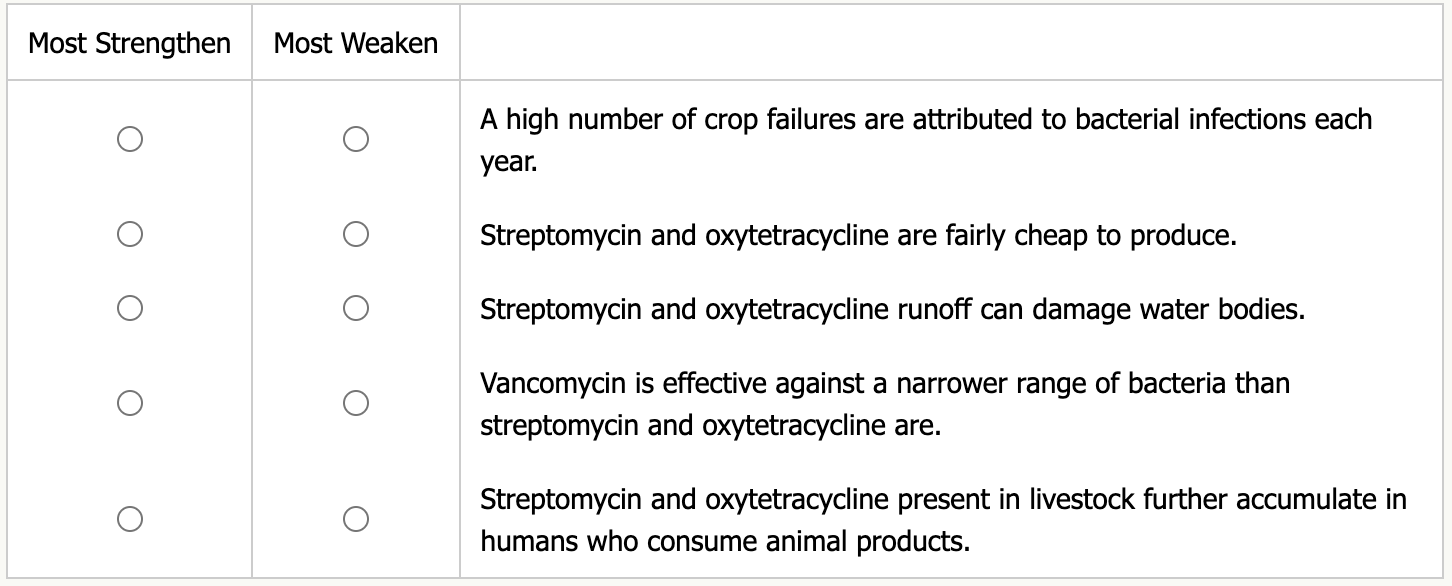
Most Strenthen : option which will negate use of antibotic which is indicated in "Streptomycin and oxytetracycline present in livestock further accumulate in humans who consume animal products."
Most Weaken : Which negates new drug use neing ineffective to existing antibiotic " Vancomycin is effective against a narrower range of bacteria than streptomycin and oxytetracycline are"
Most Weaken : Which negates new drug use neing ineffective to existing antibiotic " Vancomycin is effective against a narrower range of bacteria than streptomycin and oxytetracycline are"
 11 Jul 2024, 04:59
Kudos
Bookmarks
Organic chemist: Streptomycin and oxytetracycline are two anti-bacterial agents used in commercial farming, and may pose a serious public health risk down the line. These anti-bacterial agents are liberally applied to crops grown for animal feed and, as a result, it is common to find livestock with a build up of the chemicals in their bodies. In fact, levels of the antibiotics in livestock have been found to be up to 100 times what is needed to break down the natural bacterial eco-system of the animal, an outcome that leads to poor health outcomes for the animal and increases the risk of anti-biotic resistant bacterial strains evolving within them.
A disease specialist intends to use the chemist’s observations to argue that vancomycin, a compound that breaks down much faster than streptomycin and oxytetracycline, should replace them in the production of livestock feed, reducing the build-up of anti-biotic agents in livestock. Select the information that, if true, would most strengthen the disease specialists’ position, and that which, if true would most weaken it. Make only two selections, one in each column.
Explanation: Upon analyzing all the given options
To Strengthen
Option 3: Streptomycin and oxytetracycline runoff can damage water bodies.
This option strengthens the argument by highlighting an environmental hazard associated with the current antibiotics. If streptomycin and oxytetracycline runoff damages water bodies, switching to vancomycin, which breaks down faster, could mitigate this environmental impact.
To Weaken
Option 4: Vancomycin is effective against a narrower range of bacteria than streptomycin and oxytetracycline are
This option weakens the argument because it suggests that vancomycin may not be as effective in controlling bacterial infections in livestock compared to streptomycin and oxytetracycline. This could potentially lead to increased bacterial infections and poorer health outcomes for livestock, outweighing the benefits of faster breakdown.
Rest of the options either don't provide strong enough reasoning to either strengthen or weaken the specialist's position.

GMAT-Club-Forum-rpwzsw5o.png [ 109.32 KiB | Viewed 612 times ]
A disease specialist intends to use the chemist’s observations to argue that vancomycin, a compound that breaks down much faster than streptomycin and oxytetracycline, should replace them in the production of livestock feed, reducing the build-up of anti-biotic agents in livestock. Select the information that, if true, would most strengthen the disease specialists’ position, and that which, if true would most weaken it. Make only two selections, one in each column.
Explanation: Upon analyzing all the given options
To Strengthen
Option 3: Streptomycin and oxytetracycline runoff can damage water bodies.
This option strengthens the argument by highlighting an environmental hazard associated with the current antibiotics. If streptomycin and oxytetracycline runoff damages water bodies, switching to vancomycin, which breaks down faster, could mitigate this environmental impact.
To Weaken
Option 4: Vancomycin is effective against a narrower range of bacteria than streptomycin and oxytetracycline are
This option weakens the argument because it suggests that vancomycin may not be as effective in controlling bacterial infections in livestock compared to streptomycin and oxytetracycline. This could potentially lead to increased bacterial infections and poorer health outcomes for livestock, outweighing the benefits of faster breakdown.
Rest of the options either don't provide strong enough reasoning to either strengthen or weaken the specialist's position.
Attachment:
GMAT-Club-Forum-rpwzsw5o.png [ 109.32 KiB | Viewed 612 times ]

 11 Jul 2024, 05:48
Kudos
Bookmarks
In the context of given passage, we need the info that directly related to the build-up of anti-biotic agents in livestock and its effectiveness on the bateria. The expense is not mentioned, or the runoff that may affect the water can be treated by installing the water purification systems...
Strengthen the disease specialist's position:
Streptomycin and oxytetracycline present in livestock further accumulate in humans who consume animal products.
Weaken the disease specialist's position:
Vancomycin is effective against a narrower range of bacteria than streptomycin and oxytetracycline are.
Strengthen the disease specialist's position:
Streptomycin and oxytetracycline present in livestock further accumulate in humans who consume animal products.
Weaken the disease specialist's position:
Vancomycin is effective against a narrower range of bacteria than streptomycin and oxytetracycline are.

iabhish1509
Joined: 09 Jan 2024
Last visit: 01 Feb 2026
Posts: 125
Given Kudos: 200
Location: India
Schools: NUS BU (A$) Simon '27 (A$$) Tepper (A$)
GPA: 8
11 Jul 2024, 06:01
Kudos
Bookmarks
To Strengthen the Disease Specialist's Position:
Streptomycin and oxytetracycline present in livestock further accumulate in humans who consume animal products.
This strengthens the disease specialist's position because it highlights an additional public health risk. If these antibiotics accumulate in humans through the consumption of animal products, it underscores the need to reduce their use in livestock production to prevent potential health hazards, including antibiotic resistance.
To Weaken the Disease Specialist's Position:
Vancomycin is effective against a narrower range of bacteria than streptomycin and oxytetracycline are.
This weakens the disease specialist's position because it suggests that vancomycin may not be as effective in controlling the wide range of bacterial infections that streptomycin and oxytetracycline can handle. If vancomycin's effectiveness is limited, it may not be a suitable replacement despite its faster breakdown rate, potentially leading to ineffective bacterial control and crop failures.
Streptomycin and oxytetracycline present in livestock further accumulate in humans who consume animal products.
This strengthens the disease specialist's position because it highlights an additional public health risk. If these antibiotics accumulate in humans through the consumption of animal products, it underscores the need to reduce their use in livestock production to prevent potential health hazards, including antibiotic resistance.
To Weaken the Disease Specialist's Position:
Vancomycin is effective against a narrower range of bacteria than streptomycin and oxytetracycline are.
This weakens the disease specialist's position because it suggests that vancomycin may not be as effective in controlling the wide range of bacterial infections that streptomycin and oxytetracycline can handle. If vancomycin's effectiveness is limited, it may not be a suitable replacement despite its faster breakdown rate, potentially leading to ineffective bacterial control and crop failures.