

 Sign in with Google
 Sign in with Apple

Although the creators of the GMAT do not say so, their test functions like an IQ test. There is quite a bit of research showing that the GMAT absolutely predicts grades in an MBA program. Generally, people who score better on the GMAT perform better in graduate school. The correlation between GMAT scores and first-year MBA grades is approximately r = .47. By the standards of graduate admissions tests, that is a pretty strong correlation. Perfect predictions would occur if r = 1; predictions that are completely random would occur if r = 0.
There is still room for improving those predictions, though. That is why most graduate programs also use an applicant’s undergraduate grade-point average to predict student performance in MBA programs. The result is an improved prediction because school grades capture information and behaviors that a test does not, such as long-term motivation, the ability to meet deadlines and follow instructions, and time management. This is encouraging; it takes more than just pure brainpower and IQ to succeed in school. However, just to satisfy your curiosity, here are some things that correlate with IQ. Pretty interesting to look through.
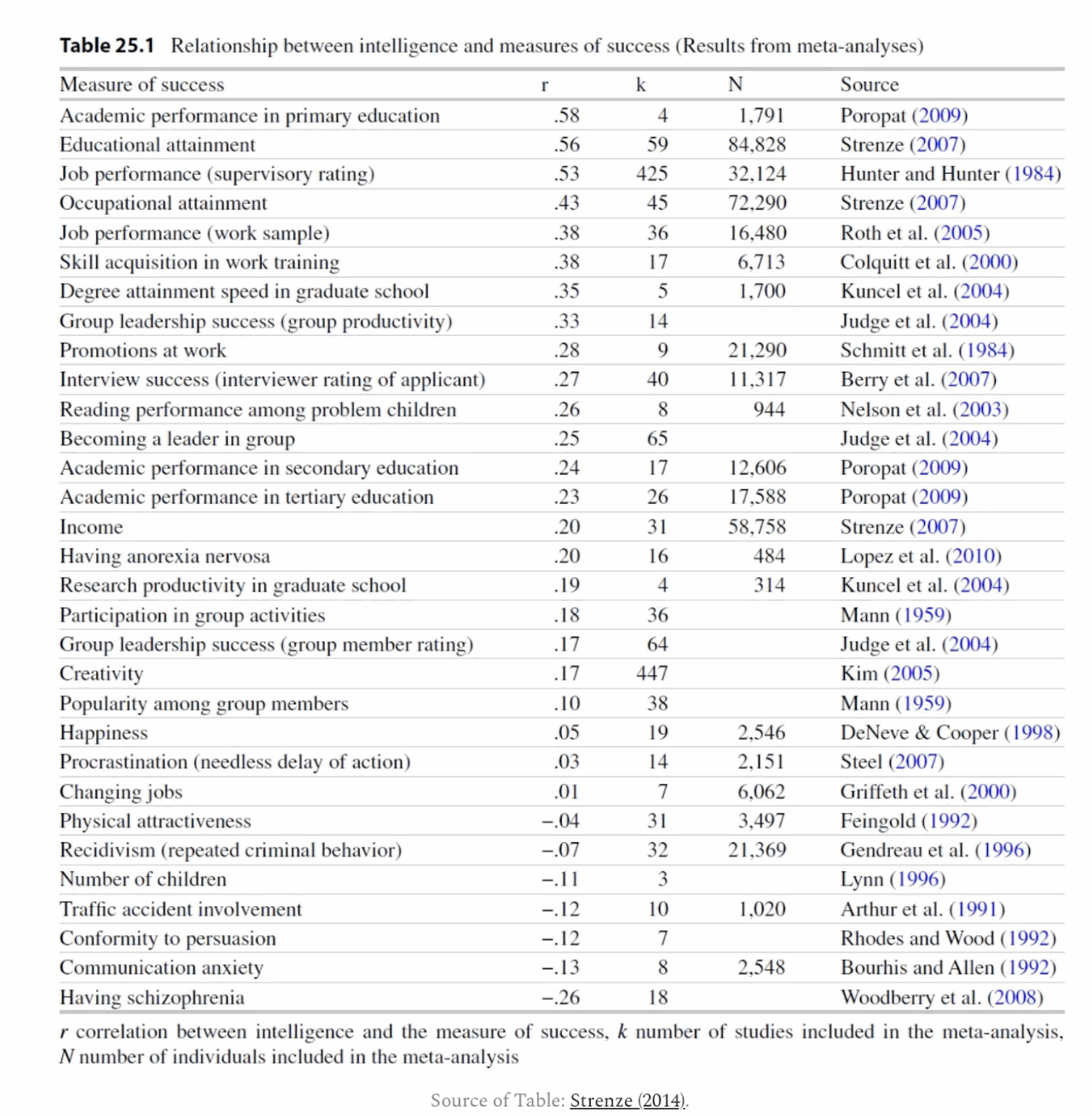
It is sometimes hard to measure if an IQ score predicts career success, as success can be subjective. However, one of the best objective measures of career success is income. Smarter people, generally, earn more money than less intelligent people. A 2007 study found that each IQ point was associated with an increase of $234-616 in salary per year ($375-985 in 2025 dollars). That is quite substantial. The relationship between higher IQ and higher salary even holds after controlling for family background variables. Even within the same job, smarter people perform better, and therefore, usually advance in their careers further than less intelligent people.
Other measures of career success are often field-specific, but they also show that smarter people perform better than their less intelligent colleagues. Smarter people earn more patents and publish more creative or scientific works than less intelligent people (though many jobs do not require either of these outcomes). Smarter individuals are also more successful when investing in the stock market and tend to be better marksmen in firearm training. There are also studies that investigate job performance, and most show that smarter people perform better at their jobs.
In addition to predicting job performance, IQ also functions as a gatekeeper variable. Many jobs have a minimum IQ needed to obtain and keep the job. Sometimes this minimum is explicit, which occurs when a person has to pass an IQ-like test in order to be certified to work in that job. However, the minimum is often implicit or indirectly set. This is particularly true in jobs that require a college degree (or a graduate degree, such as an MBA) to be hired, or if the job is sufficiently complex that less intelligent individuals do not apply or quickly drop out.
IQ’s gatekeeping function has significant implications for both workers and society. For workers, a high IQ can open career doors that are closed to those with lower intelligence. On the other hand, there’s nothing stopping a very bright person from a job with a lower IQ minimum. For society, a higher IQ minimum for a job closes off more people from obtaining or keeping that job. The principle of supply and demand means that those jobs will generally pay more (assuming demand stays constant) because there is a smaller supply of eligible employees. This is why jobs with a high minimum IQ tend to be more prestigious.
None of this means that IQ is essential for every aspect of job performance. Personal discipline, leadership, and physical fitness have weak or non-existent relationships with IQ. To the extent that a job requires these behaviors, an IQ test is not a reliable predictor of job and career success. But almost every job has at least some duties that require cognitive abilities, rendering IQ an important metric.

Author: Dr. Russell T. Warne
Personal website: https://russellwarne.com
Take an IQ test: http://riotiq.com
LinkedIn: https://www.linkedin.com/in/russell-warne
Email: [email protected]
