|
|

GMAT Club Daily Prep
Thank you for using the timer - this advanced tool can estimate your performance and suggest more practice questions. We have subscribed you to Daily Prep Questions via email.
Customized
for You
Track
Your Progress
Practice
Pays
Not interested in getting valuable practice questions and articles delivered to your email? No problem, unsubscribe here.


 17 Aug 2021, 08:00
Kudos
Bookmarks


C
Be sure to select an answer first to save it in the Error Log before revealing the correct answer (OA)!
Difficulty:
 95%
(hard)
95%
(hard)
Question Stats:
39% (01:56) correct 61%
(02:22)
wrong
based on 209
sessions
61%
(02:22)
wrong
based on 209
sessions
History
Date
Time
Result
Not Attempted Yet
In the image above, if \(AE = \sqrt{17}\), \(BE = \sqrt{5}\), and \(CE = \sqrt{13}\) then what is the area of square ABCD?
A. 2
B. 3
C. 4
D. 5
E. 6
|


Attachment:
Untitled3.png
Experience GMAT Club Test Questions
Yes, you've landed on a GMAT Club Tests question
Craving more? Unlock our full suite of GMAT Club Tests here
Want to experience more? Get a taste of our tests with our free trial today
Rise to the challenge with GMAT Club Tests. Happy practicing!



 17 Aug 2021, 09:13
Kudos
Bookmarks
Asked: In the image above, if \(AE = \sqrt{17}\), \(BE = \sqrt{5}\), and \(CE = \sqrt{13}\) then what is the area of square ABCD?
Attachment:
Screenshot 2021-08-17 at 9.02.16 PM.png [ 40.65 KiB | Viewed 5170 times ]
z^2 + (x+y)^2 = 17
z^2 + y^2 = 5
(z+x)^2 + y^2 = 13
(x+2y)x = x^2 + 2xy = 17-5 = 12
x(x+2z) = x^2 + 2xz= 13-5 = 8
2x(y-z) = 12-8 = 4
Area of the square ABCD = x^2
If x = 2; y = 2; z = 1; All 3 equations are satisfied.
z^2 + (x+y)^2 = 1^2 + (2+2)^2 = 1 + 16 = 17
z^2 + y^2 = 1^2 + 2^2 = 1+ 4 = 5
(z+x)^2 + y^2 = (1+2)^2 + 2^2 = 9 + 4 = 13
IMO C
23 Nov 2021, 03:42
Kudos
Bookmarks
Official Solution:
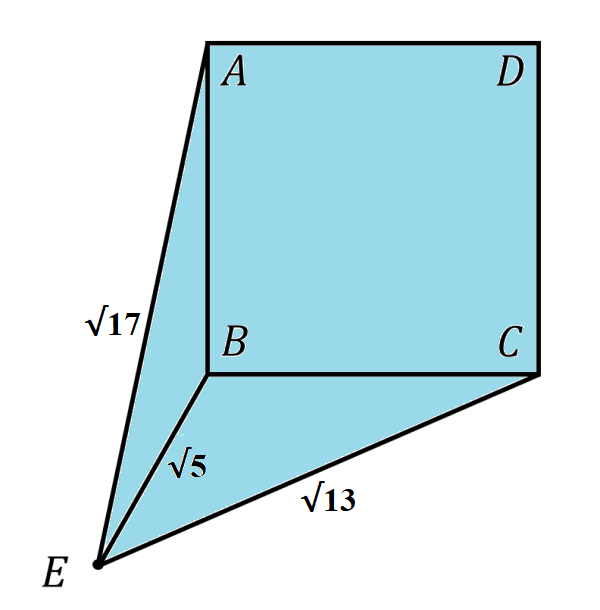
In the image above, if \(AE = \sqrt{17}\), \(BE = \sqrt{5}\), and \(CE = \sqrt{13}\) then what is the area of square ABCD?
A. \(2\)
B. \(3\)
C. \(4\)
D. \(5\)
E. \(6\)
Consider the image below:
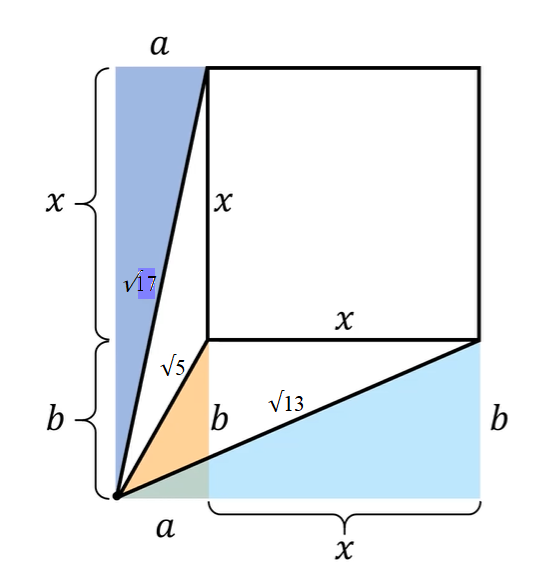
Apply Pythagorean theorem to the three triangles shown in the image:
\(a^2+b^2=(\sqrt{5})^2\);
\((x+a)^2+b^2=(\sqrt{13})^2\). Expand: \(x^2+2ax+a^2+b^2=13\). Substitute \(a^2+b^2=5\): \(x^2+2ax+5=13\). So, \(a=\frac{8-x^2}{2x}\);
\((x+b)^2+a^2=(\sqrt{17})^2\). Expand: \(x^2+2bx+b^2+a^2=17\). Substitute \(a^2+b^2=5\): \(x^2+2bx+5=17\). So, \(b=\frac{12-x^2}{2x}\).
Substitute \(a=\frac{8-x^2}{2x}\) and \(b=\frac{12-x^2}{2x}\) into \(a^2+b^2=5\)
\((\frac{8-x^2}{2x})^2+ (\frac{12-x^2}{2x})^2=5\);
\(\frac{(8-x^2)^2}{4x^2}+ \frac{(12-x^2)^2}{4x^2}=5\)
At this point it's better to plug-in the options. We are asked to fins the area of the square, which would be \(x^2\), so plug-in options for \(x^2\) and check which gives the right answer.
Option C (4) works: \(\frac{(8-4)^2}{4*4}+ \frac{(12-4)^2}{4*4}=5\)
Answer: C
In the image above, if \(AE = \sqrt{17}\), \(BE = \sqrt{5}\), and \(CE = \sqrt{13}\) then what is the area of square ABCD?
A. \(2\)
B. \(3\)
C. \(4\)
D. \(5\)
E. \(6\)
Consider the image below:
Apply Pythagorean theorem to the three triangles shown in the image:
\(a^2+b^2=(\sqrt{5})^2\);
\((x+a)^2+b^2=(\sqrt{13})^2\). Expand: \(x^2+2ax+a^2+b^2=13\). Substitute \(a^2+b^2=5\): \(x^2+2ax+5=13\). So, \(a=\frac{8-x^2}{2x}\);
\((x+b)^2+a^2=(\sqrt{17})^2\). Expand: \(x^2+2bx+b^2+a^2=17\). Substitute \(a^2+b^2=5\): \(x^2+2bx+5=17\). So, \(b=\frac{12-x^2}{2x}\).
Substitute \(a=\frac{8-x^2}{2x}\) and \(b=\frac{12-x^2}{2x}\) into \(a^2+b^2=5\)
\((\frac{8-x^2}{2x})^2+ (\frac{12-x^2}{2x})^2=5\);
\(\frac{(8-x^2)^2}{4x^2}+ \frac{(12-x^2)^2}{4x^2}=5\)
At this point it's better to plug-in the options. We are asked to fins the area of the square, which would be \(x^2\), so plug-in options for \(x^2\) and check which gives the right answer.
Option C (4) works: \(\frac{(8-4)^2}{4*4}+ \frac{(12-4)^2}{4*4}=5\)
Answer: C