Events & Promotions
|
|

GMAT Club Daily Prep
Thank you for using the timer - this advanced tool can estimate your performance and suggest more practice questions. We have subscribed you to Daily Prep Questions via email.
Customized
for You
Track
Your Progress
Practice
Pays
Not interested in getting valuable practice questions and articles delivered to your email? No problem, unsubscribe here.
 Sep 26
01:00 PM EDT
-04:00 PM EDT
Top scores are possible when you enroll in a powerful GMAT course, taught live online + 6 months access to TTP OnDemand video courses included. Class starts Saturdays Sept. 26, 2026 - Dec. 19, 2026, 1:00pm-4:00pm ES Sep 29
11:00 AM EDT
-01:00 PM EDT
" Description: Top scores are possible when you enroll in a powerful GMAT course, taught live online + 6 months access to TTP OnDemand video courses included! Class starts Tues/Thur Sept. 29, 2026 - Dec. 3, 2026, 11:00am-1:00pm EST Oct 01
07:00 AM BST
-08:00 AM GMT
Welcome to the GMAT Club's Free Interview Prep Event for Top MBA Programs! Buy tickets - Virtual series that’s all set to equip you to -excel in your MBA interviews.

TheUltimateWinner
Joined: 23 Feb 2015
Last visit: 29 Aug 2026
Posts: 2,464
Given Kudos: 1,990
Concentration: Finance, Technology
Schools: Harvard '24 Judge '23 LBS '24 McCombs '24 Mendoza Tepper '24 Ross '24 Cox Marshall '24 Fisher Kelley '24 Jones McDonough '24 Owen '24 Terry BU Simon '24 Katz GWU Mason Babson Gabelli Foster '24 Goizueta '24 Scheller Stern '23 CBS '23 Booth '23 Haas '25 Wharton '25 Stanford '26 Johnson'23 Fuqua '23 Kellogg '23 Kenan-Flagler'23 INSEAD Aug 22 intake Olin '23 Said '23 Sloan '23 Carey Arizona "22 Yale '23 UC Davis Madison '23 Anderson '23 Carroll Carlson '23 Darden '23
Schools: Harvard '24 Judge '23 LBS '24 McCombs '24 Mendoza Tepper '24 Ross '24 Cox Marshall '24 Fisher Kelley '24 Jones McDonough '24 Owen '24 Terry BU Simon '24 Katz GWU Mason Babson Gabelli Foster '24 Goizueta '24 Scheller Stern '23 CBS '23 Booth '23 Haas '25 Wharton '25 Stanford '26 Johnson'23 Fuqua '23 Kellogg '23 Kenan-Flagler'23 INSEAD Aug 22 intake Olin '23 Said '23 Sloan '23 Carey Arizona "22 Yale '23 UC Davis Madison '23 Anderson '23 Carroll Carlson '23 Darden '23
Posts: 2,464
 20 Feb 2019, 13:28
Kudos
Bookmarks


D
Be sure to select an answer first to save it in the Error Log before revealing the correct answer (OA)!
Difficulty:
 25%
(medium)
25%
(medium)
Question Stats:
71% (01:16) correct 29%
(01:35)
wrong
based on 143
sessions
29%
(01:35)
wrong
based on 143
sessions
History
Date
Time
Result
Not Attempted Yet
Solve \(x^2-2x-3<0\)
1) \(x<-1\)
2) \(x>3\)
3) \(-1<x<3\)
A) 1 only
B) 2 only
C) 1 & 2 only
D) 3 only
E) 1, 2, & 3
1) \(x<-1\)
2) \(x>3\)
3) \(-1<x<3\)
A) 1 only
B) 2 only
C) 1 & 2 only
D) 3 only
E) 1, 2, & 3

 20 Feb 2019, 13:41
Kudos
Bookmarks
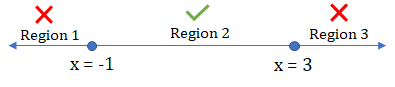
The answer here is D.
If you'll factorize the equation then (x-3)(x+1) < 0
This says that one of them is -ve and one is +ve, obviously x+1 > x-3 in all cases so we can say that
1. x+1>0 i.e. +ve => x>-1
2. x-3<0 i.e. -ve => x<3
Thus -1<x<3 is the solution.
Posted from my mobile device
If you'll factorize the equation then (x-3)(x+1) < 0
This says that one of them is -ve and one is +ve, obviously x+1 > x-3 in all cases so we can say that
1. x+1>0 i.e. +ve => x>-1
2. x-3<0 i.e. -ve => x<3
Thus -1<x<3 is the solution.
Posted from my mobile device
 20 Feb 2019, 14:18
Kudos
Bookmarks
Factorising the quadratic equation, we get :
x^2 - 2x - 3 => (x+1)(x-3) < 0
Now either (but not both) of these factors can be negative, only then the product will be negative.
Case 1: x+1 < 0 and x-3 > 0 => x<-1 and x>3 which cannot simultaneously be satisfied.
Case 2: x+1 > 0 and x-3 <0 => x>-1 and x<3 => Option D.
Posted from my mobile device
x^2 - 2x - 3 => (x+1)(x-3) < 0
Now either (but not both) of these factors can be negative, only then the product will be negative.
Case 1: x+1 < 0 and x-3 > 0 => x<-1 and x>3 which cannot simultaneously be satisfied.
Case 2: x+1 > 0 and x-3 <0 => x>-1 and x<3 => Option D.
Posted from my mobile device