Events & Promotions
|
|

GMAT Club Daily Prep
Thank you for using the timer - this advanced tool can estimate your performance and suggest more practice questions. We have subscribed you to Daily Prep Questions via email.
Customized
for You
Track
Your Progress
Practice
Pays
Not interested in getting valuable practice questions and articles delivered to your email? No problem, unsubscribe here.
 May 01
11:00 AM PDT
-12:00 PM PDT
Free- full-length test + 15 concept videos + 150+ short videos + study plan! May 03
12:30 AM EDT
-01:30 AM EDT
Learn how Kamakshi achieved a GMAT 675 with an impressive 96th %ile in Data Insights. Discover the unique methods and exam strategies that helped her excel in DI along with other sections for a balanced and high score.

BillyZ

Current Student
Joined: 14 Nov 2016
Last visit: 24 Jan 2026
Posts: 1,135
Given Kudos: 926
Location: Malaysia
Concentration: General Management, Strategy
Schools: Sloan '23 (D) Tuck '23 (D) Darden '23 (D) Ross '23 (D) Kellogg '23 (D) Wharton '23 (D) Booth '23 (D) Fuqua '24 (A) Harvard '24 (D) Stanford '24 (D)
GMAT 1: 750 Q51 V40 (Online)
GPA: 3.53
Products:
Schools: Sloan '23 (D) Tuck '23 (D) Darden '23 (D) Ross '23 (D) Kellogg '23 (D) Wharton '23 (D) Booth '23 (D) Fuqua '24 (A) Harvard '24 (D) Stanford '24 (D)
GMAT 1: 750 Q51 V40 (Online)
Posts: 1,135


A
Be sure to select an answer first to save it in the Error Log before revealing the correct answer (OA)!
Difficulty:
 15%
(low)
15%
(low)
Question Stats:
73% (01:08) correct 27%
(01:21)
wrong
based on 5672
sessions
27%
(01:21)
wrong
based on 5672
sessions
History
Date
Time
Result
Not Attempted Yet
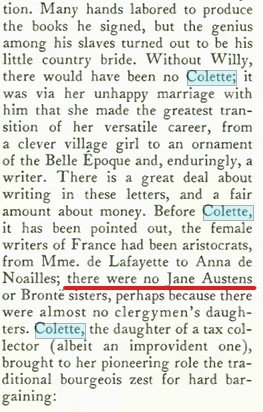
Before Colette, the female writers of France had been aristocrats, from Mme de Lafayette to Anne de Noailles; there were no Jane Austens or Brontë sisters, perhaps because there were almost no clergymen’s daughters.
(A) were no Jane Austens or
(B) were not Jane Austens or
(C) was not Jane Austen nor the
(D) was not a Jane Austen or the
(E) was no Jane Austen or no
SC42561.01
(A) were no Jane Austens or
(B) were not Jane Austens or
(C) was not Jane Austen nor the
(D) was not a Jane Austen or the
(E) was no Jane Austen or no
SC42561.01
Show Spoilernewyorker article
https://archives.newyorker.com/?iid=16410&crd=0&searchKey=Colette#folio=070
THE NEW YORKER, DECEMBER 29, 1980 ISSUE
BOOKS : An Armful of Field Flowers
Annotation 2019-09-21 204920.jpg [ 53.53 KiB | Viewed 45555 times ]
THE NEW YORKER, DECEMBER 29, 1980 ISSUE
BOOKS : An Armful of Field Flowers
Attachment:
Annotation 2019-09-21 204920.jpg [ 53.53 KiB | Viewed 45555 times ]
If this question felt shaky,
try an adaptive mini quiz of similar problems in
GMAT Club Forum Quiz →. Free plan gives 5 questions per day.

Answer is straight A.
No Jane Austen's or Bronte sisters is the correct style.
Because you have Bronte sisters, which is plural, you are required to have the plural verb 'were'. This factor eliminates C, D, and E.
Between A and B:
Not Jane Austens is not parallel to no Clergyman's in B
A is the choice
No Jane Austen's or Bronte sisters is the correct style.
Because you have Bronte sisters, which is plural, you are required to have the plural verb 'were'. This factor eliminates C, D, and E.
Between A and B:
Not Jane Austens is not parallel to no Clergyman's in B
A is the choice


 30 Sep 2019, 00:00
Kudos
Bookmarks
Skywalker18 The idea here is that there was no one like Jane Austen or the Bronte sisters. From the context, one can guess that these women, unlike pre-Colette French writers, were not from aristocratic families. Rather, they were the daughters of clergymen. It would be like if you said "There are no Donald Trumps in my family." This would just mean that no one in your family is like that.
As for the conjunction "or" it does not create a plural compound subject, so we can't use S-V to eliminate C-E. The problem with most of the choices is the way the conjunction is used. We need to say that there was no one like any of these women. E implies that there was EITHER no Austen OR no Brontes. That's not what we want at all. B and C are simply saying that those actual women weren't present, and that isn't the point. (Also, the plural "Austens" doesn't work in B without the idiom "there were no X.") Then, to answer your question in 3, the parallelism of "not a Jane Austen or the Bronte sisters" is flawed. If we aren't talking about the actual Austen in the first part, we shouldn't shift to talking about the actual Bronte Sisters in the second. We could perhaps say "There was not a Jane Austen nor any Bronte sisters."
As for the conjunction "or" it does not create a plural compound subject, so we can't use S-V to eliminate C-E. The problem with most of the choices is the way the conjunction is used. We need to say that there was no one like any of these women. E implies that there was EITHER no Austen OR no Brontes. That's not what we want at all. B and C are simply saying that those actual women weren't present, and that isn't the point. (Also, the plural "Austens" doesn't work in B without the idiom "there were no X.") Then, to answer your question in 3, the parallelism of "not a Jane Austen or the Bronte sisters" is flawed. If we aren't talking about the actual Austen in the first part, we shouldn't shift to talking about the actual Bronte Sisters in the second. We could perhaps say "There was not a Jane Austen nor any Bronte sisters."