

 Sign in with Google
 Sign in with Apple

 Every date in this article was read from the school's own admissions page in August 2026.
The test waiver has an earlier deadline
UNC Kenan-Flagler will waive the GMAT or GRE requirement if your background supports it - a 3.2+ GPA with quantitative coursework, an advanced degree, five years in a quantitative field, a CFA or CPA. The waiver has its own deadline, and it is not the application deadline. It sits two to four weeks earlier, every round:| Round | Waiver deadline | Application deadline | Gap |
|---|---|---|---|
| Round 1 | 9 Sep 2026 | 30 Sep 2026 | 21 days |
| Round 2 | 9 Dec 2026 | 6 Jan 2027 | 28 days |
| Round 3 | 10 Feb 2027 | 3 Mar 2027 | 21 days |
| Round 4 | 7 Apr 2027 | 21 Apr 2027 | 14 days |
Four schools say rounds are equal. The arithmetic says something else.
This is the question every applicant asks, so it is worth quoting the schools directly. Michigan Ross says it evaluates every round equally. Cambridge Judge says there are no round quotas and that a Round 5 application receives the same consideration as a Round 1 one. INSEAD says competition is equal across rounds and intakes, and that it keeps the offer ratio broadly constant. ISB says competition is the same across all rounds - that the advantage of applying early is time to arrange financing and logistics, not better odds. Take those statements seriously. Then notice what they do not say. A statement about how an application is read is not a statement about how many seats remain. Both things can be true at once: an admissions committee may genuinely assess a Round 3 file exactly as it assesses a Round 1 file, while the number of unclaimed places, and the unallocated scholarship budget, are not remotely the same in March as they were in September. Equal consideration is not equal odds. That is arithmetic, not cynicism. It is also worth being honest about the incentive. Schools benefit from applications continuing to arrive in later rounds - a deeper pool, better yield management. "Apply whenever, the rounds are equal" is a comfortable thing for an institution to say. The most revealing case is Cambridge, which tells you both halves itself. No round quotas, same consideration in Round 5 as Round 1 - and, in the same breath, that applying early still helps with scholarship options and College preference. The school concedes an early advantage exists. It simply locates it outside the admit decision. And one school says the quiet part out loud. SDA Bocconi states plainly that applications received well in advance of the final deadline have a greater chance of admission - the exact opposite of what Ross, Cambridge, INSEAD and ISB say about theirs. Same market, opposite disclosure. Our read, for what it is worth: apply in Round 1 or Round 2 if you need scholarship money or a visa. Round 3 is a real option, not a plan.If you are not a US citizen, your last round is not the last round
This is the finding that surprised us most, because it is invisible unless you read the fine print on each school's page. Several US schools run a final round that international applicants cannot realistically use, or cannot use at all:-
- CMU Tepper - Round 4 and the Round 4 Final deadline are domestic only
-
- UNC Kenan-Flagler - Round 3 is the last round open to international applicants; Round 4 is domestic only
-
- Vanderbilt Owen - international applicants are directed to apply by 1 April, ahead of the published final round
Round counts are not what schools advertise
While we are on the subject of tables that mislead, the four-column layout everyone uses - this site included - is a convention rather than a description. UVA Darden runs six deadlines, not four: Early Action, Round 1, Round 2 and three separate Round 3 dates. CMU Tepper runs five. Oxford Said and Cambridge Judge each run five. HEC Paris runs ten for its September intake, and then keeps accepting on a rolling basis after them. And UT Austin McCombs advertises a Round 4 that is not yours. Round 3 on 1 April 2027 is the last deadline for the Full-Time MBA; the Round 4 date belongs to the Working Professional and Executive programs. If you have been treating it as a safety net, you are reading someone else's calendar.Two rounds only for HBS and MIT
Harvard Business School and MIT Sloan run only two rounds. This is new this year for MIT Sloan. Harvard: 9 September 2026 and 5 January 2027. Sloan: 29 September 2026 and 12 January 2027. That is the entire cycle. At a school with three or four rounds, missing Round 2 costs you a few months. At these two it costs a year. Worth knowing before you decide to "wait for the next round".A decision date is not always a decision
The date sitting in the "decision" column means at least four different things depending on which school you are reading.- Chicago Booth publishes a fixed day - 3 December 2026 for Round 1. You will know on that date.
- MIT Sloan publishes a range: mid-December for Round 1, early April for Round 2. Useful for planning, useless for booking anything.
- NYU Stern publishes an initial notification date, which is a different thing entirely. By that date you receive one of three outcomes: an interview invitation, a waitlist offer, or a denial. An interview invitation means the process continues well past the date in the column.
- Columbia's January intake publishes a ceiling rather than a date - decisions are ongoing, by 31 July. You may hear in April. You may hear in July.
The advisory that is not a deadline
One more, because it is circulating as fact and it is not. INSEAD's January intake has a widely repeated 4 August date. It is not a deadline. INSEAD advises January-intake applicants heading into financial services, or wanting an internship, to apply by early August rather than waiting, because it maximizes preparation time for banking recruiting. The actual Round 4 deadline is 25 August 2026. Guidance, not a cut-off. Useful guidance - but if you have been treating 4 August as a wall, you have three more weeks than you think.The last twelve hours
Deadlines are published as dates. They close at times, and the times differ by half a day. Harvard and Columbia close at 12:00 noon ET. Wharton and Tuck close at 5:00pm ET. Cornell, Ross and UNC close at 11:59pm ET. Booth and McCombs close at 11:59pm Central, an hour later again. INSEAD closes at 23:59 Central European Time. Between Harvard's noon and Booth's midnight Central there is a twelve-hour spread on what everyone calls the same thing. If you are applying from Asia or Europe to a school that closes at noon Eastern, your real deadline is the evening before.Deposit strategies
If you are admitted early, you commit early. UVA Darden and Duke Fuqua both take Early Action deposits on 30 November 2026 - before Round 2 applications have closed elsewhere, and months before most Round 2 decisions land. Fuqua's Early Action is binding outright: accept, and you withdraw every other application. Columbia charges Round 1 admits US$7,000 to hold a place, against US$3,000 in Round 2, for the same seat. That gap is the part worth sitting with. Same program, same class, same seat - and applying in the round the school describes as equivalent costs US$4,000 less to accept. Whatever the admissions odds are, the price of an early admit is not neutral. Applying is not free either, though it is cheaper than most people assume. Fees run from $75 to $275 a school, and almost every school on our list waives them for at least some applicants - military and veterans, service corps, re-applicants, and at many schools simply attending an admissions event. The two rules that matter are that waivers are almost never granted retroactively, and that a route which existed last year may not exist this year. Sort it out before you pay, not after: our application fee waiver page lists what each school currently offers and how to claim it. Being admitted early, on the other hand, is not free at all.What should you do?
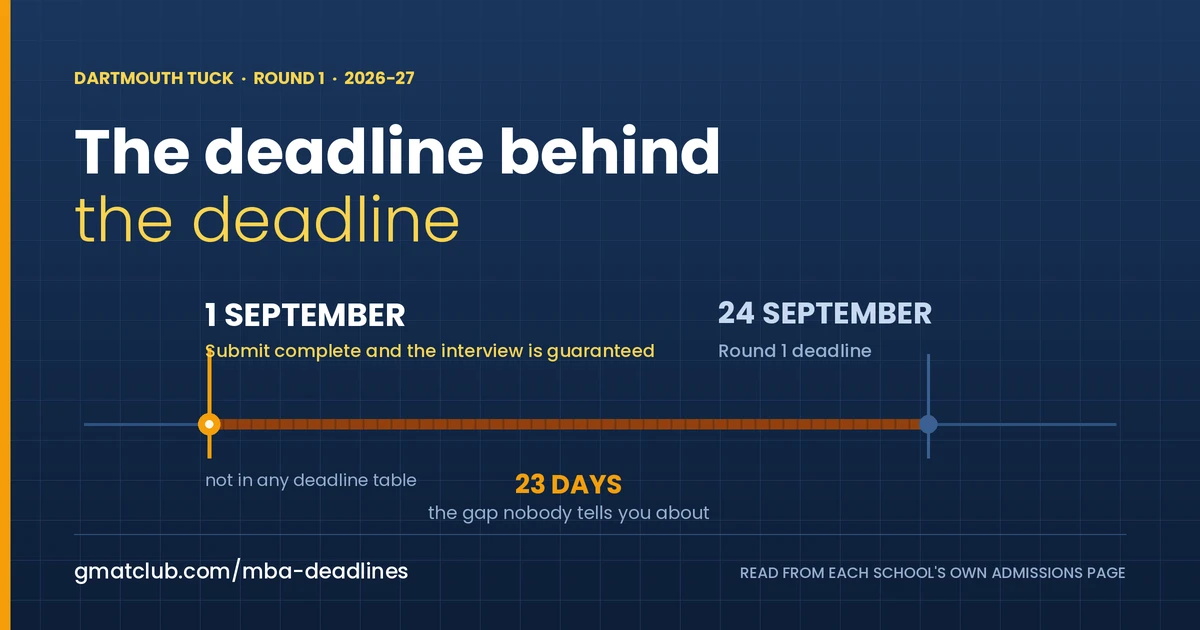
Three practical steps.- Work backwards from the pre-deadline dates, not the deadlines. If Tuck Round 1 matters to you, your date is 1 September, not 24 September. If you want UNC's test waiver, your date is 9 September, not 30 September.
- Check whether your last round is actually open to you. If you need a visa, assume the published final round is one round earlier than it looks, and confirm it with the school.
- Do not let a deadline table be your only source. Every date above came off a school's own admissions page, and several of them contradict what the aggregators show. Schools move dates without announcing it, and the corrections we received while building this page came from applicants, not from schools.
Found a date that has moved? Click it on the deadlines page and choose "Report it" - it reaches us with the school and round already attached.
BB