Last visit was: 21 Apr 2026, 16:38 It is currently 21 Apr 2026, 16:38
Close
GMAT Club Daily Prep
Thank you for using the timer - this advanced tool can estimate your performance and suggest more practice questions. We have subscribed you to Daily Prep Questions via email.

Customized
for You

we will pick new questions that match your level based on your Timer History

Track
Your Progress

every week, we’ll send you an estimated GMAT score based on your performance

Practice
Pays

we will pick new questions that match your level based on your Timer History
Not interested in getting valuable practice questions and articles delivered to your email? No problem, unsubscribe here.
Close
Request Expert Reply
Confirm Cancel
User avatar
anilnandyala
Joined: 07 Feb 2010
Last visit: 19 Jun 2012
Posts: 99
Own Kudos:
4,887
 [392]
Given Kudos: 101
Posts: 99
Kudos: 4,887
 [392]
57
Kudos
Add Kudos
333
Bookmarks
Bookmark this Post
Most Helpful Reply
User avatar
Bunuel
User avatar
Math Expert
Joined: 02 Sep 2009
Last visit: 21 Apr 2026
Posts: 109,728
Own Kudos:
Given Kudos: 105,800
Products:
Expert
Expert reply
Active GMAT Club Expert! Tag them with @ followed by their username for a faster response.
Posts: 109,728
Kudos: 810,465
 [289]
105
Kudos
Add Kudos
183
Bookmarks
Bookmark this Post
avatar
PareshGmat
Joined: 27 Dec 2012
Last visit: 10 Jul 2016
Posts: 1,531
Own Kudos:
8,270
 [45]
Given Kudos: 193
Status:The Best Or Nothing
Location: India
Concentration: General Management, Technology
WE:Information Technology (Computer Software)
Posts: 1,531
Kudos: 8,270
 [45]
32
Kudos
Add Kudos
13
Bookmarks
Bookmark this Post
User avatar
BrentGMATPrepNow
User avatar
Major Poster
Joined: 12 Sep 2015
Last visit: 31 Oct 2025
Posts: 6,733
Own Kudos:
36,441
 [30]
Given Kudos: 799
Location: Canada
Expert
Expert reply
Posts: 6,733
Kudos: 36,441
 [30]
25
Kudos
Add Kudos
5
Bookmarks
Bookmark this Post
Quote:
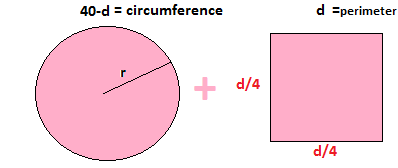
A thin piece of 40 meters long is cut into two pieces. One piece is used to form a circle with radius r, and the other is used to form a square. No wire is left over. Which of the following represents the total area, in square meters, of the circular and the square regions in term of r?

A) πr²
B) πr² + 10
C) πr² + 1/4(π² * r²)
D) πr² + (40 - 2π * r)²
E) πr² + (10 - 1/2π * r)²

Another approach is to plug in a value for r and see what the output should be.

Let's say r = 0. That is, the radius of the circle = 0
This means, we use the ENTIRE 40-meter length of wire to create the square.
So, the 4 sides of this square will have length 10, which means the area = 100

So, when r = 0, the total area = 100

We'll now plug r = 0 into the 5 answer choices and see which one yields an output of 100

A) π(0²) = 0 NOPE
B) π(0²) + 10 = 10 NOPE
C) π(0²) + 1/4(π² * 0²) = 0 NOPE
D) π(0²) + (40 - 2π0)² = 1600 NOPE
E) π(0²) + (10 - 1/2π(0))² = 100 PERFECT!

Answer: E

Cheers,
Brent
General Discussion
User avatar
ajit257
Joined: 28 Aug 2010
Last visit: 08 Apr 2011
Posts: 121
Own Kudos:
Given Kudos: 11
Posts: 121
Kudos: 4,183
Kudos
Add Kudos
Bookmarks
Bookmark this Post
Bunuel...how did u get side of the square as (40-2pi*r)/4 ?
User avatar
Bunuel
User avatar
Math Expert
Joined: 02 Sep 2009
Last visit: 21 Apr 2026
Posts: 109,728
Own Kudos:
810,465
 [5]
Given Kudos: 105,800
Products:
Expert
Expert reply
Active GMAT Club Expert! Tag them with @ followed by their username for a faster response.
Posts: 109,728
Kudos: 810,465
 [5]
3
Kudos
Add Kudos
2
Bookmarks
Bookmark this Post
ajit257
Bunuel...how did u get side of the square as (40-2pi*r)/4 ?

\(40-2\pi{r}\) meters of wire are left for the square means that \(40-2\pi{r}\) is the perimeter of the square so the side of it will be \(\frac{40-2\pi{r}}{4}=10-\frac{\pi{r}}{2}\).
avatar
Study1
Joined: 14 Sep 2010
Last visit: 06 Jan 2019
Posts: 8
Own Kudos:
51
 [3]
Given Kudos: 4
Posts: 8
Kudos: 51
 [3]
2
Kudos
Add Kudos
1
Bookmarks
Bookmark this Post
A thin piece of 40 m wire is cut in two. One piece is a circle with radius of r. Other is a square. No wire is left over. Which represents total area of circle and square in terms of r? 

From a 40m rope, two equal parts of 20 represent, respectively, the circumference of Circle C and the perimeter of Square D.

1. Express the perimeter of D in terms of the circumference of C.

Perimeter + Circumference  = 40

Perimeter = 40 - C

2. Substitute accepted identities for perimeter and circumference.

 4s = 40 - 2(pi)(r)

3.  Express the side of the square in terms of r.

s = 10 - (pi)(r)/2

4. Write area of circle and square in terms of r.

Area(C) + Area(D) 
= (pi)(r)^2 + s^2 
= (pi)(r)^2 +  (10 - (pi)(r)/2)^2

5.  Verify

2(pi)(r) = 20

r = 10/pi 
   = 3.18 (approx. to hundredth)

s   = (10 - (pi)(r)/2) 
    = 10-  [3.14(3.18)]/2
    = 5

The actual value of the side of the square derived from stating area of square in terms of r is consistent with its known perimeter.

Posted from my mobile device
User avatar
KarishmaB
Joined: 16 Oct 2010
Last visit: 21 Apr 2026
Posts: 16,438
Own Kudos:
79,375
 [6]
Given Kudos: 484
Location: Pune, India
Expert
Expert reply
Active GMAT Club Expert! Tag them with @ followed by their username for a faster response.
Posts: 16,438
Kudos: 79,375
 [6]
5
Kudos
Add Kudos
1
Bookmarks
Bookmark this Post
PhilosophusRex
A thin piece of wire 40 meters long is cut into two pieces. One piece is used to form a circle with radius R, and the other is used to form a square. No wire is left over. Which of the following represents the total area, in square meters, of the circular and square regions in terms of R.

1) \(\pi R^2\)
2) \(\pi R^2 + 10\)
3) \(\pi R^2 + 1/4\pi^2R^2\)
4) \(\pi R^2 + (40 - 2\pi R)^2\)
5) \(\pi R^2 + (10 - 1/2\pi R)^2\)

4) or 5) is a given, I just dont see how you make the calculation necessary.

Very minimal calculations are required if you assume a convenient value for R e.g. R = 7/2 since \(\pi = 22/7\)
Circumference in this case \(= 2\pi*R = 2*(22/7)*(7/2) = 22\)
So length of leftover wire = 18
Side of square = 18/4
Area of square = \((9/2)^2\)

Now put R = 7/2 in the second half of the options you want to check.
i.e. say you want to check option (E)
\((10 - 1/2\pi R)^2 = [10 - (1/2)*(22/7)*(7/2)]^2 = (9/2)^2\)

Option (E) is correct since the area of the square is (9/2)^2 when R = 7/2 (as shown above)
User avatar
ENAFEX
Joined: 03 Aug 2010
Last visit: 25 Oct 2012
Posts: 84
Own Kudos:
Given Kudos: 20
Status:And the Prep starts again...
Concentration: IT Consulting
GMAT 1: 490 Q42 V17
Posts: 84
Kudos: 280
Kudos
Add Kudos
Bookmarks
Bookmark this Post
Tried to solve this using the numbers given but I am not able to proceed. Please help. Just curious to know. Thanks.

Say the length of each piece = 20.

So Circumference =20
perimeter of square = 4*side
So length of side = 20/4 = 5.

How do I proceed further?
User avatar
Bunuel
User avatar
Math Expert
Joined: 02 Sep 2009
Last visit: 21 Apr 2026
Posts: 109,728
Own Kudos:
810,465
 [7]
Given Kudos: 105,800
Products:
Expert
Expert reply
Active GMAT Club Expert! Tag them with @ followed by their username for a faster response.
Posts: 109,728
Kudos: 810,465
 [7]
3
Kudos
Add Kudos
4
Bookmarks
Bookmark this Post
ENAFEX
Tried to solve this using the numbers given but I am not able to proceed. Please help. Just curious to know. Thanks.

Say the length of each piece = 20.

So Circumference =20
perimeter of square = 4*side
So length of side = 20/4 = 5.

How do I proceed further?

The length of each piece = 20;

Circumference of the circle is \(2\pi{r}=20\) --> \(r=\frac{10}{\pi}\) --> \(area=\pi{r^2}=\frac{100}{\pi}\);
Perimeter of the square \(4*side=20\) --> \(side=5\) --> \(area=5^2=25\);

The total area is \(\frac{100}{\pi}+25\). Now, you should substitute the value of \(r=\frac{10}{\pi}\) in the answer choices and see which one gives \(\frac{100}{\pi}+25\). Answer choice E works.

Hope it helps.
avatar
gmarchanda
Joined: 13 Aug 2012
Last visit: 20 Feb 2015
Posts: 2
Given Kudos: 1
Posts: 2
Kudos: 0
Kudos
Add Kudos
Bookmarks
Bookmark this Post
Bunuel
A thin piece of wire 40 meters long is cut into two pieces. One piece is used to form a circle with radius r, and the other is used to form a square. No wire is left over. Which of the following represents the total area, in square meters, of the circular and the square regions in terms of r?

A. \(\pi*r^2\)
B. \(\pi*r^2 + 10\)
C. \(\pi*r^2 + \frac{1}{4}*\pi^2*r^2\)
D. \(\pi*r^2 + (40 - 2\pi*r)^2\)
E. \(\pi*r^2 + (10 - \frac{1}{2}\pi*r)^2\)

The area of a circle will be - \(\pi{r^2}\) and \(2\pi{r}\) meters of wire will be used;
There will be \(40-2\pi{r}\) meters of wire left for a square. Side of this square will be \(\frac{40-2\pi{r}}{4}=10-\frac{\pi{r}}{2}\), hence the area of the square will be \((10-\frac{\pi{r}}{2})^2\).

The total area will be - \(\pi{r^2}+(10-\frac{\pi{r}}{2})^2\).

Answer: E.


Bunuel- the perimeter of the circle and the square are the same, so: 2(pi)r=4a (a being one side of the square).
a= (pi)r/2
area of square in terms of r: a^2= (pi)^2*r^2/4
wont this mean that option c is also correct? what am I missing?
User avatar
pqhai
User avatar
Retired Moderator
Joined: 16 Jun 2012
Last visit: 26 Nov 2015
Posts: 864
Own Kudos:
8,939
 [1]
Given Kudos: 123
Location: United States
Posts: 864
Kudos: 8,939
 [1]
1
Kudos
Add Kudos
Bookmarks
Bookmark this Post
gmarchanda
Bunuel
A thin piece of wire 40 meters long is cut into two pieces. One piece is used to form a circle with radius r, and the other is used to form a square. No wire is left over. Which of the following represents the total area, in square meters, of the circular and the square regions in terms of r?

A. \(\pi*r^2\)
B. \(\pi*r^2 + 10\)
C. \(\pi*r^2 + \frac{1}{4}*\pi^2*r^2\)
D. \(\pi*r^2 + (40 - 2\pi*r)^2\)
E. \(\pi*r^2 + (10 - \frac{1}{2}\pi*r)^2\)

The area of a circle will be - \(\pi{r^2}\) and \(2\pi{r}\) meters of wire will be used;
There will be \(40-2\pi{r}\) meters of wire left for a square. Side of this square will be \(\frac{40-2\pi{r}}{4}=10-\frac{\pi{r}}{2}\), hence the area of the square will be \((10-\frac{\pi{r}}{2})^2\).

The total area will be - \(\pi{r^2}+(10-\frac{\pi{r}}{2})^2\).

Answer: E.


Bunuel- the perimeter of the circle and the square are the same, so: 2(pi)r=4a (a being one side of the square).
a= (pi)r/2
area of square in terms of r: a^2= (pi)^2*r^2/4
wont this mean that option c is also correct? what am I missing?

Hello.

The question only says: A thin piece of wire 40 meters long is cut into two pieces, NOT into same length pieces. Thus, your assumption 2(pi)r=4a is wrong.

Hope it's clear.
User avatar
TeamGMATIFY
Joined: 20 Aug 2015
Last visit: 31 Oct 2016
Posts: 339
Own Kudos:
1,527
 [4]
Given Kudos: 10
Location: India
GMAT 1: 760 Q50 V44
Expert
Expert reply
GMAT 1: 760 Q50 V44
Posts: 339
Kudos: 1,527
 [4]
1
Kudos
Add Kudos
3
Bookmarks
Bookmark this Post
anilnandyala
A thin piece of wire 40 meters long is cut into two pieces. One piece is used to form a circle with radius r, and the other is used to form a square. No wire is left over. Which of the following represents the total area, in square meters, of the circular and the square regions in terms of r?

A. \(\pi*r^2\)
B. \(\pi*r^2 + 10\)
C. \(\pi*r^2 + \frac{1}{4}*\pi^2*r^2\)
D. \(\pi*r^2 + (40 - 2\pi*r)^2\)
E. \(\pi*r^2 + (10 - \frac{1}{2}\pi*r)^2\)

Given: 40 meters long wire is cut into two pieces. One circle with radius r and the rest is used to form a square
Required: Total area of the circle and the square

Since we are given the length of the wire, we should find the perimeters.

Perimeter of the circle = \(2*\pi*r\)
Hence left over wire after removing the circle = \(40 - (2*\pi*r)\)

We need to form a square from this length.
In other words, this is the perimeter of the square and each side of a square is equal.

Hence side of square = \(\frac{1}{4}(40 - (2*\pi*r))\) = \(10 - \frac{1}{2}\pi*r\)

Area of the square = \((10 - \frac{1}{2}\pi*r)^2\)

Total required area = \(\pi*r^2 + (10 - \frac{1}{2}\pi*r)^2\)
Option E
User avatar
ScottTargetTestPrep
User avatar
Target Test Prep Representative
Joined: 14 Oct 2015
Last visit: 21 Apr 2026
Posts: 22,276
Own Kudos:
26,526
 [3]
Given Kudos: 302
Status:Founder & CEO
Affiliations: Target Test Prep
Location: United States (CA)
Expert
Expert reply
Active GMAT Club Expert! Tag them with @ followed by their username for a faster response.
Posts: 22,276
Kudos: 26,526
 [3]
2
Kudos
Add Kudos
1
Bookmarks
Bookmark this Post
anilnandyala
A thin piece of wire 40 meters long is cut into two pieces. One piece is used to form a circle with radius r, and the other is used to form a square. No wire is left over. Which of the following represents the total area, in square meters, of the circular and the square regions in terms of r?

A. \(\pi*r^2\)
B. \(\pi*r^2 + 10\)
C. \(\pi*r^2 + \frac{1}{4}*\pi^2*r^2\)
D. \(\pi*r^2 + (40 - 2\pi*r)^2\)
E. \(\pi*r^2 + (10 - \frac{1}{2}\pi*r)^2\)


We are given that a thin piece of wire 40 meters long is cut into two pieces. One piece is used to form a circle with radius r and the other is used to form a square.

Since the circumference of a circle with radius r is 2πr, the amount of wire used to form the circle is 2πr. Thus, we have 40 – 2πr left over to form the square. In other words, the perimeter of the square is 40 – 2πr. However, since we need to calculate the total area of the circular and the square regions, we need to determine the side of the square in terms of r. Since the perimeter of the square is 40 – 2πr, the side of the square is:

side = (40 – 2πr)/4

side = 10 – (1/2)πr

Now we can determine the areas of the circle and the square.

Area of circle = πr2

Area of square = side^2 = (10 – (1/2)πr)^2

Thus, the combined area of the circle and square is πr2 + (10 – (1/2)πr)2.

Answer: E
User avatar
PGTLrowanhand
Joined: 30 Oct 2012
Last visit: 13 Apr 2026
Posts: 77
Own Kudos:
Given Kudos: 3
Status:London UK GMAT Consultant / Tutor
Expert
Expert reply
Posts: 77
Kudos: 178
Kudos
Add Kudos
Bookmarks
Bookmark this Post
Hi GMATters,

Check out my video explanation for this question here!


Enjoy!

Rowan
avatar
shivamtibrewala
Joined: 02 Nov 2017
Last visit: 28 Jul 2018
Posts: 14
Own Kudos:
3
 [1]
Given Kudos: 34
Posts: 14
Kudos: 3
 [1]
Kudos
Add Kudos
1
Bookmarks
Bookmark this Post
Bunuel
A thin piece of wire 40 meters long is cut into two pieces. One piece is used to form a circle with radius r, and the other is used to form a square. No wire is left over. Which of the following represents the total area, in square meters, of the circular and the square regions in terms of r?

A. \(\pi*r^2\)
B. \(\pi*r^2 + 10\)
C. \(\pi*r^2 + \frac{1}{4}*\pi^2*r^2\)
D. \(\pi*r^2 + (40 - 2\pi*r)^2\)
E. \(\pi*r^2 + (10 - \frac{1}{2}\pi*r)^2\)

The area of a circle will be - \(\pi{r^2}\) and \(2\pi{r}\) meters of wire will be used;
There will be \(40-2\pi{r}\) meters of wire left for a square. Side of this square will be \(\frac{40-2\pi{r}}{4}=10-\frac{\pi{r}}{2}\), hence the area of the square will be \((10-\frac{\pi{r}}{2})^2\).

The total area will be - \(\pi{r^2}+(10-\frac{\pi{r}}{2})^2\).

Answer: E.


Could you please share some extra questions which are similar to this?
User avatar
Bunuel
User avatar
Math Expert
Joined: 02 Sep 2009
Last visit: 21 Apr 2026
Posts: 109,728
Own Kudos:
810,465
 [4]
Given Kudos: 105,800
Products:
Expert
Expert reply
Active GMAT Club Expert! Tag them with @ followed by their username for a faster response.
Posts: 109,728
Kudos: 810,465
 [4]
1
Kudos
Add Kudos
3
Bookmarks
Bookmark this Post
shivamtibrewala
Bunuel
A thin piece of wire 40 meters long is cut into two pieces. One piece is used to form a circle with radius r, and the other is used to form a square. No wire is left over. Which of the following represents the total area, in square meters, of the circular and the square regions in terms of r?

A. \(\pi*r^2\)
B. \(\pi*r^2 + 10\)
C. \(\pi*r^2 + \frac{1}{4}*\pi^2*r^2\)
D. \(\pi*r^2 + (40 - 2\pi*r)^2\)
E. \(\pi*r^2 + (10 - \frac{1}{2}\pi*r)^2\)

The area of a circle will be - \(\pi{r^2}\) and \(2\pi{r}\) meters of wire will be used;
There will be \(40-2\pi{r}\) meters of wire left for a square. Side of this square will be \(\frac{40-2\pi{r}}{4}=10-\frac{\pi{r}}{2}\), hence the area of the square will be \((10-\frac{\pi{r}}{2})^2\).

The total area will be - \(\pi{r^2}+(10-\frac{\pi{r}}{2})^2\).

Answer: E.


Could you please share some extra questions which are similar to this?

Similar questions.
2-D:
https://gmatclub.com/forum/a-thin-piece ... 88486.html
https://gmatclub.com/forum/a-rope-20-6- ... 18959.html
https://gmatclub.com/forum/a-rope-40-fe ... 37872.html
https://gmatclub.com/forum/a-board-of-l ... 09400.html
https://gmatclub.com/forum/a-board-of-l ... 49870.html
https://gmatclub.com/forum/a-wood-beam- ... 45560.html
https://gmatclub.com/forum/if-x-inches- ... 27649.html
https://gmatclub.com/forum/a-rectangula ... 05133.html


3-D:
https://gmatclub.com/forum/m01-183522.html (GMAT Club)
https://gmatclub.com/forum/there-is-a-r ... 96312.html (Veritas Prep)
https://gmatclub.com/forum/cubes-with-e ... 93391.html
https://gmatclub.com/forum/if-a-4-cm-cub ... 07843.html (GMAT Club)
https://gmatclub.com/forum/a-large-cube- ... 10256.html
https://gmatclub.com/forum/64-small-iden ... 51009.html
https://gmatclub.com/forum/the-entire-ex ... 55955.html (Manhattan GMAT)
https://gmatclub.com/forum/a-big-cube-is ... 99424.html
https://gmatclub.com/forum/a-large-solid ... 51096.html
https://gmatclub.com/forum/a-wooden-cube ... 62570.html
https://gmatclub.com/forum/a-cube-of-si ... 48513.html
https://gmatclub.com/forum/a-certain-cl ... 67230.html (GMAT Prep)
https://gmatclub.com/forum/a-cube-has-a ... 09376.html
https://gmatclub.com/forum/a-cube-is-pa ... 80789.html (Data Sufficiency)
https://gmatclub.com/forum/a-certain-cu ... 63928.html
https://gmatclub.com/forum/if-a-cube-of ... 40938.html
User avatar
Bunuel
User avatar
Math Expert
Joined: 02 Sep 2009
Last visit: 21 Apr 2026
Posts: 109,728
Own Kudos:
810,465
 [4]
Given Kudos: 105,800
Products:
Expert
Expert reply
Active GMAT Club Expert! Tag them with @ followed by their username for a faster response.
Posts: 109,728
Kudos: 810,465
 [4]
1
Kudos
Add Kudos
3
Bookmarks
Bookmark this Post
shivamtibrewala
Bunuel
A thin piece of wire 40 meters long is cut into two pieces. One piece is used to form a circle with radius r, and the other is used to form a square. No wire is left over. Which of the following represents the total area, in square meters, of the circular and the square regions in terms of r?

A. \(\pi*r^2\)
B. \(\pi*r^2 + 10\)
C. \(\pi*r^2 + \frac{1}{4}*\pi^2*r^2\)
D. \(\pi*r^2 + (40 - 2\pi*r)^2\)
E. \(\pi*r^2 + (10 - \frac{1}{2}\pi*r)^2\)

The area of a circle will be - \(\pi{r^2}\) and \(2\pi{r}\) meters of wire will be used;
There will be \(40-2\pi{r}\) meters of wire left for a square. Side of this square will be \(\frac{40-2\pi{r}}{4}=10-\frac{\pi{r}}{2}\), hence the area of the square will be \((10-\frac{\pi{r}}{2})^2\).

The total area will be - \(\pi{r^2}+(10-\frac{\pi{r}}{2})^2\).

Answer: E.


Could you please share some extra questions which are similar to this?

23. Geometry


24. Coordinate Geometry


25. Triangles


26. Polygons


27. Circles


28. Rectangular Solids and Cylinders


29. Graphs and Illustrations


For more check Ultimate GMAT Quantitative Megathread
User avatar
CrackverbalGMAT
User avatar
Major Poster
Joined: 03 Oct 2013
Last visit: 21 Apr 2026
Posts: 4,846
Own Kudos:
Given Kudos: 226
Affiliations: CrackVerbal
Location: India
Expert
Expert reply
Posts: 4,846
Kudos: 9,180
Kudos
Add Kudos
Bookmarks
Bookmark this Post
Solution:

Area of a circle = πr^2 and

Wire used = Circumference of the wire

=2πr meters

Wire left for a square =40−2πr meters

Side of this square will be 40−2πr/4

=10−(πr/2)

=>Area of the square = (10−πr/2)^2.

The total area = πr^2+(10−πr/2)^2.

(option e)

Devmitra Sen
GMAT SME
User avatar
Alpha1350
Joined: 14 Apr 2021
Last visit: 23 Apr 2024
Posts: 17
Own Kudos:
Given Kudos: 5
GPA: 3.19
Posts: 17
Kudos: 17
Kudos
Add Kudos
Bookmarks
Bookmark this Post
Hi,

I was wondering what would happen if they asked the same question but instead of square they used rectangle?
so perimeter of rectange + Circumference of circle = 40
2 (l + w ) = 40 - 2 pi r
l + w = (40 - 2 pi r)/2
Area of circle + area of rec

Pi r^2 + l x w - what would i write under l x w ?

thanks!
 1   2   
Moderators:
Math Expert
109728 posts
Tuck School Moderator
853 posts