

 Sign in with Google
 Sign in with Apple

- How do finance career paths and MBA admissions overlap?
- What’s the appeal of the finance career path?
- Pros and cons of investment banking
- What are the finance industry employers?
- Investment banker salary + bonus
- Post – MBA Associate position at an investment bank
- Private equity compensation
- Is investment banking a good career goal for my MBA essay?
- Sample MBA application essay excerpts
How do finance career paths and MBA admissions overlap?
Our insights about MBA admissions for finance industry candidates was through a client study we did several years ago about success factors for getting admitted to Harvard, Stanford and Wharton for private equity applicants. In this analysis, we are looking to guide young professionals who are currently not in either investment banking (IB) or private equity (PE) roles but who seek to attain that IB-PE career path through and after their MBA program.
We wrote about the merits of the investment banking career path in a conversation with SBC consultant, Puja, whose professional trajectory followed a similar route. Puja shared,
“I began to work towards an investment banking career after earning my MBA from Wharton. The idea of working on large corporate deals was intellectually exciting to me. Plus, the prospect of applying my strong quantitative foundation, along with the ability to interface directly with clients, was extremely appealing.”
Career switching through the MBA experience is common but it entails a lot of time and diligence. We often see clients whose pre-MBA career paths entail softer skills primarily and so they look to the MBA degree to acquire hard, quantitative analyses and frameworks for a comparably data-driven career path ahead. We have seen many non-traditional applicants, including those from education and marketing, covet the finance industry career path because of its prestige and financial upside.
Request a free MBA candidacy analysis to understand your career profile for MBA admissions
What’s the appeal of the finance career path?
A Wall Street career path conjures up images of advising the super wealthy through billion-dollar transactions. It’s not surprising that many ambitious professionals find that path alluring. Selling financial savvy and market predictions can give these young professionals the feeling that they are superheroes and can bring huge paydays. IPOs, mergers, acquisitions, corporate lending, institutional trading, and other big-ticket Wall Street transactions are all among the appealing-but-demanding work responsibilities of a finance professional.
Investment banking is the foundation of Wall Street riches. Bloggers online have said, “Wall Street is still the greatest bastion of individual capitalism in the world and a place where determined individuals can work their way from answering the phones to calling the shots in just a matter of years. But the reward doesn’t come easy, free, or fairly.” It requires incredible diligence, preparation and work ethic.

Pros and cons of investment banking
When we canvassed sources about the pros and cons of the finance, here was what we heard:
Pros
- Rubbing elbows with the rich and famous
- Six figures compensation right out of school
- Investment banking pays more than consulting
- Gain an incredible financial skillset
- Build a great network
- Incredible exit opportunities into other attractive career tracks
Cons
- Long hours: 70 to 100 hour weeks
- Pay is traditionally heavily weighted toward the bonus and that’s volatile
- Positions usually go unadvertised and require hustle; must fight tooth-and-nail for a shot
- Filled with high-performance people who are used to getting their way
- Quality of life
What are the finance industry employers?
Bulge Bracket Investment Banks:
JP Morgan, Goldman Sachs, and Morgan Stanley; Bank of America Merrill Lynch and Citi; Credit Suisse and Barclays; Deutsche Bank and UBS.
Middle Market and Other Full-Service Banks:
Wells Fargo, RBC, Jefferies, Houlihan Lokey, Harris Williams and many European, Asian, and Canadian banks, such as HSBC, BNP Paribas, Mizuho, Nomura, BMO, and CITIC
Elite Boutique Investment Banks:
Centerview, Evercore, Greenhill, Guggenheim, Lazard, Moelis, Perella Weinberg, PJT Partners (formerly Blackstone), Qatalyst, and Rothschild (only in Europe)
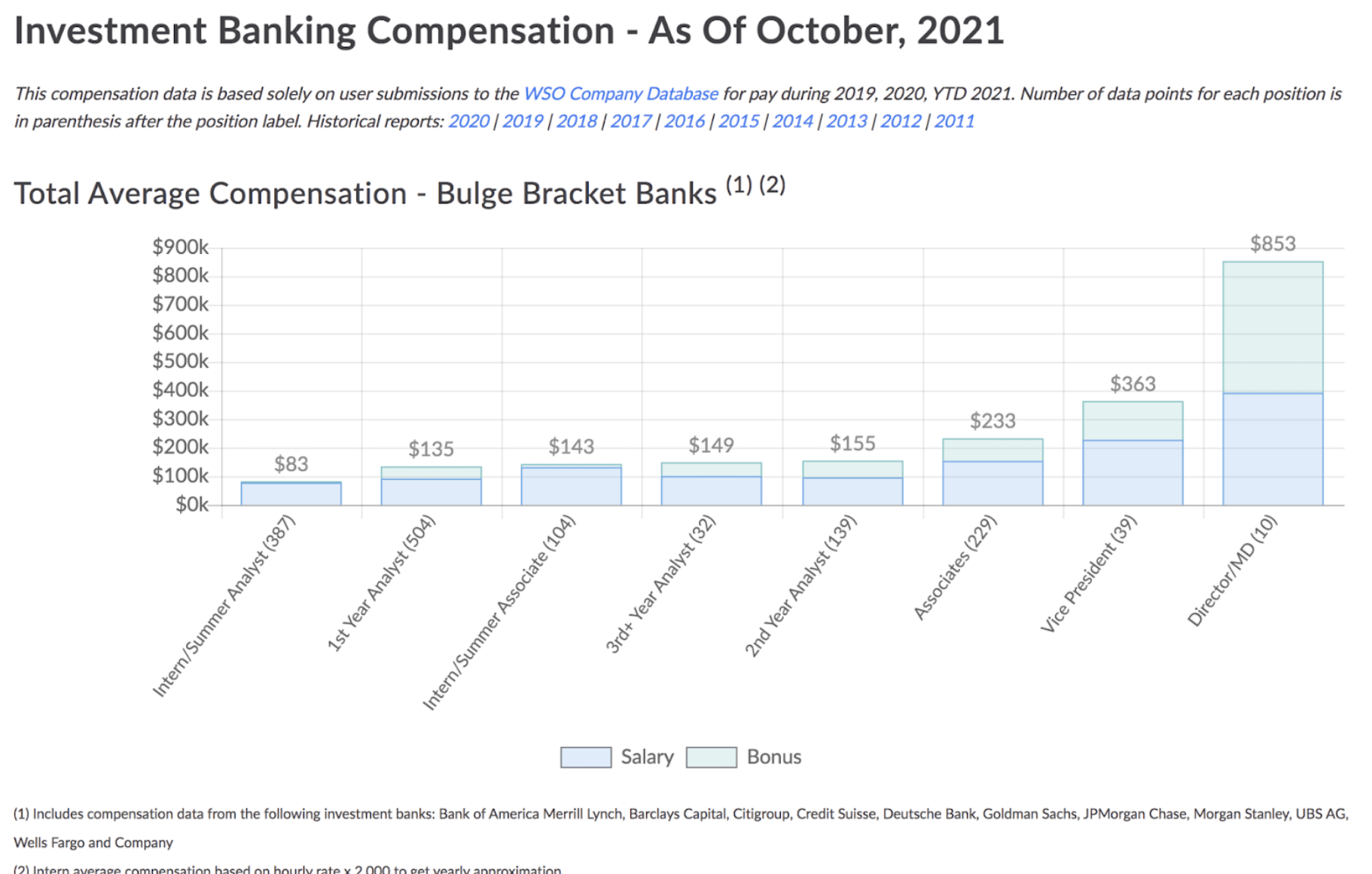
Investment banker salary* + bonus:
- Analyst – First Year: $70,000 – $150,000
- Analyst – Third Year: $120,000 – $350,000
- Associate – First Year: $150,000 – $350,000
- Associate – Third Year: $250,000 – $500,000
- Vice President: $350,000 – $1,500,000
- Managing Director/Partner: $500,000 – $20,000,000+
Typically an IB analyst bonus is between 30-100% of base.
*Source: https://www.wallstreetoasis.com/salary/investment-banking-compensation
Post – MBA Associate position at an investment bank
Varies according to signing bonus, relocation bonus etc.
- Base salary: $125,000-$150,000
- Bonus: $80,000-$200,000
- Total: $200,000-$500,000 based on tenure and seniority
Private equity* compensation
- Analyst/Associate – First Year: $100K – $250K
- Analyst/Associate – Second Year: $150K – $300K
- Analyst/Associate – Third Year +: $170K – $350K
- Vice President: $300K – $800K
- Managing Director/Partner: $500K – $10MM+
*Source: https://www.wallstreetoasis.com/salary/private-equity-compensation
Is investment banking a good career goal for my MBA essay?
We asked the former MBA Admissions Officers on our team to chime in. A former Wharton Admissions Officer on our team shared, “Attainable career goals, as stated in the MBA application, are important to the top MBA programs, especially since several, such as Wharton, have combined Admissions and Career Services under the same umbrella.
MBA Admissions Officers are thinking about exit opportunities when reviewing the application in terms of:
- is this person already on the fast track,
- are their goals achievable and reasonable,
- do they have a plan for how they will use their time during the program
- how will they meet their goals?
Whether investment banking makes sense for your career path essay depends on many factors. What you end up pursuing when you’re actually at your MBA program is entirely up to you but getting in is the first priority, right? Let’s look at sample career goals next.
Sample MBA application essay excerpts
Example #1:
After receiving an MBA from Columbia, I first intend on transitioning from strategy consulting into investment banking, where I will gain financial modeling skills and have the opportunity to identify and evaluate prospective targets. In this role, I would combine my previous acquisition implementation experience from consulting with M&A finance principles from my MBA coursework to achieve a well-rounded understanding of the entire transaction life cycle. My role in investment banking will then serve as a critical stepping stone for me to move into private equity after 3-5 years. This transition will allow me to integrate both financial and operational deal knowledge to make sophisticated investment decisions and enhance stakeholder values. An MBA at Columbia at this time would be pivotal in helping me navigate my career transition from strategy consulting to investment banking.
Example #2:
Post-MBA, I plan to pursue an investor relations role focused on Latin American clients at a private equity firm. Leveraging my background of working directly with Latin American institutional investors in custodial banking services, I will pivot into a front office role of acquiring and servicing new clients for this investment class at a firm such as XXX or ZZZ. With the increasing popularity of private equity investments, I believe I could be a real asset to a private equity firm due to my fluency in Spanish, my cultural background, and my experience with local regulation in Latin America. These skills combined with a Goizueta MBA will enable me to capitalize on the opportunity to help PE firms grow and expand into the growing Latin American markets. However, I recognize that I need the technical finance skills that a Goizueta MBA could offer me in order to be successful at a PE firm. Additionally, I believe Goizueta would help me enhance my worldview through the global focus and the immersion opportunities to engage in projects globally.
Example #3
An MBA from Wharton will enable me to make the transition from management consulting to private equity. As a consultant, I have sized markets, analyzed SWOTs, and developed quantitative and qualitative research techniques. As early as 2007 I was leading projects on my own including a study to develop market penetration strategies and scenarios in the regional jet market for Spirit Aerosystems, a multibillion dollar aircraft structures manufacturer. Based on my recommendations, Spirit has expanded into a standalone aero-structures supplier, breaking out of its captive supplier position by broadening its customer base. My five years as a consultant coupled with my military training and leadership have provided me with a solid foundation from which to begin my MBA. A Wharton MBA will allow me to integrate the lessons I have learned in both pursuits and provide me with the managerial knowledge, cross-functional business acumen, and formal leadership training required of a successful private equity professional.
Example #4
In the short term, I will use my MBA to transition to a private equity investment role at a multinational investment firm like Carlyle, Blackstone or KKR. By capitalizing on Wharton’s advanced elective finance classes, I hope to sharpen my analytical proficiency and deepen my investment strategy knowledge.
Ultimately, I hope to leverage the leadership skills I develop at Wharton to land an executive position in the private equity division of a global investment firm. I intend to use my platform to campaign for the promotion of women to leadership positions across the industry. Through courses such as William Lauder’s Decision-Making in the Leadership Chair, I will have direct exposure to C-suite professionals and learn how to both position myself for a similar role and overcome challenges once in the position.
For more information on career opportunities, see our Career Recruiting by MBA Program overview.
Request a free MBA candidacy analysis to understand your career profile for MBA admissions
The post Is finance a good career path and why? appeared first on Stacy Blackman Consulting - MBA Admissions Consulting.
