Events & Promotions
|
|

GMAT Club Daily Prep
Thank you for using the timer - this advanced tool can estimate your performance and suggest more practice questions. We have subscribed you to Daily Prep Questions via email.
Customized
for You
Track
Your Progress
Practice
Pays
Not interested in getting valuable practice questions and articles delivered to your email? No problem, unsubscribe here.
 Sep 23
12:30 AM EDT
-01:30 AM EDT
Learn how Keshav, a Chartered Accountant, scored an impressive 705 on GMAT in just 30 days with GMATWhiz's expert guidance. In this video, he shares preparation tips and strategies that worked for him, including the mock, time management, and more Sep 24
01:30 AM EDT
-01:30 AM EDT
Tejas studied hard but kept repeating the same mistakes. After 3 attempts at 645, a focused 4-week strategy helped him identify and fix what was holding him back—leading to a 695 with just 12–15 hours of study per week. Sep 26
01:00 PM EDT
-04:00 PM EDT
Top scores are possible when you enroll in a powerful GMAT course, taught live online + 6 months access to TTP OnDemand video courses included. Class starts Saturdays Sept. 26, 2026 - Dec. 19, 2026, 1:00pm-4:00pm ES Sep 26
06:00 PM PDT
-07:00 PM PDT
Free- full-length test + 15 concept videos + 150+ short videos + study plan! Sep 29
11:00 AM EDT
-01:00 PM EDT
" Description: Top scores are possible when you enroll in a powerful GMAT course, taught live online + 6 months access to TTP OnDemand video courses included! Class starts Tues/Thur Sept. 29, 2026 - Dec. 3, 2026, 11:00am-1:00pm EST Oct 01
07:00 AM BST
-08:00 AM GMT
Welcome to the GMAT Club's Free Interview Prep Event for Top MBA Programs! Buy tickets - Virtual series that’s all set to equip you to -excel in your MBA interviews.


GMAT Prep Software Scoring Analysis
Importance of the First 10 / Middle 10 / Last 10 Questions on the GMAT
Importance of the First 10 / Middle 10 / Last 10 Questions on the GMAT
In this Post:
Why Run GMAT Prep Scenarios?
Methodology
Quant:
- Importance of the first 10 questions ?
- Importance of the middle 10 questions?
- Importance of the last 10 questions questions?
- What if I guess or miss every 3rd question?
- Importance of the last 10 questions on GMAT Quant?
- Importance of the last 10 questions on GMAT Quant?
- Importance of the last 10 questions on GMAT Quant?
Verbal:
- Importance of the first 9 questions ?
- Importance of the last 9 questions questions?
- Importance of SC?
- Importance of RC?
Takeaways & Practical Applications
Why Run GMAT Prep Scenarios?
The main reason for this post and analysis are the myths and debates related to the importance of the first 10 questions on the GMAT. At some point someone said that the first 10 questions are critical and absolutely pivotal to scoring high on the GMAT. The reasoning offered was that the adaptive algorithm is more aggressively varying the difficulty on the first 10 questions of the test and if one makes quite a few mistakes, the author of the theory argued, a test taker would not be able to recover since the subsequent questions were only providing incremental and much smaller contribution to the score. After this theory came out lots of people started spending huge amounts of time on the first 10 questions and trying to get them right at all cost, thinking it would result into a higher score, which prompted GMAC to come out with their "Myth" explanations that the first 10 questions actually do not matter. This debate has lived on for at least 10 years until 2 things happened:
1) GMAT Prep moved online (it used be a software you downloaded and the algorithm in the software was supposedly simplified and different from the algorithm used on the GMAT to prevent people from messing with it and figuring it out)
2) GMAC announced that the scoring algorithm of the online GMAT Prep is exactly the same as used for the GMAT. I don't have a link to the statement nor proof but I believe this was made in one of their webinars for test prep industry and is generally a widely accepted fact. Moreover since the GMAT Prep is a really good predictor of the final GMAT score, it should produce consistent results while running various scenarios. On the other hand, we have also run a number of these scenarios on the old GMAT Prep platform and the results are very consistent between the 2
Therefore, we are able to get a pretty clear picture about what happens when you miss certain questions and once and for all, and understand how important or not important are those first 10 questions. Note however, that these are lab tests in perfect condition (more on that in methodology).
Methodology:
1. We used GMAT Prep Tests 1 and 2 with a large question database.
2. When we evaluated a scenario, such as what I get the first 10 questions wrong on Quant or Verbal, we actually had to solve every question. We did not guess. We purposefully answered the first 10 questions incorrectly (after solving them
 ) and then proceeded to solve the other 21 questions to answer them correctly. In some cases, we used google
3. We ran scenarios multiple times to make sure the score consistent (oh what a fun day it was)
4. We evaluated Quant and Verbal sections of the GMAT Prep separately and recorded the results for both just in case.
What is the importance of the first 10 Quant Questions?
- Experiment: First 10 Incorrect; 21 Correct We attempted the worst case scenario and answered the first 10 questions incorrectly (not guess but incorrectly); then we answered the remaining 21 questions correctly. To make sure it was not a glitch, we have reset GMAT Prep and attempted the same process of getting first 10 questions wrong. We ran the experiment 3x times.
- Result 1: Q29, 11th percentile
- Result 2: Q30, 13th percentile
- Result 3: Q31, 14th percentile
What is the importance of the last 10 questions?
Experiment: Answer 21 Correct | 10 Incorrect.
We attempt the worst-case scenario and answered the first 21 Quant questions correctly while answering the remaining 10 questions incorrectly (no guessing).
Result: Q49, 73rd percentile
Conclusion:
The last 10 question don't count as much as the first 10 on quant
The questions were much harder this time with some new topics/types appearing on the test such as coordinate geometry/probability etc. As long as you can get the first 21 right, you get a very high score and just guess the last 10 but it is not easy to answer 21 questions correctly in a row. At the same time, I have not guessed the last 10 but rather answered them incorrectly (which means I still had to solve those questions). If you are guessing, you will most likely get a higher score. Question mix was 18PS / 13 DS. When simulated in the previous GMAT Prep version, this scenario resulted in a score of Q50.
What is the importance of the middle 10 questions?
Experiment: Answer 11 Correct | 10 Incorrect | 10 Correct
We attempted the worst-case scenario and answered the first 11 Quant questions correctly; then answered the following 10 questions incorrectly, and finally, answered the remaining 10 questions correctly.
Result: Q49, 73rd percentile
Conclusion:
The middle 10 quant questions seem to have as high of value as the last 10 and by far much less important than the first 10 questions
The questions were not much easier than in the second scenario above even though I have made 10 consecutive mistakes. When simulated in the previous GMAT Prep version, this scenario resulted in the same score - Q49.
What if I guess or miss every third question?
Experiment: Guest every third questions | 10 incorrect | 21 correct
I will try to test a scenario in which a test takers answers every third question incorrectly (e.g. 3, 6, 9, etc. Thus giving themselves an extra 2 mins on quant). This scenario will simulate someone who takes 3 mins instead of 2 per question and then guesses every third question. Please note that this is the worst case scenario (we do not get any guesses right)
Result: Q48, 65th percentile
Conclusion:
Almost the same score as in the case of missing the last 10 questions.
Question mix was 18PS and 13 DS. Interesting that even missing every third question, you can still get a Q48, just 1 point lower than getting the first 21 questions correct in a row. It is much harder to get 21 questions correct in a row than to miss every third one as question difficulty will adjust down after 2 correct answers. When this scenario was simulated in the old Desktop GMAT Prep version, this scenario resulted in Score - Q49.
What is the Importance of not Leaving Questions Unanswered?
Experiment: Leave the Last 10 Questions Unanswered
We answered the first 21 questions correctly and then waited for the time to run out, leaving the last 10 questions unanswered. Then we will compare the results to getting the last 10 wrong.
Result: Q39, 28th percentile
Conclusion:
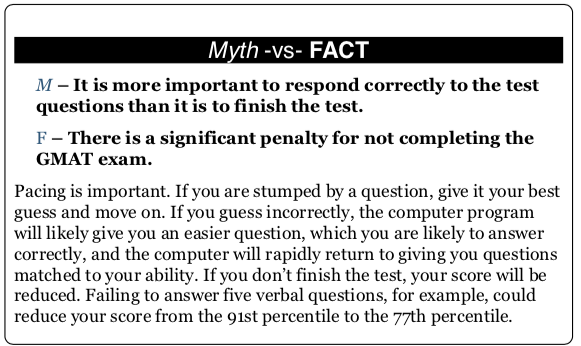
Leaving the questions unanswered carries a significant penalty. My score in this scenario was Q39 compare that with Q49 when I simply answered the last 10 questions wrong. Therefore, even a wrong answer is better than no answer at all! Answering all questions and finishing a test on time is very important. So, it's better to finish the test and answer all the final questions, even if some incorrectly than not finish the test and leave several final questions unanswered. Only scenario 1 (missing first 10 questions) gave a lower score than this case.
What is the Importance of DS questions?
Experiment: Miss all DS after the first 10 Questions
We attempted the first 10 questions correctly and then missed all subsequent DS questions, while answering PS correctly.
Result: Q50. 87th percentile
Conclusion:
We ended up answering the first 10 questions CORRECT and then missed 10 DS while answering 11 PS questions correctly - it was a hybrid case of missing 10 middle questions and the result was very close. In this case the question mix was 18 PS / 13 DS. We ran across 3 DS in the first 10 questions of the test.
What is the Importance of PS questions
Experiment: Miss all PS after the first 10 Questions
We are also going to analyze importance of PS vs. DS. We will attempt answering the first 10 questions correctly and then miss all PS questions, while answering all DS questions correctly.
Result: Q49, 73rd percentile
Conclusion:
There does not appear to be any difference that we can spot based on this scenario between the weights of the PS and DS questions. When answered first 10 questions CORRECT and then missed 11 PS and answering 10 DS questions correctly, the score was exactly the same as missing 10 DS questions or missing 10 middle questions. Questions mix was 18PS / 13DS and 7 of the first 10 questions were PS, consistently with the previous DS exercise.
Takeaways
One of the logical takeaways one can jump to prematurely is to drop everything and focus on the first 10 questions or first 21 questions and forget about the rest. However, that's not the main takeaway or the one that will give you the highest score. We will explain below.
Takeaway #1 do not leave any questions ananswered
Takeaway #2: don't be picky about questions - PS or DS, make sure to answer them as they are treated equally. Don't agonize, just answer one question at a time
Takeaway #3: The first 10 questions are indeed important. There is irrefutable evidence in the shape of Q30 that if you get the first 10 wrong, there is no way back. GMAT is unforgiving if you miss the first 10. However, even if you miss every third questions (meaning you make 3 mistakes in the first 10), you can recover so the first 10 questions are NOT FATAL as long as you have a realistic scenario and don't make a bunch of mistakes.
Takeaway #4: Pay close attention to the first 10 questions but do not sacrifice the test for their sake. You should treat them with higher level of attention and be a bit more careful but don't try to get every question right - it is not worth it.
Takeaway #5: Even if you did not listen to us and decided to get a perfect score on the first 21 questions, giving yourself 3 minutes per question, it is not an easy fit to answer 21 fairly challenging questions correctly even with 3 minutes of time. Chances are if you can answer 21 questions correctly in 60 mins, you can get a Q50 anyway without trying to game the system.
Takeaway #6: Don't worry about gaming the system or question order. You can afford to make mistakes and still get a Q50 or Q49. Some even reported Q51 with a few mistakes so focus on finishing the test on time and well, though do prioritize attention to the first 10 but if you are stuck, just guess and move on.

souvik101990
 Expert
Alum
Joined: 19 Mar 2012
Last visit: 15 Aug 2026
Posts: 4,309
Given Kudos: 2,326
Location: United States (WA)
Concentration: Leadership, General Management
Schools: Ross '20 (M)
GMAT 1: 760 Q50 V42
GMAT 2: 740 Q49 V42 (Online)
GMAT 3: 760 Q50 V42 (Online)
GPA: 3.8
WE:Marketing (Non-Profit and Government)
Products:
Expert reply
 Updated on: 22 Feb 2023, 22:22
Originally posted by souvik101990 on 04 Jul 2018, 03:11.
Last edited by bb on 22 Feb 2023, 22:22, edited 15 times in total.
Last edited by bb on 22 Feb 2023, 22:22, edited 15 times in total.
Update
Kudos
Bookmarks
Importance of the first and last 9 Questions on the GMAT & Importance of RC and SC
Last year when Vercules ran the what-if scenarios in this thread we found some very interesting results. Not that the GMAT has changed (or just reduced in number and minutes), I decided to make some changes. I thought of doing things in quarters (9 out of 36 questions form a quarter).
1. Importance of the first 9 questions
2. Importance of the last 9 questions
3. Importance of SC: Guess SC, all else correct
4. Importance of RC: Guess RC, everything else correct
Last year when Vercules ran the what-if scenarios in this thread we found some very interesting results. Not that the GMAT has changed (or just reduced in number and minutes), I decided to make some changes. I thought of doing things in quarters (9 out of 36 questions form a quarter).
1. Importance of the first 9 questions
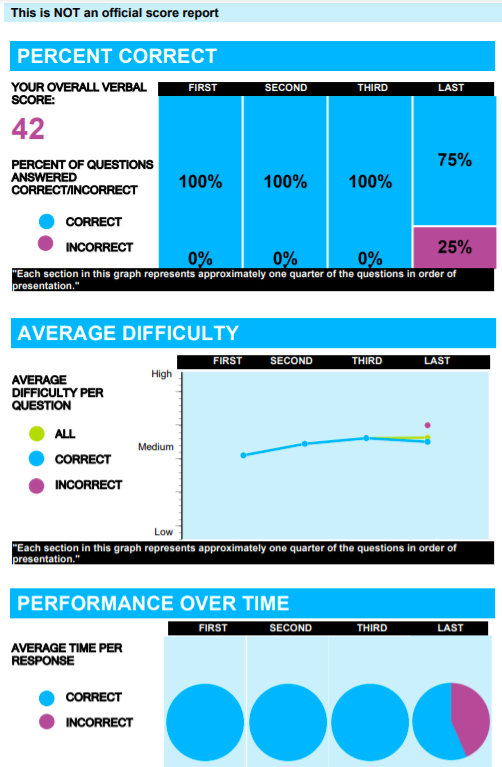
- In the first part of the test, I have tried to see what happens if we miss the first quarter entirely (i.e. the first 9 out of the 36 questions answered wrongly while answering correctly the others). To check for experimental questions and other question level based biases I ran the scenario thrice.
Experiment - GMAC says the first 10 questions are as important as the other questions. We test that theory. We have changed it to 9 because we want to take into account the reduced number of questions in the test.
Methodology - Run 3 instances of A) missing the first 9 questions . B) answering the next 27 questions correctly.
Result - V28, V29, V30
Analysis - To make this analysis more effective, let's first check the scenarios:
First Scenario - Missed the first 9 questions - 4 CRs, 4 SCs and 1 RC - V29 - 57th Percentile
Second Scenario - Missed the first 9 questions - 5 RCs, 3 SCs and 1 CR - V28 - 52nd Percentile
Third Scenario - Missed the first 9 questions - 2 RC, 3 SC and 4 CRs - V30 -59th Percentile
It appears that there's no pattern to when the first RC will appear. In the second test, the RC was as early as the third question and as a result it made me miss the entire RC, which, I think, contributed to the score decline more than the other two tests. Also, while the average difficulty of the test was pretty easy/medium, I did see a few questions with 35%-55% difficulty on GMAT Club which will easily include them in the 700-800 level category.
Last year missing the first 11 questions resulted in the V22 (27th percentile)
2. Importance of the last 9 questions
- Experiment In the second part, I decided to see what happens when you mark every question in the test, save the last 9 questions, correctly. Not to my surprise, I got a V40 or above every single time.
Methodology Run 3 instances of missing the last 9 questions on purpose but everything else marked correctly.
Result V40, V42, V42
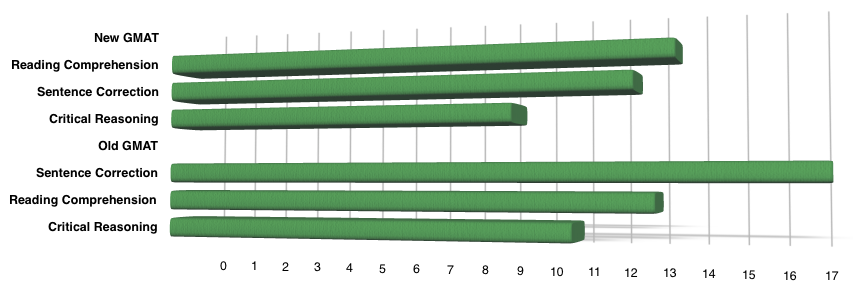
Analysis In the first scenario the 9 questions I missed were - 1 entire RC (3 questions), 4 SC and 2 CR. In the second scenario, I missed 6 RC questions each. Clearly, even though RC questions are more on the test, missing SC and CR questions wrongly makes a bigger dent in the score.
Side note Last year, missing the 11 questions at the end resulted in a score of V38. So it is definitely a good news for test takers

3. Importance of SC: Guess SC, all else correct
- This time we did a sectional test to see what happens if I guess all SC questions but mark everything else correctly.
Methodology: Mark CR and RC questions correctly and mark C for all SC questions.
Result: V37 with 11 questions answered wrong.
4. Importance of RC: Guess RC, everything else correct
- In similar fashion, I wanted to check what happens when we guess RC but keep the SC and CR answers correct. Surprising results follow!
Methodology: Mark CR and SC correctly but mark all RC questions C.
Result - SHOCKING V34
Analysis: It is pretty clear that RC matters a whole lot more now than it used to. I would advise with caution against using this strategy. Practice your RCs and go well prepared.

 17 Jul 2018, 09:05
Kudos
Bookmarks
We can test outcome when one performs exceptionally in some sections but fails abysmally in other section.
The cases such as :
1. SC, CR > 80+, RC<30
2. RC, CR > 80+, SC<30
3. SC, RC> 80+, CR<30
It will be useful for the test takers to know GMAT better.
The cases such as :
1. SC, CR > 80+, RC<30
2. RC, CR > 80+, SC<30
3. SC, RC> 80+, CR<30
It will be useful for the test takers to know GMAT better.