Last visit was: 22 Apr 2026, 13:27 It is currently 22 Apr 2026, 13:27
Close
GMAT Club Daily Prep
Thank you for using the timer - this advanced tool can estimate your performance and suggest more practice questions. We have subscribed you to Daily Prep Questions via email.

Customized
for You

we will pick new questions that match your level based on your Timer History

Track
Your Progress

every week, we’ll send you an estimated GMAT score based on your performance

Practice
Pays

we will pick new questions that match your level based on your Timer History
Not interested in getting valuable practice questions and articles delivered to your email? No problem, unsubscribe here.
Close
Request Expert Reply
Confirm Cancel
User avatar
bkpolymers1617
Joined: 01 Sep 2016
Last visit: 11 Dec 2017
Posts: 124
Own Kudos:
1,227
 [84]
Given Kudos: 33
GMAT 1: 690 Q49 V35
Products:
GMAT 1: 690 Q49 V35
Posts: 124
Kudos: 1,227
 [84]
Kudos
Add Kudos
84
Bookmarks
Bookmark this Post
Most Helpful Reply
User avatar
BrentGMATPrepNow
User avatar
Major Poster
Joined: 12 Sep 2015
Last visit: 31 Oct 2025
Posts: 6,733
Own Kudos:
36,443
 [20]
Given Kudos: 799
Location: Canada
Expert
Expert reply
Posts: 6,733
Kudos: 36,443
 [20]
8
Kudos
Add Kudos
12
Bookmarks
Bookmark this Post
User avatar
bkpolymers1617
Joined: 01 Sep 2016
Last visit: 11 Dec 2017
Posts: 124
Own Kudos:
1,227
 [7]
Given Kudos: 33
GMAT 1: 690 Q49 V35
Products:
GMAT 1: 690 Q49 V35
Posts: 124
Kudos: 1,227
 [7]
1
Kudos
Add Kudos
6
Bookmarks
Bookmark this Post
General Discussion
User avatar
bkpolymers1617
Joined: 01 Sep 2016
Last visit: 11 Dec 2017
Posts: 124
Own Kudos:
1,227
 [4]
Given Kudos: 33
GMAT 1: 690 Q49 V35
Products:
GMAT 1: 690 Q49 V35
Posts: 124
Kudos: 1,227
 [4]
1
Kudos
Add Kudos
3
Bookmarks
Bookmark this Post
The first and the foremost thing to realize is that one side of the figure would be cut by half. Now when you go through the options, please make sure on thing. There is no need to half the smaller side in the option, as it would be the total waste of time. For example, if you have a rectangular figure with a ratio of 1:4, then halfing the smaller side would bring the ration to .5 to 4, which means that the ratio will decrease further rather than remaining the same.

So now let's go to the option choices:
a) Sheet measuring 7*10 : Lets half the larger side"10", we get 7:5, now is 5/7 equal to 7/10. I would say pretty close- lets keep.
b) A sheet measuring 8 inches by 14 inches: Half the larger side we get, 7/8 vs 8/14: No chance of being close- eliminate
c) A sheet measuring 10 inches by 13 inches: Half the larger side we get, 6.5/10 vs 10/13: Not close- eliminate
d) A sheet measuring 3 feet by 5 feet: 2.5/3 vs 3/5 : No chance
e) A sheet measuring 5 feet by 8 feet: 4/5 vs 5/8: Not close

Your answer is A
User avatar
mimajit
Joined: 03 Aug 2017
Last visit: 24 Jun 2020
Posts: 75
Own Kudos:
28
 [1]
Given Kudos: 85
Posts: 75
Kudos: 28
 [1]
Kudos
Add Kudos
1
Bookmarks
Bookmark this Post
GMATPrepNow
bkpolymers1617
A project requires a rectangular sheet of cardboard satisfying the following requirement: When the sheet is cut into identical rectangular halves, each of the resulting rectangles has the same ratio of length to width as the original sheet. Which of the following sheets comes closest to satisfying the requirement?

(A) A sheet measuring 7 inches by 10 inches
(B) A sheet measuring 8 inches by 14 inches
(C) A sheet measuring 10 inches by 13 inches
(D) A sheet measuring 3 feet by 5 feet
(E) A sheet measuring 5 feet by 8 feet

Here's an algebraic solution:

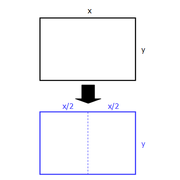
Let x be length of the LONG side of the original rectangle
Let y be length of the SHORT side of the original rectangle
Then cut the rectangle into two pieces


We want the resulting rectangles to have the same ratio of length to width as the original sheet.
In other words, we want x/y = y/(x/2)
Cross multiply to get: x²/2 = y²
Multiply both sides by 2 to get: x² = 2y²
Divide both sides by y² to get: x²/y² = 2
Take square root of both sides to get: x/y = √2

IMPORTANT: For the GMAT, everyone should know the following APPROXIMATIONS: √2 ≈ 1.4, √3 ≈ 1.7, √5 ≈ 2.2

So, we know that x/y ≈ 1.4
In other words, the ratio (LONG side)/(SHORT side) ≈ 1.4

Now check the answer choices:

(A) 10/7 = 1 3/7 ≈ 1.4 LOOKS GOOD!
(B) 14/8 = 1 6/8 = 1.75 ELIMINATE
(C) 13/10 = 1.3 ELIMINATE
(D) 5/3 = 1 2/3 ≈ 1.66 ELIMINATE
(E) 8/5 = 1.6 ELIMINATE

Answer: A

Cheers,
Brent

Hi Brent a lil basic question : While trying to maintain the ratio of the new triangle to the Original Triangle why did you reverse the side . SHould the Sides of both the triangles not corelate that is height / width vs Height / width ie x/y ( Old ratio ) = (x/2 )/ y ( new ratio ) ?

in the solution provided by you you have done the following
" In other words, we want x/y = y/(x/2)
Cross multiply to get: x²/2 = y² ''

PLease explain :)
avatar
spawar
Joined: 04 Sep 2019
Last visit: 29 Oct 2023
Posts: 5
Own Kudos:
Given Kudos: 5
Posts: 5
Kudos: 3
Kudos
Add Kudos
Bookmarks
Bookmark this Post
Do the math. OR print thousands of documents in letter (7x11) and tabloid (11x14) sizes and KNOW that when you fold a tabloid in half you get 2 letter sizes. Closest to these dimensions is 7x10 HENCE A.

Posted from my mobile device
avatar
Kanika3agg
Joined: 09 May 2018
Last visit: 20 Feb 2021
Posts: 96
Own Kudos:
82
 [1]
Given Kudos: 75
Posts: 96
Kudos: 82
 [1]
Kudos
Add Kudos
1
Bookmarks
Bookmark this Post
bkpolymers1617
A project requires a rectangular sheet of cardboard satisfying the following requirement: When the sheet is cut into identical rectangular halves, each of the resulting rectangles has the same ratio of length to width as the original sheet. Which of the following sheets comes closest to satisfying the requirement?

(A) A sheet measuring 7 inches by 10 inches
(B) A sheet measuring 8 inches by 14 inches
(C) A sheet measuring 10 inches by 13 inches
(D) A sheet measuring 3 feet by 5 feet
(E) A sheet measuring 5 feet by 8 feet

An easy method to do this would be -

a) 7/10, 5/7, now multiply the denominator with the numerator and see which numbers are closest. so, in this case, 49 , 50
b) 4/7, 7/8 =>32, 49
c) 10/13, 13/20 . 200, 169
d) 3/5, 5/6. 18, 15
e) 5/8, 4/5. 25, 32

As you can see that A is closest, so you dont have to approximate the values in this.
User avatar
Pritishd
User avatar
UNC Kenan Flagler Moderator
Joined: 18 Jul 2015
Last visit: 05 Jul 2025
Posts: 230
Own Kudos:
313
 [2]
Given Kudos: 120
GMAT 1: 530 Q43 V20
WE:Analyst (Consumer Packaged Goods)
GMAT 1: 530 Q43 V20
Posts: 230
Kudos: 313
 [2]
2
Kudos
Add Kudos
Bookmarks
Bookmark this Post
mimajit
GMATPrepNow
bkpolymers1617
A project requires a rectangular sheet of cardboard satisfying the following requirement: When the sheet is cut into identical rectangular halves, each of the resulting rectangles has the same ratio of length to width as the original sheet. Which of the following sheets comes closest to satisfying the requirement?

(A) A sheet measuring 7 inches by 10 inches
(B) A sheet measuring 8 inches by 14 inches
(C) A sheet measuring 10 inches by 13 inches
(D) A sheet measuring 3 feet by 5 feet
(E) A sheet measuring 5 feet by 8 feet

Here's an algebraic solution:

Let x be length of the LONG side of the original rectangle
Let y be length of the SHORT side of the original rectangle
Then cut the rectangle into two pieces


We want the resulting rectangles to have the same ratio of length to width as the original sheet.
In other words, we want x/y = y/(x/2)
Cross multiply to get: x²/2 = y²
Multiply both sides by 2 to get: x² = 2y²
Divide both sides by y² to get: x²/y² = 2
Take square root of both sides to get: x/y = √2

IMPORTANT: For the GMAT, everyone should know the following APPROXIMATIONS: √2 ≈ 1.4, √3 ≈ 1.7, √5 ≈ 2.2

So, we know that x/y ≈ 1.4
In other words, the ratio (LONG side)/(SHORT side) ≈ 1.4

Now check the answer choices:

(A) 10/7 = 1 3/7 ≈ 1.4 LOOKS GOOD!
(B) 14/8 = 1 6/8 = 1.75 ELIMINATE
(C) 13/10 = 1.3 ELIMINATE
(D) 5/3 = 1 2/3 ≈ 1.66 ELIMINATE
(E) 8/5 = 1.6 ELIMINATE

Answer: A

Cheers,
Brent

Hi Brent a lil basic question : While trying to maintain the ratio of the new triangle to the Original Triangle why did you reverse the side . SHould the Sides of both the triangles not corelate that is height / width vs Height / width ie x/y ( Old ratio ) = (x/2 )/ y ( new ratio ) ?

in the solution provided by you you have done the following
" In other words, we want x/y = y/(x/2)
Cross multiply to get: x²/2 = y² ''

PLease explain :)

Hi mimajit,

The question you have asked is actually the key to getting the question correct. If you observe the diagram from Brent's post then x is the longer side and y is the shorter side of the rectangle. And we know that in a rectangle the length is the longer side and the width is the shorter side.

When we slice the rectangle into two halves x divides into two \(\frac{x}{2}\)'s and now \(\frac{x}{2}\) no longer remains the longer side and it is y that becomes the length now. Hence, when we take the ratio of length by width y becomes the length and \(\frac{x}{2}\) becomes the width.

As a side note, if you continue to keep \(\frac{x}{2}\) as the length then you will end up with a tautology - \(\frac{x}{y} = \frac{x}{2y}\) where \(\frac{x}{y}\) cancel out on both sides.

Warm Regards,
Pritish
Kudos
Add Kudos
Bookmarks
Bookmark this Post
Quote:
A project requires a rectangular sheet of cardboard satisfying the following requirement: When the sheet is cut into identical rectangular halves, each of the resulting rectangles has the same ratio of length to width as the original sheet. Which of the following sheets comes closest to satisfying the requirement?

(A) A sheet measuring 7 inches by 10 inches
(B) A sheet measuring 8 inches by 14 inches
(C) A sheet measuring 10 inches by 13 inches
(D) A sheet measuring 3 feet by 5 feet
(E) A sheet measuring 5 feet by 8 feet

Official Explanation:

There are two possible approaches to this problem: algebra and working backwards from the answer choices. Both solutions are given below.

Algebraic Solution:
Say the original sheet measures L by W, with L > W, so that the cut yields two rectangular halves measuring L/2 by W each.
Per the project requirements, the ratio of these new dimensions must be the same as the ratio of L to W. Consider both possible ways in which the ratio might be set up. If the ratio of original to new is set up as L : W = L/2 : W, then it reduces to 1 = 1/2, an impossible condition. (Or, if you prefer to reason theoretically, it is impossible to reduce L by half but leave W unchanged and have the ratio stay the same.)

Therefore, the width (W) of the original rectangle, must become the longer side for the smaller rectangles. The ratio must be set up as L : W = W : L/2.

Set up the ratio:
W/\(\frac{L}{2}\)=\(\frac{L}{W}\)
\(W^2\)=\(\frac{L^2}{2}\)
\(2W^2=L^2\)
\(W√2=L\)
The condition thus requires original dimensions that come as close as possible to satisfying \(W√2=L\), or, equivalently,\(\frac{L}{W}=√2\).
The square root of 2 is approximately 1.4 (if you don’t already have this memorized, memorize it right now!). The answer choices represent the size of the original sheet (before being cut); call the larger dimension L and the smaller one W. Use the answer choices to calculate an approximate value for L/W. The one closest to 1.4 is the correct answer.

(A) 10/7 = approximately 1.4
(B) 14/8 = 7/4 = 1.75
(C) 13/10 = 1.3
(D) 5/3 = approximately 1.7
(E) 8/5 = 1.6
Choice A comes closest to the requirement. The correct answer is (A).


Working Backwards:
As shown at the beginning of the algebraic solution, when the paper is cut in half, what used to be the width becomes the length of the smaller rectangles. In other words, in order for the original ratio to equal the new one, \(L : W = W : \frac{L}{2.}\)
Starting from the answer choices, test the requirement directly. First, find the ratio of the original dimensions (\(\frac{L}{W}\)). Then, find the ratio of the dimensions after one dimension (the longer one) is cut in half; this will be W/\(\frac{L}{2}\). The correct answer is the choice for which the two ratios are closest to being equal.

(A) The original ratio is 10/7. Half of 10 is 5, so the new dimensions are 7 and 5. The ratio for each smaller rectangle is 7/5 = 14/10. (Remember to use the larger number as the numerator, as you did in the original ratio.) Find a common denominator to compare the ratios: 100/70 and 98/70. Pretty close!

(B) The original ratio is 14/8. Half of 14 is 7, so the ratio for each smaller rectangle is 8/7. Find a common denominator to compare the ratios (but make your life easier: simplify 14/8 to 7/4): 49/28 and 32/28. These are not as close as the ratios in answer (A), so eliminate (B).

(C) The original ratio is 13/10. Half of 13 is 6.5, so the ratio for each smaller rectangle is 10/6.5 = 20/13. Find a common denominator to compare the ratios: 169/130 and 200/130. These are not as close as the ratios in answer (A), so eliminate (C).

(D) The original ratio is 5/3. Half of 5 is 2.5, so the ratio for each smaller rectangle is 3/2.5 = 6/5. Find a common denominator to compare the ratios: 25/15 and 18/15. These are not as close as the ratios in answer (A), so eliminate (D).

(E) The original ratio is 8/5. Half of 8 is 4, so the ratio for each smaller rectangle is 5/4. Find a common denominator to compare the ratios: 32/20 and 25/20. These are not as close as the ratios in answer (A), so eliminate (E).
The correct answer is (A).
User avatar
Rickooreo
Joined: 24 Dec 2021
Last visit: 15 Mar 2026
Posts: 291
Own Kudos:
Given Kudos: 239
Location: India
Concentration: Finance, General Management
GMAT 1: 690 Q48 V35
GPA: 3.95
WE:Real Estate (Consulting)
GMAT 1: 690 Q48 V35
Posts: 291
Kudos: 32
Kudos
Add Kudos
Bookmarks
Bookmark this Post
Bunuel requesting you approach for solving this question.
I did not understand why the solution posted above have considered length cut to half and not width. Or it doesn't matter
User avatar
Adarsh_24
Joined: 06 Jan 2024
Last visit: 03 Apr 2025
Posts: 241
Own Kudos:
Given Kudos: 2,015
Posts: 241
Kudos: 65
Kudos
Add Kudos
Bookmarks
Bookmark this Post
I don’t think there is any merit in length always being largest. It should depend on the context.
User avatar
bumpbot
User avatar
Non-Human User
Joined: 09 Sep 2013
Last visit: 04 Jan 2021
Posts: 38,968
Own Kudos:
Posts: 38,968
Kudos: 1,117
Kudos
Add Kudos
Bookmarks
Bookmark this Post
Automated notice from GMAT Club BumpBot:

A member just gave Kudos to this thread, showing it’s still useful. I’ve bumped it to the top so more people can benefit. Feel free to add your own questions or solutions.

This post was generated automatically.
Moderators:
Math Expert
109754 posts
Tuck School Moderator
853 posts